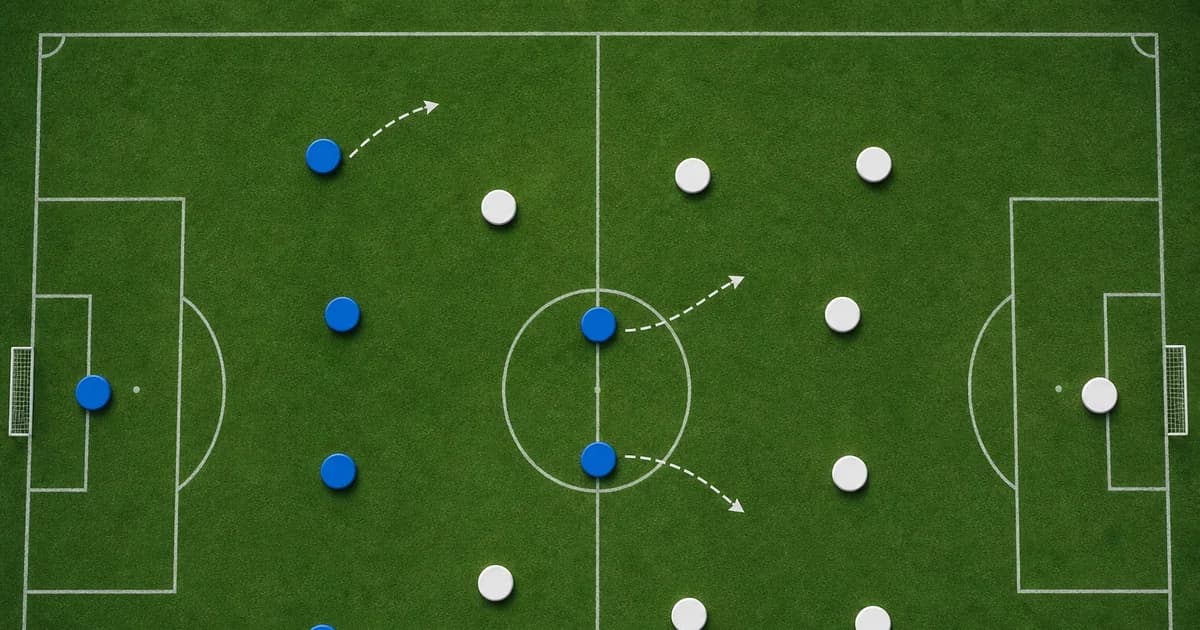
Being in an offside position is not an offence. Under the offside rule in Law 11 of the IFAB Laws of the Game 2026/27, a player is only penalised if they are in an offside position at the moment a team-mate plays or touches the ball and then become involved in active play. A player level with the second-last opponent is onside, and nobody can be offside directly from a throw-in, goal kick or corner kick. Below: the Law in plain words, then the situations that cause most sideline arguments.
Key Takeaways
- Standing in an offside position is legal; the offence only happens when the player becomes involved in active play.
- Position is judged at the moment a team-mate plays or touches the ball, not when the receiver gets it.
- Level with the second-last opponent, or with the last two opponents, is onside.
- There is no offside offence when the ball comes directly from a throw-in, goal kick or corner kick.
- In US small-sided soccer there is no offside before U9, and in 7v7 it can only be called between the build-out line and the goal line.
What Law 11 actually says
The official text is on the IFAB site under Law 11: Offside. It has three parts.
The position. A player is in an offside position if any part of the head, body or feet is in the opponents' half (not counting the halfway line) and is nearer to the opponents' goal line than both the ball and the second-last opponent. Hands and arms do not count, for any player, including goalkeepers. The Law sets the top of the arm at the bottom of the armpit.
The offence. A player in an offside position when a team-mate plays or touches the ball is only penalised for becoming involved in active play by:
- interfering with play: playing or touching a ball passed or touched by a team-mate;
- interfering with an opponent: blocking the opponent's line of vision, challenging them for the ball, clearly attempting to play a ball that is close when this impacts an opponent, or making an obvious action that clearly impacts the opponent's ability to play the ball;
- gaining an advantage: playing the ball or interfering with an opponent after it rebounds or deflects off the goalpost, crossbar, a match official or an opponent, or after a deliberate save by any opponent.
No offence. There is no offside offence if a player receives the ball directly from a goal kick, a throw-in or a corner kick. The sanction for an offside offence is an indirect free kick to the defending team where the offence occurred, even if that spot is in the attacker's own half.
Five things the offside rule does not say
- "He was offside when he got the ball." The moment that counts is when the team-mate plays or touches the ball. Where the receiver is when the ball arrives does not matter.
- "Level is offside." The Law says the opposite. Level with the second-last opponent, or level with the last two opponents, is not an offside position.
- "She's standing offside, blow the whistle." Being in an offside position is not an offence. The Law opens with that exact sentence.
- "You can't be offside in your own half." Correct for the position. But if a player is in an offside position in the opponents' half, then runs back into their own half and plays the ball, the indirect free kick is taken where they played it, in their own half.
- "Any touch by a defender resets offside." Only a deliberate play by an opponent resets it. A deflection or rebound off a defender does not, and a deliberate save never does.
Offside scenarios, worked through
Scenario 1: the through ball from midfield
A central midfielder plays a pass from just inside the opponents' half. At the moment of the pass, the striker is one step beyond the last outfield defender, and the goalkeeper is on the goal line. The striker runs onto the ball and scores.
Offside? Yes. At the moment of the pass the striker was in the opponents' half and nearer to the goal line than both the ball and the second-last opponent (the last outfield defender). Playing the ball is interfering with play. Indirect free kick to the defending team where the striker played the ball.
Scenario 2: level with the defender
Same pass, but the striker's shoulder and hip are in line with the last defender's hip when the ball is played. Only the striker's arm is ahead.
Offside? No. Arms do not count, and level is onside. Play on.
Scenario 3: offside position, not involved
A winger is two yards beyond the defensive line on the far side when the ball is played to a team-mate in an onside position on the near side. The winger does not move towards the ball, does not block anyone's view, and the onside team-mate dribbles in and scores.
Offside? No. Being in an offside position is not an offence, and the winger did not interfere with play or an opponent. The goal stands.
Scenario 4: the throw-in
Your right back takes a throw-in level with the penalty area. Your forward is standing behind every defender, next to the goalkeeper, and receives the throw directly.
Offside? No. There is no offside offence when the ball is received directly from a throw-in (Law 11.3).
The exemption only covers receiving the ball directly. If the forward lays it back and then receives a return pass while still beyond the defenders, that second pass can be offside.
Scenario 5: the shot that rebounds
A midfielder shoots from 20 yards. At the moment of the shot, a forward is in an offside position. The ball hits the post and bounces to the forward, who scores.
Offside? Yes. The forward gained an advantage by playing a ball that rebounded off the goalpost, having been in an offside position when the team-mate shot. The same answer applies if the goalkeeper saves and the ball spills to that forward.
Scenario 6: the defender's miskick
A long ball is played forward. A forward is in an offside position. A defender, with time and a clear view of the ball, tries to clear it with a volley but slices it straight to the forward, who scores.
Offside? No. The defender deliberately played the ball. Law 11 says a player receiving the ball from an opponent who deliberately played it has not gained an advantage, unless it was a deliberate save. An inaccurate clearance is still deliberate play. If instead the ball simply struck the defender while they were turning away, it is a deflection, and the forward would be penalised.
Scenario 7: blocking the goalkeeper's view
A free kick is struck towards goal. A forward in an offside position stands directly in front of the goalkeeper and does not touch the ball, which goes in.
Offside? Yes. Clearly obstructing the opponent's line of vision is interfering with an opponent. Indirect free kick to the defending team.
How offside works in US youth formats
The IFAB lets national associations change the Laws for youth football (General Modifications). In the US, the small-sided standards from US Soccer's Player Development Initiatives set offside by age group:
- U6 to U8 (4v4): no offside at all.
- U9 and U10 (7v7): offside applies, but the build-out line replaces the halfway line as the reference. A player cannot be penalised for offside between the halfway line and the build-out line, only between the build-out line and the goal line (US Soccer).
- U11 and U12 (9v9) and older: the standard Law 11 applies across the opponents' half.
Your league or state association may adjust these, so read its rules alongside the Laws. For how each format shapes positions on the field, see our guides to 7v7 soccer formations and 9v9 soccer formations.
The Law, referee practice and coaching opinion
The Law is what is written above: position at the moment the ball is played, involvement in active play, the three restart exemptions.
Referee practice at youth level often means one referee and no assistants, so level calls are judged from 30 yards away. Many referees wait to see whether the player in an offside position actually becomes involved before whistling. That is the Law, not a lenient reading of it.
Coaching opinion is everything about using offside: a high line, timed runs, "check your shoulder". None of that is a rule. In our view, U9 to U12 players learn offside faster in small-sided games than from a whiteboard talk.
Practical takeaways
For coaches: teach forwards to watch the passer's foot, not the ball's landing spot, because the moment of the pass is what counts. Teach defenders that stepping up together is a team decision, and that a sloppy deflection off their boot does not reset offside.
For players: if you are in an offside position and the ball goes elsewhere, stay out of the play and walk back onside.
For parents: "He was offside when he got the ball" is never the test. If you cannot see the passer's foot and the last defender in the same glance, you cannot judge it either.
For young referees: judge in two steps. First, was the player in an offside position when the team-mate played the ball? Second, did they become involved? Signal only when both answers are yes. Our post on youth soccer referee scheduling and pay covers the operational side of keeping referees in your league, and our Laws of the Game 2026/27 guide lists this season's changes.
When the coaching staff agrees on how to teach the offside rule, the message to players and families is the same at every age group. Send the two-step offside test (position at the pass, then involvement) to every U9 to U12 family as one Centro broadcast, in English and Spanish. See how Centro works for clubs.
Cover photo: Pierre-Yves Beaudouin, CC BY-SA 3.0, cropped, via Wikimedia Commons. License terms.