7v7 Soccer Formations Explained: Guide for Youth Coaches
The five most common 7v7 soccer formations broken down for youth coaches. Learn when to use each shape, how to choose the right one for your team, and how to teach positioning to U10 players without losing their attention.
On this page
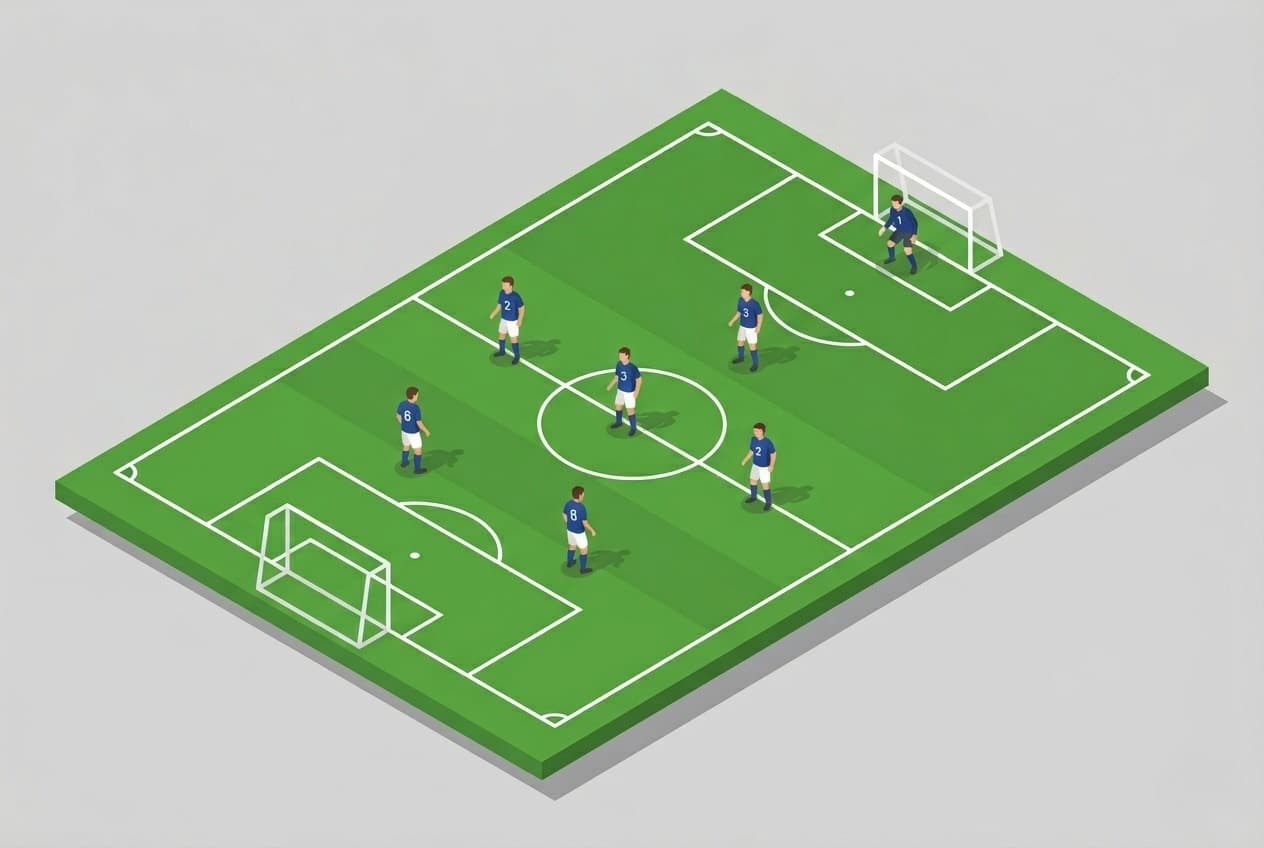
If you coach U10 soccer, your players are stepping onto a 7v7 field for the first time. And for most of them, this is the first time they will ever hear the word "formation." Choosing the right soccer formation 7v7 shape gives your team a starting point, a place on the field where each player knows where to stand, where to move, and who is nearby. It does not need to be complicated. It just needs to make sense for your players.
This guide breaks down the five most common 7v7 soccer formations, explains when to use each one, and covers how to actually teach positioning to 8 and 9 year olds without losing their attention.
Key Takeaways
7v7 is the standard game format for U10 (and sometimes U9 and U11 depending on the league), played on a field roughly 55 to 65 yards long and 35 to 45 yards wide (US Soccer PDI Standards)
The 2-3-1 is the most popular 7v7 formation and the best starting point for most teams
Every formation is a starting shape, not a rigid system. At U10, players will drift, and that is fine
The best formation for your team depends on your players' strengths, not what a professional team runs
Teach formations through small-sided games and positioning exercises, not lectures
Why 7v7 Soccer Formations Matter (Even at U10)
The 7v7 format is a bridge. Before this, your players were in 4v4, where the field was small enough for everyone to chase the ball together. After this, they will move to 9v9, where real team shape becomes essential. The 7v7 game sits right in the middle.
According to the US Soccer Player Development Framework, U9 and U10 fall within the "Foundation Phase," where players begin learning age-appropriate individual and collective tactical principles (US Soccer Player Development Framework, 2023). This is the first time most players will experience defined positions and structure on the field.
The goal at this stage is not tactical perfection. The goal is spatial awareness: where should a player be relative to their teammates? US Youth Soccer's spatial awareness curriculum recommends teaching players to recognize "channels" (left, center, right) and "thirds" (defensive, middle, attacking) during this phase (US Youth Soccer Player Development Model).
Players in this age group get significantly more touches in small-sided formats. Research shows that players in smaller game formats receive 135% more ball touches and face 260% more decision-making opportunities compared to 11v11 play (US Soccer/USSF research data). That means every 7v7 game is already teaching your players faster than a full-sided match ever could.
The 5 Most Common 7v7 Soccer Formations
Every formation below is listed without the goalkeeper. So a "2-3-1" means 1 goalkeeper plus 2 defenders, 3 midfielders, and 1 forward (7 total players).
2-3-1 (The Standard)
Shape: Two center-backs at the back. Three midfielders across the middle (left, center, right). One striker up top.
The 2-3-1 is widely considered the most balanced and popular soccer formation 7v7 option available. Multiple coaching resources, including Rondo Coach, TheMastermindSite, and SoccerCoachingPro, recommend it as the default starting choice for youth teams.
Strengths: The three midfielders create natural passing triangles and give the team width on both sides of the field. Roles are clearly defined, which makes it easier for young players to understand where they belong. The wide midfielders learn to attack and defend, which develops well-rounded players over time.
Weaknesses: Midfielders have to cover a lot of ground, which can be physically demanding at this age. With only two defenders, the team is exposed on counter-attacks if midfielders push too high. The lone striker can become isolated without midfield support.
Best for: Most teams, especially those new to 7v7. If you are not sure where to start, start here.
On the field, think of it as a pyramid. From the goalkeeper's perspective, two defenders are spread across the back. Three midfielders are staggered slightly higher, covering the width of the field. The striker sits at the top, closest to the opponent's goal.
3-2-1 (The Defensive Shape)
Shape: Three defenders (left-back, center-back, right-back). Two midfielders in the center. One striker up top.
Strengths: Three defenders provide strong coverage across the entire back line. This shape is excellent for teaching players to build out from the back, especially with the build-out line rule in 7v7, which requires the opposing team to retreat behind a midfield line on goal kicks and goalkeeper possessions (US Soccer PDI Build-Out Line Rules). Three short-pass options from the goalkeeper make distribution much easier.
Weaknesses: With only two midfielders, the middle of the field can be overrun by teams running a 2-3-1. The lone striker stays isolated unless midfielders push forward, which creates gaps behind them.
Best for: Teams that struggle defensively or are facing stronger opponents.
Real-world scenario: Your team lost 6-1 last week because they could not defend crosses from wide areas. Two defenders simply could not cover the width of the field. Switching to 3-2-1 gives you an extra defender to cover that width and stabilizes the backline. You sacrifice some midfield presence, but your players feel more secure, and the scoreline gets closer.
2-1-2-1 (The Diamond)
Shape: Two center-backs. One holding midfielder. Two attacking midfielders. One striker.
The diamond is a step up in complexity. The holding midfielder sits in front of the two defenders, forming the base of a diamond. Two attacking midfielders push higher, creating what amounts to a front three with the striker.
Strengths: The formation creates clear layers and multiple passing angles. The holding midfielder provides defensive cover, which frees the two attacking midfielders to focus on creating chances. This 7v7 soccer formation naturally develops a defensive midfielder, which is a critical position as players progress to 9v9 and 11v11.
Weaknesses: The shape is narrow, which means teams that play wide can exploit the flanks. If the holding midfielder does not connect well with the attacking players, the team can split into two disconnected halves. It demands a higher soccer IQ from young players compared to the 2-3-1.
Best for: Technical teams with strong midfielders. Teams looking to evolve beyond the 2-3-1 after their first season.
1-2-1-2 (The Attacking Shape)
Shape: One sweeper/center-back. Two midfielders. One attacking midfielder. Two forwards.
This is the most attacking-oriented 7v7 formation you can run. Two forwards plus an attacking midfielder give you three players committed to pressuring the opponent's defense at all times.
Strengths: Maximum attacking output. Forward partnerships develop quickly because two strikers learn to combine with each other. The formation keeps opposition defenders pinned back under constant pressure.
Weaknesses: One defender is not enough against quality opponents. The lone sweeper can easily face 2-on-1 or 3-on-1 situations on counter-attacks. Coaching resources from SoccerHelp document real examples of teams getting overwhelmed when using this shape against evenly matched opponents.
Best for: Chasing a game late in the second half. Dominating possession against significantly weaker opponents. This is a situational formation, not a default choice.
3-1-2 (The Anchor)
Shape: Three defenders. One central midfielder. Two forwards.
Strengths: The three-player defensive base is very difficult to break down. Two forwards provide a constant goal threat and learn to work as a striker partnership. The single midfielder acts as a pivot, connecting defense to attack. This shape produces strong counter-attacking play: absorb pressure at the back, then release the ball to two fast forwards.
Weaknesses: The lone midfielder must cover enormous ground. If an opponent's midfield overloads the center, the gap between your defenders and forwards becomes a problem. Without wide midfielders, width depends entirely on whether your fullbacks push forward.
Best for: Teams with a strong central midfielder who can distribute the ball. Counter-attacking teams with two quality forwards. Protecting a lead late in a game.
Free resourceClub bylaws templateEditable, with guidance notesHow to Choose the Right Soccer Formation 7v7 Shape for Your Team
Start with the 2-3-1. Watch what happens over two or three games. Then adjust based on what you see, not based on what looks good on paper.
Assess your players first. Do you have strong, physical defenders who are comfortable with the ball at their feet? Stay with the 2-3-1 or try a 3-2-1 to build out from the back. Do you have fast, skilled attackers but your defense leaks goals? Move to a 3-1-2 for more cover. Do you have a standout central midfielder who can read the game and distribute? The 2-1-2-1 diamond will get the most out of that player.
Real-world scenario: A coach notices their left midfielder has great speed but poor defensive awareness. Every time the opponent attacks down that side, the midfielder is caught too high up the field. The coach shifts from a 2-3-1 to a 2-1-2-1 diamond, placing that player as a left attacking midfielder with less defensive responsibility. The holding midfielder provides the cover that was missing. The fast player thrives in a more attacking role, and the team concedes fewer goals.
The formation should serve your players. Your players should not be forced into a formation that does not fit them. If you are using a tryout evaluation form at the start of the season, the data from those assessments can guide your formation choice before the first game.
Teaching Formations to 8-10 Year Olds
Do not use a whiteboard for 20 minutes. Ask almost any experienced coach and they will tell you the same thing: young players learn far more from doing than from listening. The coaching principle of "No Lines, No Laps, No Lectures" exists for a reason.
Use Cones to Mark Positions
Place a cone at each position on the field. Walk your players through the shape from goalkeeper to forward. Have each player stand on their cone. Let them look around and see where their teammates are relative to them. Then remove the cones and play a short scrimmage. This method, described by NSCAA National Staff Coach Chico Borja, produced visible improvements in team shape within a month of regular use (Footy4Kids).
Run "Freeze" Exercises During Scrimmages
During small-sided games at practice, call out "Freeze." Everyone stops. Ask: "Where should you be right now?" Physically guide players to the correct spots if needed. Then restart play immediately. Tim Bradbury recommends keeping each freeze to under two minutes and planning your questions in advance (ENYYSA). The freeze method follows a three-step process: review the situation, rehearse the correct positioning, then restart.
Keep Instructions Simple
At this age, one sentence is better than five. Tell your defender: "Your job is to stay between the ball and our goal." Tell your striker: "Stay high and be ready when we win the ball." That is enough. Players at U10 do not need to understand zonal marking or pressing triggers.
Build It Into Every Session
Revisit positioning for five minutes at the start of every training session. Repetition builds habits. US Youth Soccer's spatial awareness curriculum recommends teaching the same concepts repeatedly through varied activities rather than one-time lectures (US Youth Soccer Player Development Model). If you are looking for structured soccer practice plan templates, having a brief positioning segment at the beginning of each session keeps formations fresh without eating into scrimmage time.
US Soccer's Play-Practice-Play methodology (US Soccer) supports this approach. Start with a small-sided game where you observe positioning. Run a focused activity that targets the specific gaps you noticed. End with a scrimmage where players apply what they practiced. This is how how to start a youth soccer club coaching programs recommend structuring every session from the beginning.
Building and Testing Formations with AI
Planning a formation on paper is one thing. Seeing it laid out visually, with player names assigned to each position, makes it real for both the coaching staff and the players.
Interactive tactics boards let you drag players into formations and see the shape before you step onto the field. Centro's Game Plan module includes formations across all game formats, including 7v7. You can build a formation, assign player names, save it, and share it with your coaching staff in seconds.
The practical value shows up on game day. You can test different shapes for different opponents without starting from scratch each time. If you ran a 2-3-1 all season but want to try a 3-2-1 for a specific matchup, you can build it, review it, and have it ready before warmups.
Centro's tactics board has every 7v7 formation built in. Drag, drop, assign players, and share with your staff in minutes. See how AI Game Plan builds a session.
Keep reading
More on running a better club.

9v9 Soccer Formations: The Complete Guide for Youth Coaches
A development-first guide to 9v9 soccer formations for U11 and U12 coaches. We cover the 3-2-3, 2-3-2-1, 3-3-2, the rules every FYSA coach needs, and how to teach the shape through small-sided games.

Florida Level 2 Background Screening for Youth Coaches: What's Required Now
Florida’s Level 2 fingerprint screening requirement has applied since July 1, 2026, per F.S. 943.0438. We cover what the statute requires, how SB 1546 set that date, and the compliance steps a club needs to have in place now.
11v11 Youth Soccer Formations: 4-3-3, 4-2-3-1, 3-5-2 Explained
Picking 11v11 youth soccer formations at U13 is a development decision more than a tactical one. We cover the 4-3-3, 4-2-3-1, and 3-5-2: what each teaches young players, what you need to make each one work, and a simple decision tree.