Free Soccer Practice Plan Templates by Age Group (U6 to U14)
Free downloadable soccer practice plan templates for every age group from U6 to U14. Each template follows a four-phase session structure (warm-up, technical, game play, cool-down) with age-appropriate drills, timing, and coaching points backed by U.S. Soccer and US Youth Soccer guidelines.
On this page
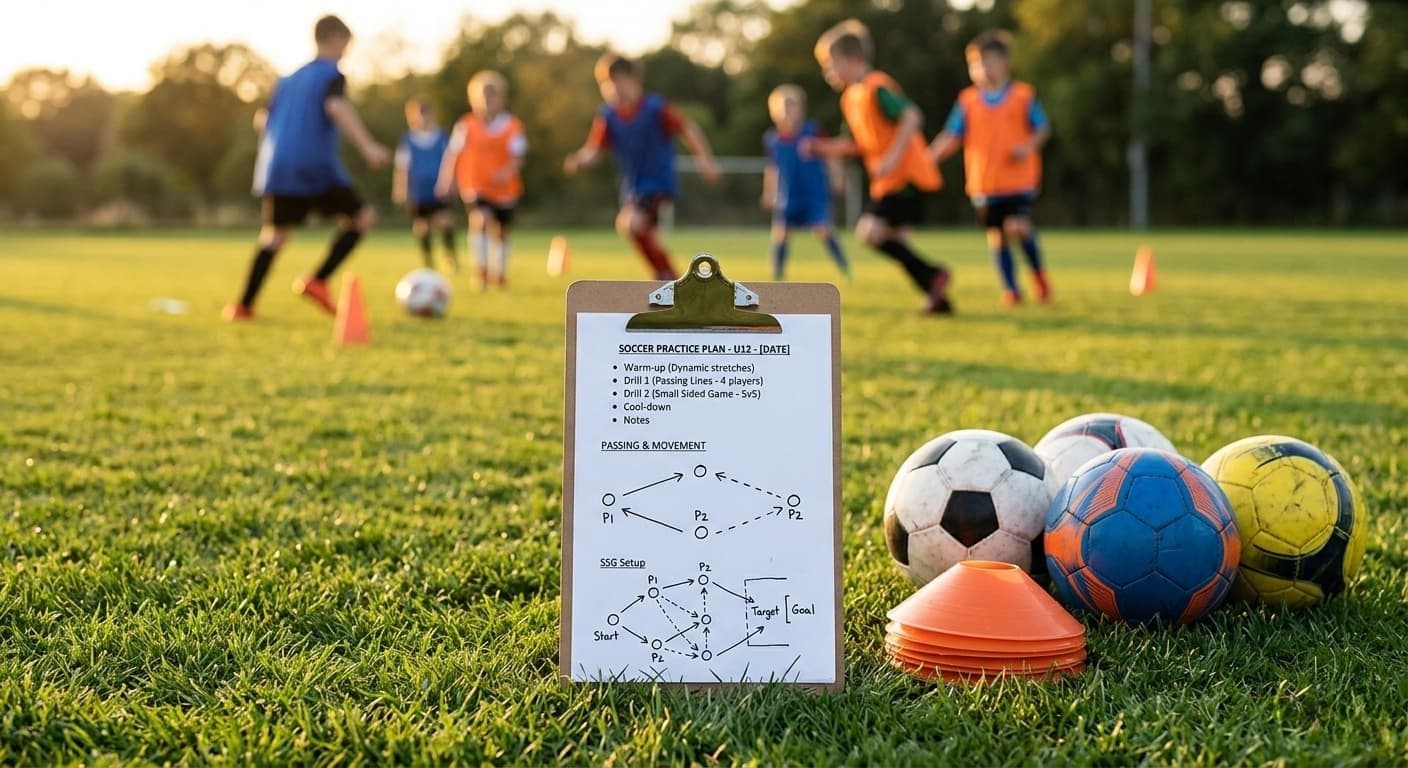
A good soccer practice plan template is the difference between 60 minutes of organized development and 60 minutes of kids standing in lines. With over 3 million youth soccer coaches in the United States (the vast majority of them volunteers, according to the Aspen Institute's State of Play 2025 report), most are showing up to the field without a written plan. That's a problem, because research shows that coaching preparation is directly tied to whether kids keep playing or quit.
We built these free templates so every coach, from the first-time parent volunteer to the experienced club director, can walk onto the field with a clear plan that fits their age group. Download them, print them, and customize them for your team.
Want the method behind the templates? Our guide on how to plan a youth soccer practice covers the single-objective discipline and the time math for building your own sessions.
Key Takeaways
Every soccer practice plan template follows a four-phase structure: warm-up, technical work, game-related activity, and cool-down
Younger age groups (U6 and U8) need shorter activities (5 to 8 minutes each) with frequent transitions between drills
Older age groups (U10 through U14) can handle 12 to 15 minute blocks with increasing tactical complexity
A written plan takes about 10 minutes to create and saves 30 or more minutes of confusion at the field
All templates below are free to download and customize for your club's needs
Why Every Coach Needs a Written Soccer Practice Plan Template
Here is a scene we have all watched play out. A volunteer parent coach shows up to Tuesday night U8 practice with a bag of cones and a vague idea. The warm-up is "run two laps." Then one passing drill runs for 25 minutes because there is nothing else planned. Half the kids are sitting in the grass picking dandelions by minute 15. The other half are arguing. Practice ends early because the coach ran out of things to do.
Now picture the coach one field over. She has a single printed page with four activities, each timed to the minute. The warm-up is a 5-minute tag game that gets every kid moving. A 10-minute dribbling activity follows, then a 10-minute small-sided game, and a 5-minute cool-down. Kids rotate between activities before they lose focus. The session ends on time, and every player touched the ball dozens of times.
The difference between those two coaches is not talent or experience. It is a one-page plan.
The Research Behind Structured Sessions
A landmark study by Barnett, Smoll, and Smith (published in The Sport Psychologist, 1992) found that players who trained under coaches with structured preparation had a dropout rate of just 5%, compared to 26% for players whose coaches had no formal training or session structure. The win-loss records were identical. Kids did not quit because of losing. They quit because practice was boring.
The Aspen Institute's State of Play 2025 report found that fewer than one in three youth coaches (32.5%) have received any training in youth development practices. And the most common reason families gave for a child leaving a sport was diminishing enjoyment, at 22.5% of responses (Aspen Institute/Utah State University National Youth Sport Survey, 2019).
The Four-Phase Session Structure
U.S. Soccer's grassroots coaching curriculum and the US Youth Soccer Coaching Manual both recommend a progressive session structure. The version we use in our templates breaks every practice into four phases:
Phase 1: Warm-Up (10 to 15% of session time). Movement-based games that raise heart rate and introduce the session topic. No laps. No static stretching for players under 12 (U.S. Soccer recommends dynamic warm-ups at grassroots ages).
Phase 2: Technical Activity (25 to 30% of session time). Focused skill work in pairs or small groups. Every player needs a ball at U6 and U8. Repetition matters here, but keep activities short enough that kids stay engaged.
Phase 3: Game-Related Activity (40 to 50% of session time). Small-sided games (3v3, 4v4, or 7v7 depending on age) where players apply the session's skill in a realistic setting. This aligns with U.S. Soccer's Play-Practice-Play methodology, which puts game-like experiences at the center of every session.
Phase 4: Cool-Down (5 to 10% of session time). Light stretching, a team huddle, and a quick recap. This is where coaches reinforce one key message from the session.
This structure works because it mirrors how kids actually learn. Short bursts of focused work followed by the chance to apply it in a real game setting. The US Youth Soccer Coaching Manual puts it plainly: players learn best through game-like experiences where they can experiment and make decisions.
Soccer Practice Plan Templates by Age Group
Below are our recommended templates for each age group. Each one follows the four-phase structure above, adjusted for the developmental needs and attention spans of that age. You can download all of them from our coaching resources hub.
U6 Practice Plan (Ages 5 to 6)
Developmental focus: Fun, movement, and comfort with the ball. At this age, every activity is about falling in love with the game.
Session length: 45 minutes Number of activities: 3 to 4 plus free play Activity duration: 5 to 8 minutes each Game format: 3v3 or 4v4, no goalkeeper Ball size: Size 3 Key rule: Every player gets their own ball. US Youth Soccer states that players who have to wait their turn become bored and lose interest.
Phase Time Sample Activity Coaching Points Warm-Up 5 min "Shark Tag": one player is the shark, others dribble to avoid being tagged Keep your ball close, use small touches Technical 8 min "Ball Explorers": players try touching the ball with different body parts (feet, knees, head) Praise effort, not perfection Game Play 12 min 3v3 scrimmage on a 25x20 yard field, no goalkeepers, multiple small goals Let them play, minimal stoppages Cool-Down 5 min "Red Light, Green Light" with the ball, then team huddle Ask: "What was your favorite part today?"
Download the U6 practice plan PDF
U.S. Soccer's Player Development Framework calls U6 the "Discovery Phase," where players have a "me, my, mine" orientation. That is completely normal. Do not force passing or positions at this age. Let them explore.
U8 Practice Plan (Ages 7 to 8)
Developmental focus: Ball mastery. Dribbling, first touch, and simple 1v1 skills.
Session length: 60 minutes Number of activities: 4 plus scrimmage Activity duration: 8 to 10 minutes each Game format: 4v4, no goalkeeper Ball size: Size 3
Phase Time Sample Activity Coaching Points Warm-Up 8 min "Pac-Man Dribbling": one player without a ball tries to tag dribblers inside a 20x20 grid Head up while dribbling, change direction Technical 10 min "Cone Gate Dribbling": pairs of cones form gates, players dribble through as many as possible in 60 seconds Use both feet, push the ball ahead before the gate Game Play 15 min 4v4 scrimmage with small goals, rotate teams every 5 minutes Encourage 1v1 attempts, celebrate trying Cool-Down 5 min Juggling challenge (how many touches before it hits the ground?), then team circle "One thing you got better at today"
Download the U8 practice plan PDF
The U.S. Soccer Player Development Framework places U8 in "Foundation Phase I," where players start developing scanning skills, receiving, and short passing. But the emphasis is still on individual ball skills, not team tactics.
U10 Practice Plan (Ages 9 to 10)
Developmental focus: Passing, possession, and basic combination play. This is the start of what coaches call the "Golden Age of Learning," when kids absorb motor skills faster than at any other point in development (US Youth Soccer Player Development Model).
Session length: 75 minutes Number of activities: 4 to 5 Activity duration: 10 to 12 minutes each Game format: 7v7 with goalkeeper Ball size: Size 4
Phase Time Sample Activity Coaching Points Warm-Up 10 min "Rondo Lite": 4v1 keep-away in a 10x10 grid, rotate the defender every 60 seconds Two-touch maximum, body open to receive Technical 12 min Wall pass drill: pairs practice give-and-go combinations through cone gates Timing of the pass, angle of the run Tactical 15 min 4v4+2 (two neutral players always join the attacking team): possession game with transition Move after you pass, find the open player Scrimmage 20 min 7v7 on a half field with build-out line Apply the wall pass in game situations Cool-Down 5 min Light stretching, team discussion "When did you see a great pass today?"
Download the U10 practice plan PDF
US Youth Soccer notes that at U10, players start shifting from "how" (technique) to "when, where, with whom, and against whom" (skill and tactics). But the priority is still building the individual player before building the team.
U12 Practice Plan (Ages 11 to 12)
Developmental focus: Tactical awareness, positional understanding, and performing skills under pressure. US Youth Soccer calls U12 "the most important age for skill development."
Session length: 75 to 90 minutes Number of activities: 4 to 5 Activity duration: 12 to 15 minutes each Game format: 9v9 with goalkeeper Ball size: Size 4
Phase Time Sample Activity Coaching Points Warm-Up 10 min Dynamic movement circuit: high knees, side shuffles, backward runs, then partner passing on the move Warm up with the ball whenever possible Technical 15 min Passing combination in a diamond: wall pass, overlap, and through ball patterns Weight of the pass, first touch direction Tactical 15 min 6v6 directional game: teams score by completing 5 passes then playing through an end zone Shape when in possession, width and depth Scrimmage 20 min 9v9 with conditions (example: goals only count from combinations of 3+ passes) Encourage players to try multiple positions Cool-Down 5 min Static stretching, coach-led review of the session topic Connect today's training to the next game
Download the U12 practice plan PDF
Players at this age are developing the ability to think critically about their own performance. They can handle constructive feedback and benefit from being asked questions rather than given constant instructions. The 9v9 format acts as a bridge between small-sided play and the full 11v11 game.
U14 Practice Plan (Ages 13 to 14)
Developmental focus: Game intelligence, decision-making under pressure, and positional training. The U.S. Soccer Player Development Framework calls this the "Training to Train" phase.
Session length: 90 minutes Number of activities: 4 to 5 Activity duration: 15 to 20 minutes each Game format: 11v11 Ball size: Size 5
Phase Time Sample Activity Coaching Points Warm-Up 12 min Positional rondo: 6v3 in a defined shape (back four plus two midfielders vs. three pressers) Play out of pressure, body position to receive Technical/Tactical 18 min Functional group training: back four and goalkeeper work on building from the back against 3 pressers Goalkeeper distribution, center back splitting Game Scenario 20 min 8v8 with transition focus: when possession changes, attacking team must score within 8 seconds Speed of transition, quick combination play Scrimmage 25 min 11v11 on full field with halftime discussion Apply the session topic in full game context Cool-Down 5 min Stretching with individual player feedback One specific coaching point per player
Download the U14 practice plan PDF
U14 players are going through rapid physical changes. Growth spurts can temporarily affect coordination and balance. Be patient with players who seem to have "lost" skills they had at U12. The U.S. Soccer Player Development Framework recommends that even at U14, players should still be exposed to multiple positions.
Free resourceFree practice plan templatesFour-phase sessions by age group, U6 to U14How to Customize These Templates for Your Team
These templates are starting points. Every team is different, and a good youth soccer practice plan adapts to the reality on the ground.
Adjusting for Team Size
An 8-player team and a 20-player team cannot run the same session. With 8 players, you can run a single 4v4 scrimmage and everyone plays. With 20 players, you need multiple grids running simultaneously during technical work and at least two small-sided games during the scrimmage phase. The key principle: minimize standing time. If a player is waiting in line, the drill needs to be restructured.
Adapting for Available Space
Not every club has a full-size field. If you are working with half a field or a small park, adjust the session toward more technical work and smaller-sided games (3v3, 4v4). Tight spaces actually benefit younger age groups, where the focus should be on close ball control anyway. Use your season planning tool to map out which sessions need more space and schedule accordingly.
Seasonal Progression
Your practice plans should change depending on the time of year.
Pre-season (weeks 1 to 3): Heavy focus on fitness, technical fundamentals, and team bonding. More time in the technical phase, less in tactical work.
In-season (ongoing): Balance between maintaining skills and preparing for opponents. Shift time toward the game-related and scrimmage phases.
Tournament prep (final 2 weeks before a tournament): Here is a real scenario. A U10 coach has been running technical sessions all season, focused on passing and first touch. Two weeks before a district tournament, she shifts the plan. Week one emphasizes small-sided games with quick transitions (3v3 and 4v4 with immediate counter-attacks). Week two focuses on set pieces (corners, free kicks, goal kicks) and a full 7v7 scrimmage with game-day conditions. The technical work drops to the warm-up phase only. This targeted shift gives players specific preparation for tournament intensity without abandoning the skills they have been building all season.
Building Practice Plans Faster with AI
Writing a practice plan from scratch takes 10 to 15 minutes if you know what you are doing. But what if you could describe what your team needs to work on, and get a complete session plan back in seconds?
That is how AI session builders work. You tell the system the age group, the focus area (pressing, possession, counter-attacking, set pieces), and the session length. It generates a full plan with phases, timing, drill descriptions, and coaching points.
Centro's AI Game Plan module does exactly this. It draws from a library of a drill library organized across 37 categories and 7 game formats (11v11 down to 3v3). Tell the AI "build a 75-minute session focused on defensive shape for U12" and it produces a complete plan with warm-up, technical work, a game-related activity, and a scrimmage, all with specific coaching points for each phase.
Every drill and session plan works in both English and Spanish. For clubs with bilingual coaching staffs (which describes a large percentage of youth soccer clubs in the U.S.), that means the head coach and the assistant can both read the same plan in their preferred language.
The AI also tracks what your team has practiced recently. If you have not worked on set pieces in three weeks, it flags it. If your sessions have been heavy on possession but light on defending, it suggests a shift. It is not replacing coaching decisions. It is making sure nothing falls through the cracks.
Free Downloads
All of our soccer practice plan templates are available for free. No email required, no paywall.
Age Group Session Length Focus Area Format Download U6 45 min Fun and movement 3v3 / 4v4 Download PDF U8 60 min Ball mastery 4v4 Download PDF U10 75 min Passing and possession 7v7 Download PDF U12 75-90 min Tactical awareness 9v9 Download PDF U14 90 min Game intelligence 11v11 Download PDF
You can also browse our full library of drills, formations, and free practice plans organized by age group and skill focus.
Start Building Better Practices Today
Every template on this page is free, and they will make your next practice better than your last one. But templates are just the beginning.
Try Centro's AI Session Builder free for 14 days. Tell it what your team needs to work on, and it builds the full practice plan for you. No credit card required. See how AI Game Plan builds a session
Keep reading
More on running a better club.

Soccer Age Group Calculator 2026-27: A Bilingual Parent & Admin Guide
A soccer age group calculator 2026 is the most-asked-for tool in U.S. youth soccer this spring. We cover the new Aug 1 to Jul 31 math, the official US Club Soccer matrix, the FYSA primary source, and why the bilingual gap matters for South Florida.
August 1, 2026 Youth Soccer Age Group Transition: Checklist
The 2026-27 seasonal year youth soccer transition took effect on August 1, 2026, per joint USYS, US Club Soccer, and AYSO announcement. We cover the player-side math, the six-phase director's operational checklist, the bilingual parent-comms cadence, and the FYSA-specific implementation references.

How to Write a Youth Soccer Club Business Plan (+ Free Template)
A youth soccer club business plan prevents the three mistakes that kill most new clubs: undercharging, overspending, and growing without systems. This guide walks through all seven sections with real financial data, cost benchmarks by club size, and a free fill-in-the-blank template.