A legal throw-in needs four things at the moment the ball is released: the thrower faces the field, has part of each foot on the touchline or on the ground outside it, uses both hands, and delivers the ball from behind and over the head from the spot where it went out. Those are the throw-in rules in Law 15 of the IFAB Laws of the Game 2026/27. Get one wrong and the throw goes to the other team. Below we cover each requirement, the restart details most people miss, and the calls that start arguments at youth games.
Key Takeaways
- A foul throw is retaken by the opposing team, not by the same player.
- Part of each foot must be on the touchline or outside it; one foot fully on the field is a foul throw.
- A goal cannot be scored directly from a throw-in, and nobody can be offside from one.
- Opponents must stand at least 2 m (2 yds) from the spot where the throw is taken.
- Since 2026/27, a team that deliberately delays a throw-in can lose it to a five-second countdown.
What Law 15 says
The full text is on the IFAB site under Law 15: The Throw-in. In short:
When it is awarded. A throw-in goes to the opponents of the player who last touched the ball when the whole ball passes over the touchline, on the ground or in the air. Under the 2026/27 wording it is also awarded when the referee penalises a team for delaying its own throw-in.
How it is taken. At the moment of delivering the ball, the thrower must:
- stand facing the field of play;
- have part of each foot on the touchline or on the ground outside the touchline;
- throw the ball with both hands from behind and over the head, from the point where it left the field.
Distance. All opponents must stand at least 2 m (2 yds) from the point on the touchline where the throw is taken.
When the ball is in play. When it enters the field. If the ball touches the ground before entering, the same team retakes it from the same spot. If the throw is not taken correctly, the opposing team takes it.
Second touch. The thrower must not touch the ball again until it has touched another player. A second touch is an indirect free kick; a second touch with the hand is a direct free kick, or a penalty kick inside the thrower's own penalty area (an indirect free kick if the thrower is the goalkeeper handling inside their own penalty area).
Scoring. A goal cannot be scored directly from a throw-in. A throw straight into the opponents' goal is a goal kick; straight into the thrower's own goal is a corner kick.
The throw-in rules people get wrong
"Both feet must stay on the ground." The Law says part of each foot on the touchline or the ground outside it at the moment of delivery. Under the Law, a raised heel or a dragged toe is still legal as long as part of each foot is touching the ground at release. A foot lifted completely off the ground at the moment of release is not.
"Both feet must be behind the line." No. Part of each foot on the line itself is fine. One foot fully inside the field is not.
"The ball has to come straight over the head." The Law says from behind and over the head. A throw released from beside the ear or a one-handed flick is not taken correctly.
"A foul throw gets a retake." Under the Law the opposing team takes the throw. A retake by the same team only happens when the ball touches the ground before entering the field.
"You can be offside from a throw-in." Not directly. Law 11.3 says there is no offside offence when a player receives the ball directly from a throw-in.
Throw-in scenarios
Scenario 1: the U10 front-foot slide
A U10 defender steps into the throw and their front foot slides fully onto the grass inside the touchline as the ball leaves their hands.
Legal? No. At the moment of delivery, part of each foot must be on or outside the touchline. The opposing team takes the throw-in from the same spot.
Scenario 2: the throw that never enters
A player throws the ball sideways along the touchline. It lands just outside the field and bounces away without ever crossing onto the field.
Legal? The ball was never in play. The same team retakes the throw from the same spot.
Scenario 3: throw into the goal
A U14 player with a long throw sends it from near the corner flag. Nobody touches it and it drops into the net.
Goal? No. A goal cannot be scored directly from a throw-in. Goal kick to the defending team. If a defender or an attacker had touched it on the way, the goal would count.
Scenario 4: thrower plays it again
A midfielder throws the ball against a defender's back, it rebounds, and the midfielder takes it on.
Legal? Yes, if the throw was taken correctly and not careless or reckless. The ball touched another player before the second touch. Law 15 lets a player deliberately throw the ball at an opponent to play it again, as long as it is not careless, reckless or using excessive force.
Scenario 5: the opponent who will not back off
A defender stands one step from the thrower, waving their arms.
Call? An opponent who unfairly distracts or impedes the thrower, including moving closer than 2 m, is cautioned for unsporting behaviour. If the throw has been taken, an indirect free kick is awarded.
Scenario 6: the incorrect throw that goes to an opponent
A U12 player throws with one foot off the ground. The ball goes straight to an opponent, who is already running into space.
Call? Under the 2026/27 Law 5 wording, the referee may play advantage when a restart is taken incorrectly and the opponents benefit. Letting the opponent run with the ball is now a legal option, so do not expect a whistle in every case.
Scenario 7: the throw to your own goalkeeper
A defender throws the ball back to their goalkeeper, who picks it up inside the penalty area.
Legal? No. A goalkeeper cannot handle the ball received directly from a team-mate's throw-in. Indirect free kick to the opponents, with no card for the goalkeeper (Law 12.2).
The five-second countdown on throw-ins
The 2026/27 Laws add a countdown for deliberate delay. If a player is unfairly delaying their team's throw-in, the referee whistles, signals, and counts down five seconds with a raised hand. If the ball is not in play by zero, the throw-in goes to the opposing team. The player is only cautioned if they then excessively delay the other team's throw (throw-in and goal-kick countdown protocol).
Two points matter at youth level. The countdown is for deliberate delay, not for a nine-year-old who does not know whose throw it is. And an IFAB example treats a player who appears to take a throw-in but suddenly leaves it to a team-mate as possible deliberate delay, which can start the countdown. Our Laws of the Game 2026/27 guide covers the countdown alongside this season's other changes.
Youth modifications
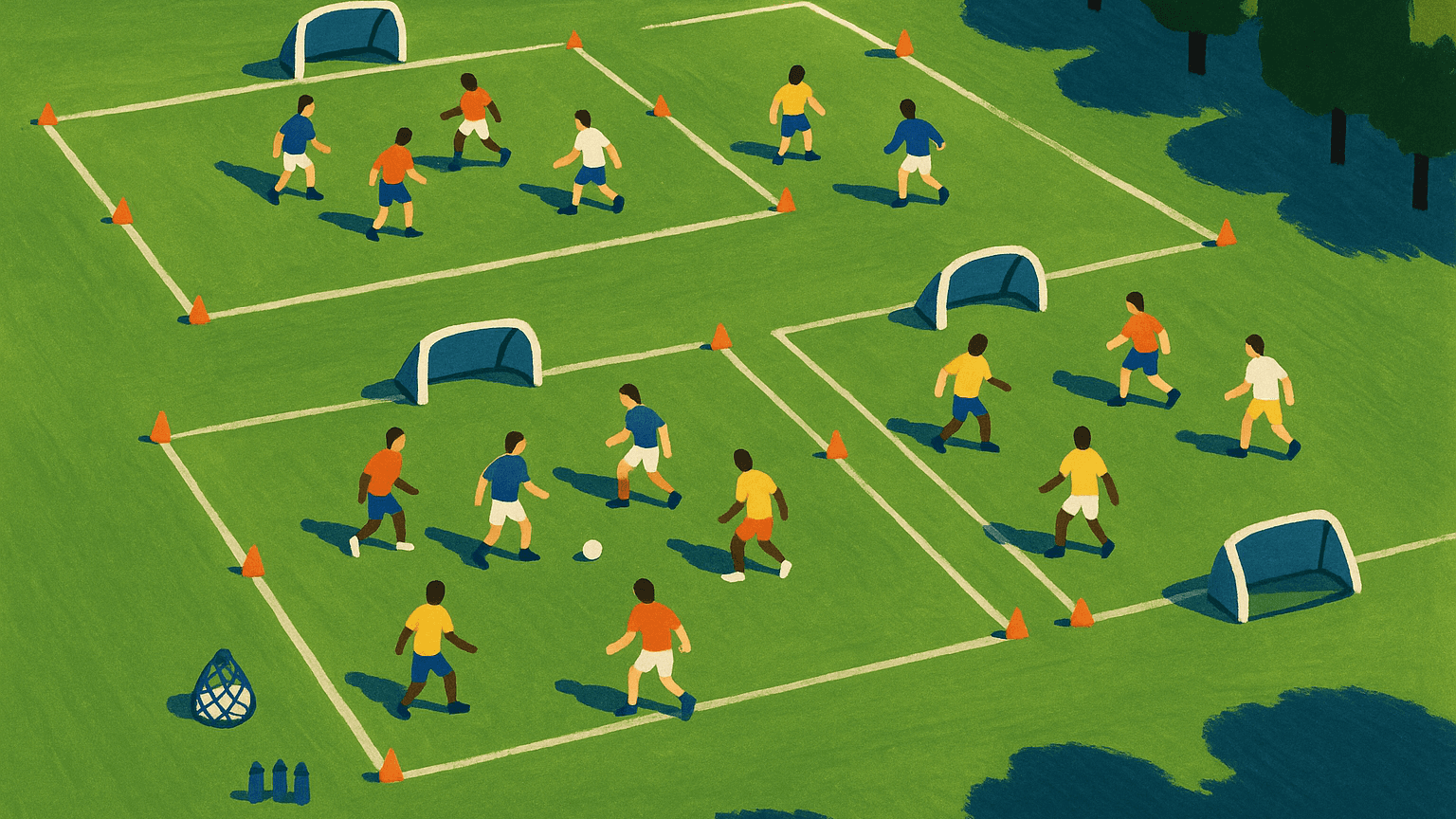
In the US small-sided standards, 4v4 games for the youngest players (U6 to U8) allow kick-ins or dribble-ins in place of throw-ins when the ball goes over the sideline. From 7v7 upwards, the standard Law 15 applies. Some recreational leagues add their own retake rule for the youngest age groups. That is a league rule, not the Law, so read your league's rules before arguing it on the sideline. Our small-sided games guide explains why the youngest formats look so different.
Law, referee practice and coaching opinion
The Law is what is above: four delivery requirements, 2 m distance, the ground-before-entering retake.
Referee practice varies with age. Many referees at U9 and U10 explain the mistake to the player as they hand the ball to the other team. At older ages, referees tend to call a foot fully inside the field and a ball released beside the head, and let small heel lifts go.
Coaching opinion: we think throw-ins are a set piece. Name a taker on each side before the match and practise the routine, including where the receiver moves and where the safe option is.
Practical takeaways
For coaches: teach the feet first. A player who drags the back toe along the ground and keeps the front foot on the line is taking the throw correctly. Spend five minutes at the end of a session on quick, correct throws, and use our U10 soccer drills for session ideas.
For players: face the field, both hands, behind the head, feet down. If you are unsure, throw short to a team-mate's feet.
For parents: a throw going to the other team is a foul throw, not a bad call. The referee is not required to explain it.
For young referees: check the feet at the moment of release, not before. If the ball never entered the field, it is a retake by the same team, not a change of possession.
If your coaches agree on one throw-in routine, the club can send it to every family on the team before game day as one broadcast, in English and Spanish, and the team calendar tells families when and where to be. See how Centro works for clubs.
Cover photo: Tadeáš Bednarz, CC BY-SA 4.0, cropped, via Wikimedia Commons. License terms.