In US Youth Soccer play, players aged 10 and under may not head the ball in matches or in organized team practice. Players aged 11 and 12 may head in matches, but no player should head the ball more than 25 times in a week. From 13, US Youth Soccer sets no heading restriction. U.S. Soccer's coaching guides say something similar in different words, and the two documents do not line up exactly, which is why coaches and parents hear different numbers on the same sideline.
This guide puts both texts side by side, explains the birthday problem that the new school-year age groups create on U11 and U13 teams, and turns the 25-header limit into something a coach can actually run.
Heading rules by age at a glance
Age or team | US Youth Soccer Rule 305 (policy dated June 23, 2026) | U.S. Soccer age-group coaching guides |
|---|---|---|
10 and under / U10 and younger | No heading in matches. No heading practice in any organized team setting. | No heading in practice or games. |
U11 team | Written by age, not team: 10-year-olds may not head; 11-year-olds may. | U11: no heading in practice or games. |
Age 11 and 12 / U12 | Heading allowed in matches. Practice allowed, but no single player above 25 headers per week, regardless of setting. | U12: no more than 30 minutes of heading practice per week and no more than 15 to 20 headers per player per week. |
U13 and U14 | Age 13 and older: heading allowed in matches and practice, no limit in the rule. | Same practice limit listed for U13 to U14: 30 minutes and 15 to 20 headers per player per week. |
Sources: US Youth Soccer Policy on Players and Playing Rules, Rule 305, and U.S. Soccer's age-group guides for U9 to U10, U11 to U12 and U13 to U14.
What US Youth Soccer Rule 305 says
Rule 305 sits in the playing-rules section of US Youth Soccer's policy. Three details matter more than the headline.
Where it is mandatory. The rule is mandatory for US Youth Soccer conducted events: the National Championship Series, the National Presidents Cup, the National League, the Regional Leagues and the Olympic Development Program. For state and local play it is not mandatory. State associations are "strongly encouraged" to adopt it, so your state association's own rules decide what applies in your Saturday league.
What the referee does. Players aged 10 and under may not head the ball directly from the air. If one deliberately heads the ball in a match, the referee awards an indirect free kick to the other team at the spot. If that happens inside the penalty area, the ball is moved outside the penalty area for the indirect free kick. The sanction is for a deliberate header, so a ball that strikes a child's head from close range is not an offence.
The practice limit covers the whole week. Players aged 11 and 12 may practice heading in an organized team practice or skill session, and "coaches shall monitor this practice so that no single player heads the ball more than 25 times per week, regardless of setting." Regardless of setting means a second team's practice, a futsal session or a paid skills clinic count toward the same 25. A coach cannot see those sessions, so the number has to come from a conversation with the family.
What U.S. Soccer's guides say
U.S. Soccer's age-group coaching guides list heading under "what to coach" for each band: no heading at U9 to U10, no heading at U11, and a cap of 30 minutes of heading practice and 15 to 20 headers per player per week at U12, repeated for U13 to U14. U.S. Soccer also runs a concussion initiative with guidance for coaches, referees, players and parents.
Two differences cause most of the confusion:
U.S. Soccer counts by team, US Youth Soccer by birthday. "U11: no heading" covers a whole team. "Age 10 and under" covers individual children.
The weekly numbers differ. 25 headers (US Youth Soccer) against 15 to 20 headers and 30 minutes (U.S. Soccer), and U.S. Soccer applies its limit into U13 and U14 while the US Youth Soccer rule ends at 13.
Neither document is wrong. They were written by different organizations for different purposes. Your league decides which one it enforces, and a coach who follows the stricter of the two in practice is inside both.
The birthday problem on U11 and U13 teams
From the 2026-27 season, US Youth Soccer, AYSO and US Club Soccer form age groups on an August 1 to July 31 cycle. A US Youth Soccer state association's 2026-27 FAQ puts the convention plainly: "U followed by age really means that age and younger" (2026-27 season matrix and FAQ). A 2026-27 U11 team is made of children born between August 1, 2015 and July 31, 2016.
Work through the dates and something awkward appears. On July 31, 2026, the day before the season year starts, every one of those children is 10. Each turns 11 on a birthday somewhere between August 2026 and July 2027. Read literally, Rule 305 says each child may start heading in matches on their 11th birthday. A U11 team therefore begins the season with no player allowed to head and ends it with every player allowed, one birthday at a time.
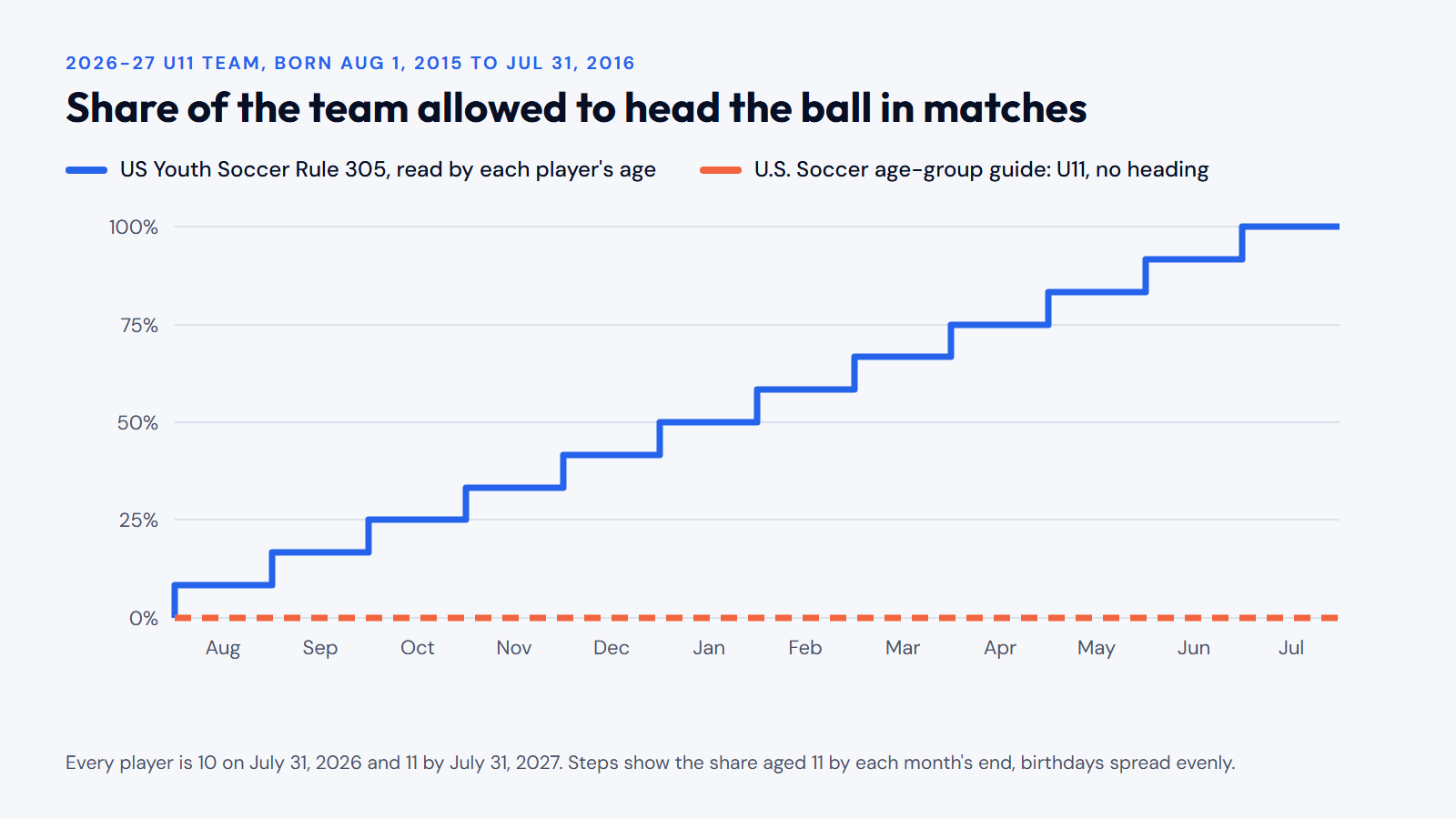
The same thing happens on a U13 team (born August 1, 2013 to July 31, 2014). Every player is 12 when the season year starts, inside the 25-header weekly limit, and leaves it on their 13th birthday.
No referee can check birthdays during a throw-in, and no coach should run a practice where half the group may head and half may not. The practical answer most coaches reach:
U11 team: no heading for anyone, all season. It satisfies the literal reading of Rule 305 and U.S. Soccer's U11 guidance at the same time.
U12 team: heading allowed in matches, practice capped by the stricter numbers: no more than 15 headers per player per week and no more than 30 minutes, which is inside both documents.
U13 team: keep the U12 practice cap. It is what U.S. Soccer's guide lists for U13 to U14, and it covers the players who are still 12.
For matches, ask your league in writing how its referees apply the rule on U11 teams. If your league uses age groups different from the August 1 cycle, the birthday maths changes; the free age-group calculator shows which 2026-27 group a birth date falls in.
How to coach heading at 11 and 12 inside the limit
A weekly cap only works if somebody counts. The simplest way is to make heading a short, planned block instead of something that happens all session.
Plan the budget for the week. With two practices a week, plan no more than 6 headers per player per practice. Two practices make 12, which stays under 15 with a little room for headers that happen in practice games or in a second team or clinic. Ask families at the start of the season whether their child plays anywhere else.
Make every header a quality repetition. Fewer, better contacts:
Start from a ball served by hand, underarm, from three or four yards, so the timing is easy and the contact is light.
Coach the contact point: the forehead, at the hairline, eyes open and mouth closed, with the neck firm and the movement coming from the trunk.
Progress the distance and the height of the serve only when the technique is consistent.
Count each player's headers out loud or on a clipboard. Players like seeing the number go down.
Keep the ball low in practice games. In a small-sided game, a below-head-height rule (a ball above head height is a turnover) stops uncounted headers piling up. It also rewards passing on the ground.
Teach the alternatives to heading. Removing heading changes how a game is played. Players aged 10 and under who never head still need to deal with high balls: let the ball bounce, take it on the thigh or the chest, move to where it will land. Build those into practice so that the no-heading rule does not turn every goal kick into a scramble.
What England did, and why it matters for US coaches
England moved in the same direction with a different method. After a two-season IFAB trial with around 16,000 teams and 107,000 players, The FA announced in May 2024 that deliberate heading would be phased out of affiliated grassroots matches from U7 to U11: U7 to U9 from 2024-25, U10 from 2025-26 and U11 from 2026-27, with heading returning in the U12 season (The FA). A deliberate header is punished with an indirect free kick, and there is no disciplinary sanction unless the offence is persistent, which can bring a caution.
The comparison is useful because England's line lands on the same place as U.S. Soccer's: no heading through U11, heading back at U12.
Why governing bodies limit heading
The study most often cited in this debate is a 2019 retrospective study of 7,676 former professional players in Scotland, compared with 23,028 matched people from the general population. Over a median of 18 years, mortality with neurodegenerative disease as the primary cause was 1.7 percent among the former players and 0.5 percent among the controls (Mackay and colleagues, New England Journal of Medicine). The authors say the observations need to be confirmed in prospective studies, and the study did not measure heading itself. It is evidence about professional careers, not about a 12-year-old's Tuesday practice. It is also part of why heading guidance for children errs on the side of caution.
If a player takes a blow to the head in practice or a match, the rule is the same at every age: remove them from play and do not return them until they have been evaluated as your league's concussion policy and your state's youth concussion law require. U.S. Soccer's concussion initiative page links its guidance for coaches and parents.
A one-minute checklist for coaches and club directors
Find out which heading rule your league enforces: your state association's adoption of Rule 305, U.S. Soccer's guidance, or its own text.
Ask how referees apply the rule to U11 teams, where players turn 11 during the season.
Decide the club's practice standard for U11, U12 and U13 and write it into the coaching guide.
Ask families whether players train with another team or a clinic, because the 25-header limit covers every setting.
Plan heading as a short, counted block in two practices a week, not as part of every game.
Brief coaches on removing any player with a suspected head injury.
For U10 sessions that build ball control for high balls without heading, see our U10 soccer drills. For the 2026-27 age-group change itself, our age-group guide explains the August 1 cycle and what it means for families.