How to Coach Youth Soccer: The Complete Guide for 2026
Coaching youth soccer in 2026 means navigating new U.S. Soccer frameworks, state compliance changes, and player retention challenges that didn't exist a decade ago. This hub guide surveys the entire landscape and points you to deeper resources for each piece of the picture.
On this page
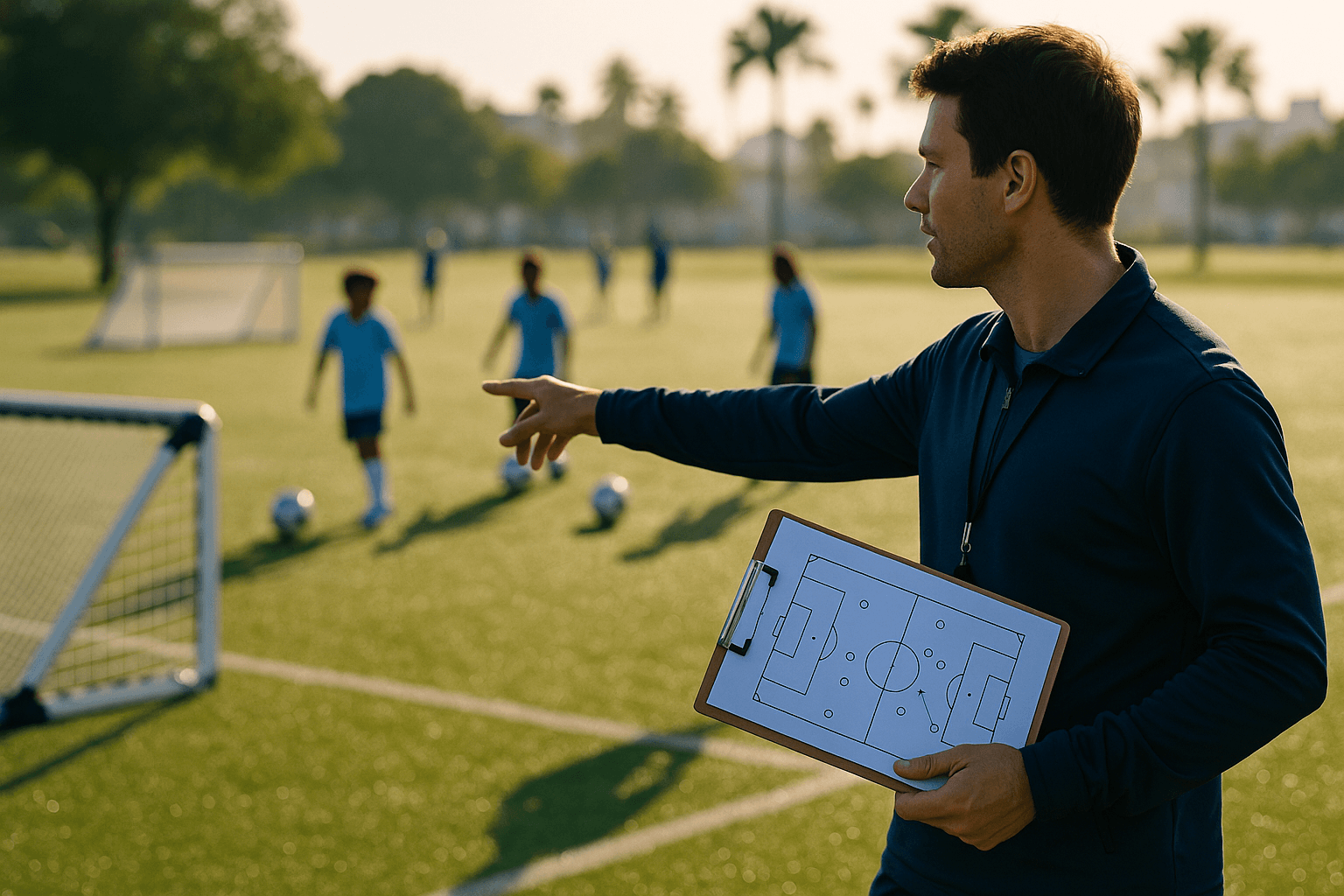
If you've just been handed a clipboard and a roster of eight-year-olds, or you're a Director of Coaching writing a season curriculum, or you're a technical director trying to make sense of FYSA's 2026/27 compliance changes, this is your map. We built it as a hub, not a long-form lecture. Each section gives you the high-level picture and points you to a longer guide when you want to go further on any one piece. If you've ever searched for how to coach youth soccer and gotten 14 conflicting blog posts back, this is meant to be the one that organizes the rest.
Why coaching youth soccer in 2026 looks nothing like it did in 2006
The cultural ground has moved. Per the Aspen Institute, the average kid plays a sport for less than three years before quitting, and the typical age of attrition is around 11. The most common reason isn't injury or talent. It's that the sport stopped being fun. Costs are part of the picture too: families now spend an average of $883 per child per sport per year, a figure that has risen 46 percent since 2019.
The technical ground has moved as well. U.S. Soccer rolled out an updated Player Development Framework in 2023, the Grassroots license pathway has been redesigned around four small-sided game models, AI-powered coaching tools have arrived in the youth space (more on that in section ten), and Florida coaches now work under a fingerprint background-check requirement (more on that in section eleven).
What this all means for the modern coach is simple: the job is retention through development, not Saturday wins. If you keep a player engaged from U7 through U17, you've done the most important thing the data says we can do for them. Almost everything else follows.
If you're brand new to the role, our volunteer coach onboarding guide walks through the first 30 days step by step.
The U.S. Soccer framework every coach should know
The U.S. Soccer Player Development Framework, refreshed in 2023, organizes a player's progression into phases that roughly map to age. Discover (around U5 through U8) is about ball mastery and play. Learn (around U9 through U12) introduces structure and decision-making. Compete (around U13 through U17) layers in tactical detail and team identity. After that, players move into high-performance and lifelong stages.
Mapped onto those phases are four progressive game models, and these are the rules a coach actually has to know on a Saturday: 4v4 with no goalkeeper at U6 through U8, 7v7 with a goalkeeper and a build-out line at U9 through U10, 9v9 with a goalkeeper at U11 through U12, and 11v11 from U13 up.
Two Player Development Initiatives drive most coaching decisions inside that ladder. First, deliberate heading is not allowed in matches at U11 and younger, and is restricted at U12 (roughly 30 minutes per practice week, 15 to 20 headers per player per week). Second, the build-out line at 7v7 forces the opposing team to retreat to a designated line during goal kicks and goalkeeper possessions, which gives U9 and U10 players the time and space to actually build out from the back instead of booting it.
We'll publish a dedicated guide on the U.S. Soccer Player Development Model in the coming weeks. For now, the takeaway: every session you plan should respect the game model your players are in and the developmental phase they're in. Coaching 11v11 ideas at a 9v9 group is the most common technical mistake we see in newer coaches.
The coaching license pathway: Grassroots, D, C, B, A, Pro
Entry into the U.S. Soccer education system starts with a free, roughly 20-minute Introduction to Grassroots Coaching online module. From there, the Grassroots tier itself splits into four game-model-specific courses (4v4, 7v7, 9v9, and 11v11), each available as a roughly $25 online course or a longer in-person course. A new volunteer coach can be properly credentialed for their team in under a weekend.
The D License (around 9 weeks, in the $200 to $500 range depending on host association) is the next step up. Most state associations require the Introduction module plus the 11v11 in-person Grassroots course and one additional in-person Grassroots course as prerequisites. After D comes the C License (focused on U13 through U17, roughly $1,500 to $2,000), the B License (senior performance, around $3,000), the A License (split into Youth and Senior tracks, around $3,500 to $4,000), and finally the Pro License (around $10,000, reserved for top-flight coaches).
Running parallel to the U.S. Soccer Federation pathway is United Soccer Coaches, the largest coaching association in the country. Their diploma sequence (National Youth, National, Premier, Master) complements rather than replaces USSF licenses. Many directors of coaching hold both.
The practical advice for a brand-new volunteer: get the Introduction module done in week one, take the in-person Grassroots course that matches your team's game model in your first season, and consider the D License once you've run a full year. Costs and exact prerequisites vary by host association, so verify with FYSA before registering.
SafeSport, concussion training, and the safety stack
Every adult participant in U.S. Soccer-affiliated youth programs is required to complete SafeSport training annually. The cycle is structured: a longer Core course in year one, shorter Refresher courses in years two through four, and the Core course again in year five. The training covers emotional, physical, and sexual misconduct prevention and reporting.
Alongside SafeSport, U.S. Soccer requires concussion training. The course, "Introduction to Safe and Healthy Playing Environments," is hosted inside the U.S. Soccer Learning Center and is generally valid for two years. Most state associations also require a separate Heads Up concussion certification through the CDC for parity with state law.
Together, SafeSport and concussion training form the floor of the safety stack. They are not optional, they are not waivable, and a coach who isn't current cannot stand on a sideline.
The third piece of the safety stack in Florida (a Level 2 fingerprint background check) is significant enough that we cover it in its own section below. Plan to budget time for all three before your first session of the season.
Age-stage philosophy: U6 through U18 in five movements
U6 through U8 (Discover). The game is 4v4 with no goalkeeper. The coach's job is to facilitate, not direct. Sessions should be heavy on ball mastery, 1v1 moves, and joyful small-sided games. Avoid lines, drills, and tactical lectures. If players leave practice smiling and tired, you did your job.
U9 through U10 (Learn). The game is 7v7 with a goalkeeper and a build-out line. Players are introduced to roles in attack and defense, simple shapes such as the 1-2-3-1 or 1-3-2-1, and the idea that there are positions on the field. We go deeper in our guide to 7v7 soccer formations.
U11 through U12 (the golden age of motor learning). The game is 9v9 with a goalkeeper. This is the window where scanning, decision-making, and real positional discipline can be taught at a level that sticks for life. We cover shapes and principles in our 9v9 formations guide.
U13 through U14 (Compete). The transition to 11v11. Set pieces, principles of play, and a team identity start to matter. Tactical periodization becomes possible without sacrificing development.
U15 and up. Physical maturation, position specialization, college pathway, and ID camps. Coaching priorities shift toward periodization, position-specific work, and individual development plans.
We'll also publish dedicated guides on 4v4 formations and 11v11 formations in the coming weeks to round out the cluster.
The four components of coaching: technical, tactical, physical, psychological
Every session you plan touches some mix of four components, and a development-first curriculum touches all four across a season.
Technical. Ball mastery, 1v1, passing, receiving, finishing. The player-and-the-ball layer. Heavy at younger ages, and never goes away.
Tactical. Principles of play (penetration, support, mobility, width, depth), small-group decision-making, and set pieces. Introduced at U9 and U10, deepened from U11 up.
Physical. Age-appropriate fitness. Critically, this is where we need to remember what the U.S. Soccer Framework explicitly warns against: early specialization. A player who plays only soccer year-round at age nine is at higher risk for overuse injury and burnout than one who plays multiple sports. The "head start" most parents imagine doesn't exist in the literature.
Psychological. The often-overlooked fourth pillar. According to the Aspen Institute, 27 percent of parents say their child has lost interest in their sport, and the most common driver across income levels is that the sport stopped being fun. Income-banded data from Project Play shows this rate ranging from 31 percent in low-income families to 41 percent in high-income families. The numbers are sobering.
The psychological job of the coach, in plain terms: make practice the best 90 minutes of the kid's Tuesday. Praise effort over outcome. Treat mistakes as learning data. Insulate players from the pressure of the parent-financial-college pipeline. The four components aren't ranked, but if we had to rank them by how often they get neglected, this one is at the top.
Free resourceFree soccer practice plan templatesBy age group, U6 through U14The practice-planning framework: Play-Practice-Play
U.S. Soccer's Grassroots methodology is built around a three-phase session structure called Play-Practice-Play. It replaced the older four-phase warm-up, technical, small-sided, scrimmage model that many coaches still use.
Phase 1, Play (10 to 15 minutes). Players arrive and are immediately put into small-sided games. The coach observes. No long warm-up, no lines, no whistle-driven drills. Players are getting touches and the coach is diagnosing.
Phase 2, Practice (25 to 35 minutes). Targeted, game-realistic activities focused on the day's theme. Coaches use guided questions ("Where could you have played that pass?") rather than direct instruction. The activity itself does most of the teaching.
Phase 3, Play (15 to 30 minutes). A final game closer to match dimensions, where players apply what they just practiced.
Time allocation should adjust by age. A U6 session might run 45 to 60 minutes total, a U10 session 60 to 75, a U14 session 75 to 90.
The older four-phase model still has merit and many clubs still use it well. The practical takeaway across both methodologies is the same: lines, laps, and isolated drills don't resemble the game, and they should be minimized at every age.
For ready-to-run plans, see our free practice plan templates by age group. We'll also publish a guide on building a 1-hour session from scratch in the coming weeks.
Game-day management: the 90 minutes parents actually see
Pre-game starts 30 minutes before kickoff. A short dynamic warm-up, a first-touch activity, and a brief tactical reminder limited to one cue (not seven). Players should arrive on the field calm, warm, and clear on their starting position.
Substitution patterns vary by age. At U10 and below, equal play is the standard, and FYSA's 4v4 game model uses quarters partly to make this easy to manage. From U11 up, a development-first club still rotates positions through U12 so every player experiences attack, defense, and (if they want) goalkeeper. Specialization can wait.
Halftime is for one cue, not five. Thirty seconds of "We aren't getting wide enough on the right, fix that one thing" beats five minutes of tactical adjustments your players won't remember. Save the bigger conversations for the next training session.
Post-game should be short and positive. We like two or three reflection questions ("What did you try today? What worked? What would you change?") followed by a quick acknowledgment of effort. Then orange slices, and let them go.
The single biggest game-day mistake we see is yelling positions during play. The game itself is the teacher. A player who is constantly told where to stand is a player who isn't learning to read the game. Quiet sidelines develop better players. Our 7v7 formations guide goes deeper on what to teach during the week so you don't need to coach over the top of the game on Saturday.
Parent management is the silent half of the job
Most experienced volunteer coaches will tell you parents are harder than players. Four practices prevent the majority of parent issues we see across youth clubs everywhere.
The pre-season parent meeting. Hold one before practices start. Cover your coaching philosophy, expectations for the season, communication channels, and equal-play policy if applicable. Putting it in writing prevents most of the conflicts that show up in November.
Written sideline behavior expectations. Parents are spectators, not coaches. No coaching from the touchline, no refereeing the referee, no negative comments to your own kid in front of teammates. If you write it down before the season, you can point to it during the season.
The 24-hour rule. No playing-time or tactical complaints within 24 hours of a game. The cool-down period prevents heated emails from becoming the pattern of communication, and it gives you time to respond thoughtfully when one does come in.
Bilingual communication for Hispanic families. In Florida, especially in South Florida, a meaningful share of FYSA rosters live in Spanish-dominant households. Bilingual handouts, Spanish-language WhatsApp updates, and translated parent meetings aren't a nice-to-have. They're the difference between a family staying in the program and quietly leaving in March. We cover the operational side in our guide to running a bilingual youth soccer club, and you can find ready-to-customize parent meeting language in our parent handbook templates.
The technology stack of a modern youth coach in 2026
The coach's tech stack in 2026 is layered, and it helps to think of it as four boxes rather than one.
Communication. TeamSnap, GameChanger, GotSport, and club-specific apps live here. They handle rosters, schedules, RSVPs, and parent messaging. Most clubs already have one.
Game-day video. This category expanded sharply in 2026. TeamSnap announced an exclusive partnership with XbotGo on April 22, 2026, embedding AI-tracked 4K Falcon-camera streaming directly into TeamSnap ONE. Veo and Trace play in the same space. These tools automate filming and clipping. They do not plan training. Worth keeping that distinction clear.
Tactics boards. TacticalPad, CoachTube, and the humble dry-erase board still cover most needs. A halftime drawing on a sideline whiteboard can communicate more than a fancy app, depending on the coach.
Session planning and curriculum. Historically the most painful piece of the stack. A typical coach spends 45 to 90 minutes planning one session by hand: pulling drills from PDFs, sketching diagrams, adapting for age, writing it up in a format the assistant coach can actually run. Multiply that by two practices per week across a 30-week season and you have 50 to 90 hours of admin per coach per year, before the first cone goes down.
This is where AI-powered tools have genuinely changed the picture for youth coaches, and it's where Centro fits. We cover that in section thirteen.
Florida-specific context every FYSA coach must know in 2026
The Florida Youth Soccer Association is one of the largest state associations in the country, with 200-plus member clubs and leagues, more than 105,000 registered players, and over 20,000 coaches and officials. FYSA hosts B, C, D, and Grassroots courses on behalf of U.S. Soccer, and FYSA membership is the credentialing path most South Florida clubs run on. We cover the registration mechanics in our FYSA registration guide for new clubs.
Three Florida-specific compliance items deserve a coach's attention right now.
F.S. 943.0438, in force since July 1, 2026. Florida's Independent Sanctioning Authority law requires every club, league, or sanctioning body operating youth athletic activities to conduct a Level 2 fingerprint background screening on every coach, assistant coach, manager, or referee who has direct contact with minors. The screening runs through the AHCA Care Provider Background Screening Clearinghouse. The original effective date was January 1, 2025, then was extended to July 1, 2026, by SB 1546 in the 2025 session. Confirm the current status with FYSA before publishing your own club policy.
Heat protocol and the Zachary Martin Act. Florida law and FHSAA guidance require Wet Bulb Globe Temperature monitoring and graded practice modifications during heat conditions. From May through September in South Florida, this isn't theoretical. A WBGT reading above 92 degrees triggers practice cancellation under most county and FHSAA frameworks. Build the protocol into your weekly planning, not your panic playbook.
Named Florida exemplars. Weston FC, founded in 1998 and a 2020 MLS NEXT founding member, runs a youth-level Performance Program led by an exercise physiologist who has collaborated with U.S. Soccer's National Youth Program. Inter Miami CF Academy, officially launched in 2019 at the Florida Blue Training Center, partners with two dozen-plus South Florida community clubs (including Hollywood FC, established 1985) to create a Discovery pathway from rec ball to the pro game. Both are useful reference points for what a Florida coaching curriculum looks like at the top end.
Five mistakes new coaches make, and the development-first habits that replace them
1. Coaching to win Saturday's game. The cure is a written season curriculum. If your weekly plan exists only in your head, the temptation to chase the win takes over by mid-season. A documented plan keeps you honest.
2. Specializing too early. Project Play, the American Academy of Pediatrics, and the U.S. Soccer Framework all warn against year-round single-sport play before puberty. Encourage your U10s to play basketball, baseball, anything else in the off-season.
3. Yelling positions during play. The game is the teacher. A player who is constantly directed verbally during a match never learns to scan, read pressure, and decide for themselves. Coach during the week, observe on the weekend.
4. Not rotating positions. Every player at U10 and below should play at least three positions in a season, including goalkeeper if they want to. Locking a kid into one role at age nine because they're "good there" is one of the surest ways to limit their development.
5. Mistaking discipline for development. Making players run laps for losing isn't teaching, it's theater. Real discipline is showing up prepared, treating teammates with respect, and tracking back when you lose the ball. Build that culture in tryouts (see our tryout evaluation form) and reinforce it every session.
Where Centro fits in the modern coach's stack
If you read section ten and recognized your own life in the 45-to-90-minute session-planning slog, that's the gap Centro was built for. Our AI Game Plan generates a full session in roughly 60 seconds. The library carries 1,500-plus drills and 160-plus formations spanning every U.S. Soccer game model from 4v4 through 11v11. The platform is fully bilingual in English and Spanish, which matters in South Florida where a meaningful share of staff and parents work in both. And because the same activity can be translated between 7v7, 9v9, and 11v11 formats with one click, club curricula stay coherent as players move up through the age groups.
To be clear about where Centro sits in the stack: we are the planning layer. We complement TeamSnap or GotSport for communication, XbotGo or Veo for game-day capture, and the dry-erase board on your sideline for halftime. We aren't trying to be all four boxes.
If you're ready to put a session on the field this week, start with our free practice plan templates by age group. If you're a Director of Coaching building a full curriculum, our guide to starting a youth soccer club covers the operational layer. The honest truth about how to coach youth soccer well in 2026 is that the framework, the pathway, and the tools have all matured. Coaching well is harder than it was in 2006, but you have more support around you than any generation of volunteer coaches before you. You don't have to figure it out alone.
Keep reading
More on running a better club.
Bilingual Soccer Coaching: How to Coach Youth Soccer in Two Languages
Mixed-language teams are the norm in much of the US. This guide makes bilingual soccer coaching practical: where language actually matters, the field techniques that work for two-language teams, and how serving bilingual parents differs from coaching bilingual players.
AI Youth Soccer Coaching in 2026: Tools, Limits, and What Comes Next
AI youth soccer coaching is changing how clubs plan practice, analyze games, and communicate with parents. We tour the tools coaches actually use in 2026, the limits of single-purpose apps, and how an integrated club platform changes the math.
How to Build a Club Soccer Curriculum That Every Coach Follows
A club soccer curriculum is what makes a club bigger than any one coach. This guide shows directors how to map a curriculum to age and game format, roll it out to volunteer coaches without an academy budget, and measure whether it works.