9v9 Soccer Formations: The Complete Guide for Youth Coaches
A development-first guide to 9v9 soccer formations for U11 and U12 coaches. We cover the 3-2-3, 2-3-2-1, 3-3-2, the rules every FYSA coach needs, and how to teach the shape through small-sided games.

On this page
Your U11 team just stepped onto a bigger field. Eight outfield players plus a keeper. Real offside calls. No more build-out line. If we are picking 9v9 soccer formations to win Saturday's game, we are already coaching the wrong thing. The job at this age is to teach scanning, decisions under pressure, and the first taste of real positional discipline so our players are ready for 11v11 in two seasons.
This guide walks through the four shapes that actually work in U11 and U12, the official rules that frame the format, the default we recommend, and the mistakes we see clubs make every fall in South Florida.
Key Takeaways
9v9 soccer formations exist as a development bridge between 7v7 and 11v11, not as a system to maximize wins at U11 and U12.
The 3-2-3 is the cleanest default because it teaches width, a double pivot, and transitions naturally into a 4-3-3 at full-sided play.
US Youth Soccer's Player Development Initiatives require a 16-player roster cap, 50 percent minimum playing time, and a 30-game annual ceiling.
Teach formations through small-sided games (3v3, 4v4, 5v5) inside the bigger shape rather than chalk-talk on a whiteboard.
Rotate every player through at least three positions across a season, including goalkeeper.
Why 9v9 exists at U11 and U12
US Youth Soccer mandated 9v9 for U11 and U12 in 2017 as part of its Player Development Initiatives. The reason was developmental, not competitive. Players coming out of 7v7 were arriving at full-sided soccer without the ability to scan, make decisions under pressure, or hold a position when the ball was on the other side of the field.
9v9 fixes that by adding two outfield players, stretching the field, and forcing real choices about width and depth. Arlington Soccer Club's coaching staff describes U11 and U12 as "the critical transition period," sitting at the back end of the golden age of motor learning while players begin teetering between childhood and adolescence physically.
If we treat the format as a winning system, we waste the bridge. If we treat it as a teaching tool, we hand our 13-year-olds a head start. The 7v7 shapes your players just outgrew are the foundation here, and the conceptual jump into 9v9 should feel like a natural progression for any club that already has a strong stepping up from 7v7 formations curriculum.
The official rules every U11 and U12 coach needs to know
Before we pick a formation, we need to know the format we are coaching inside.
The field runs 70 to 80 yards long and 45 to 55 yards wide, per US Youth Soccer Association recommendations as documented by Your Soccer Home. Goals are recommended at 6.5 by 18.5 feet, with a maximum of 7 by 21 feet, according to the Michigan State Youth Soccer Association's published game format. Both age groups use a size 4 ball and play two 30-minute halves.
Eight outfield players plus a goalkeeper take the field per side. Offside is enforced under Law 11. The build-out line that supported U9 and U10 keepers is gone. Deliberate heading is not permitted at U11 and is restricted at U12 under the US Soccer concussion initiative adopted by FYSA.
US Youth Soccer's Player Development Initiatives cap the roster at 16 players, require a minimum of 50 percent playing time per game per player, and limit teams to 30 games per calendar year with no more than one match per day. FYSA-affiliated clubs are allowed up to five guest players, free substitutions for U15 and under, and games are officiated by one center referee with two assistant referees. Clubs should download the current FYSA Rules PDF each season from the FYSA rules-and-bylaws page to confirm any updates, and we recommend you stay within the 16-player roster limit by tracking it on a clean roster template.
The 3-2-3: your default starting formation
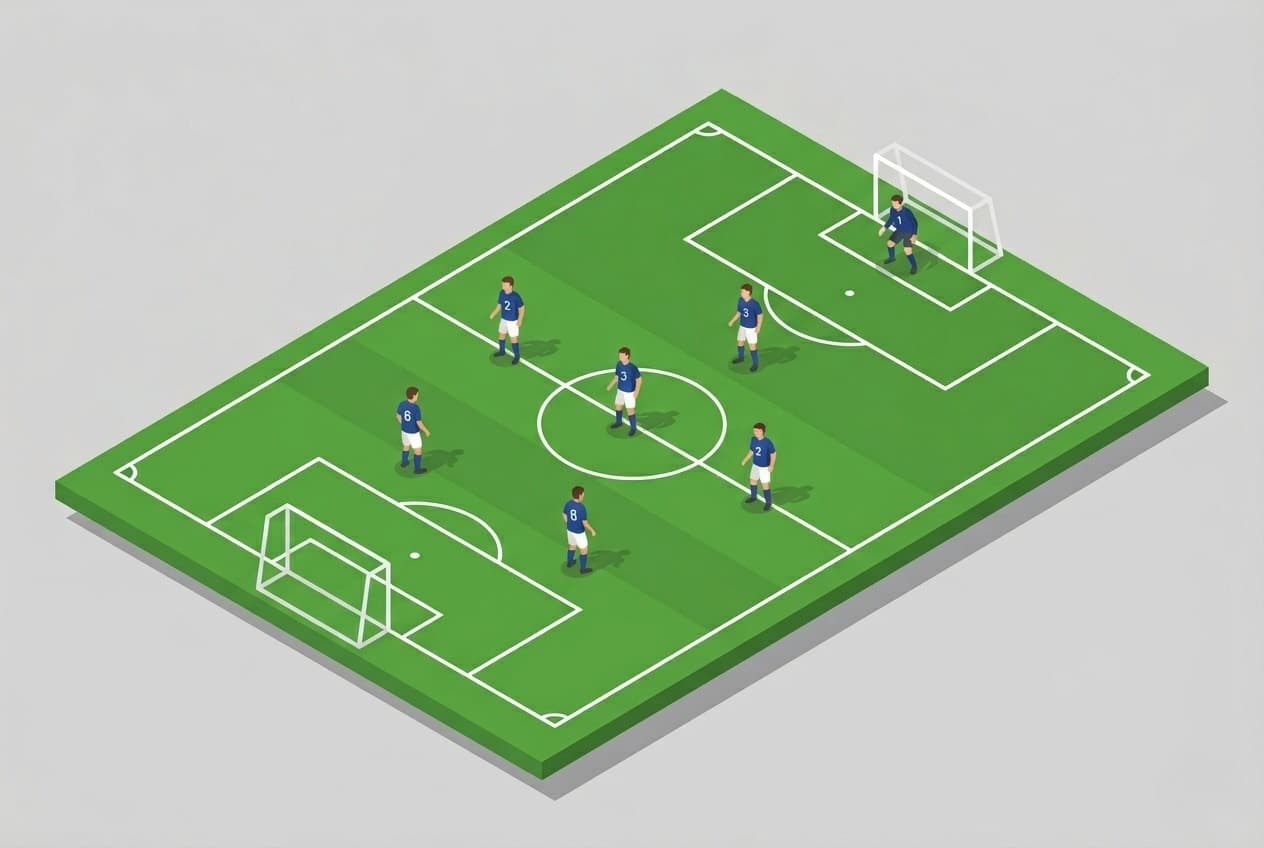
If we do not yet know our team, we start here. Three defenders, two central midfielders, three forwards.
The 3-2-3 delivers natural width through the wide forwards, a double pivot that lets one midfielder push and one stay, and a back three that learns to defend in a chain. It builds out from the back the way a 4-3-3 does at 11v11, which is exactly the bridge we want.
Strengths include balanced triangles all over the pitch, easy progression up the wings, and clear positional reference points for players still learning what a "left back" really is. The weakness is the central midfield. If our wide forwards do not track back, the two number 8s get overloaded fast.
Use the 3-2-3 when you have a roster you are still learning, when you want every player exposed to a clean transition shape, and when you are coaching a club that wants one identity across the U11 and U12 age band.
The 2-3-2-1: when you have a creative midfield
Two defenders, three midfielders, two wide attackers, one striker.
This shape works when we have a midfield triangle that can dominate central possession, plus two wingers who actually defend. It teaches a holding 6 with two attacking 8s, classic wing combinations into the box, and a lone striker who learns to play with her back to goal.
The 2-3-2-1 transitions cleanly into a 4-3-3 or 4-2-3-1 at 11v11. The risk is the back two. If those defenders cannot match the technical level of the rest of the team, opponents counter through the channels and the wingers get caught upfield.
Free resourceClub bylaws templateEditable, with guidance notesThe 3-3-2: if you are heavy at striker
Three defenders, three midfielders, two forwards.
This is the shape for a roster that has more attacking talent than defensive composure in wide areas. The back three covers for U11 fullbacks who cannot yet defend 1v1, and the two-striker partnership teaches combination play, third-man runs, and front-post versus back-post movements.
The 3-3-2 transitions into a three-back system at 11v11, which is increasingly common. Watch for narrow attacking play and a midfield three that gets pinned because there is no advanced wide outlet.
The 3-2-2-1 and 2-4-2: situational shapes
The 3-2-2-1 (sometimes drawn as 3-1-3-1) is more defensive-minded. It creates a layered midfield with a holding 6 and two attacking 8s sitting underneath a single forward. It is useful as a tournament adjustment when we play a team that overruns the middle, but it is not a season-long default at this age because it isolates the striker.
The 2-4-2 floods the midfield. We will likely control central possession, but we trade away wide cover and ask our two defenders to hold against any quick switch. Use this as a 15-minute experiment in a friendly, not as the shape your players line up in every Saturday.
How to actually teach a formation to U11 and U12 players
Whiteboards do not coach soccer. Small-sided games do.
A 3-2-3 is taught through 3v2 and 2v3 zoned grids, end-zone games that reward switching the ball wide, and 5v5 plus goalkeepers in a half field that mimics the back six of your real shape. A 2-3-2-1 is taught with 4v4 plus a target striker, where one team must combine through midfield to find the lone forward. We use a structured practice plan template to make sure every session ladders up to the same shape we play on Saturday.
Position rotation at this age is non-negotiable. Every player should see at least three different positions over the course of a season, including goalkeeper. The U11 striker who never plays in the back will be a worse forward at 16 because she never learned what defenders see.
Common mistakes coaches make at 9v9
We see the same patterns every fall in South Florida.
Rigid position enforcement. "Stay in your zone" kills creativity at the exact age we are trying to develop scanning and decision-making. Picking a formation to win Saturday's game rather than to teach skills. Skipping the 7v7 to 9v9 conceptual bridge entirely and just shouting new positions at confused 11-year-olds. Comparing players to each other instead of to where each one was six weeks ago. Specializing strikers at age 11. Chasing results in a stage where US Soccer explicitly says results should not be recorded.
The fix is club-wide. Clubs that pick one playing identity, one default formation, and one set of teaching principles across all U11 and U12 teams develop better players, full stop. We help clubs onboard your volunteer coaches around one team identity so the shape on the field actually matches what the curriculum says.
What South Florida clubs are doing in 9v9
Weston FC sits at the development-first end of the spectrum. The club was invited into MLS NEXT in 2020 after years in the US Soccer Boys Developmental Academy and now runs roughly 1,000 players across about 70 teams. Their stated philosophy is to develop "good human beings through soccer," with bi-weekly coach education sessions led by figures including former Real Madrid youth coach Kike Guijarro. They describe their sport-science program as the first of its kind at the youth-soccer level in the US.
Hollywood FC, founded in 1985, runs U11 and U12 9v9 teams across USL Academy, EDP, the SFUYSA League, The Florida League, MDSL, SFPSL, CCL, and GHSL Gold Divisions. Their stated competitive ethos is direct: "player development is demanded and playing time is earned." They are exactly the volunteer-driven, Hispanic-community Broward County club that has to make 9v9 work across multiple sanctioning bodies at once.
At the top of the regional pyramid, Inter Miami CF Academy's U-12 side recently competed at the LALIGA FC FUTURES Mundial U-12 in Brunete, Spain, against CA River Plate, SE Palmeiras, Boca Juniors, and Flamengo. Even at that level, the U-12 game is still played in age-appropriate small-sided formats before the step up to full-sided soccer. The format is the format, no matter the badge.
Plan your 9v9 season with Centro
Picking the right shape is one piece. Building a season of training that actually teaches that shape is the harder part, especially when you are coaching three nights a week after work. Centro's AI Game Plan generates 9v9 sessions with formation diagrams, translates concepts between 7v7, 9v9, and 11v11 for coaches transitioning teams up, and runs in English and Spanish so your bilingual staff is on the same page. If you are building a new club from scratch, our guide to if you are building a new club from scratch walks through the structural pieces too.
We built Centro from the sideline of a South Florida youth academy that was juggling seven disconnected tools. Now we put practice planning, formations, payments, registration, and parent communication in one place for $25 per month. See how AI Game Plan builds a session.
Keep reading
More on running a better club.
7v7 Soccer Formations Explained: Guide for Youth Coaches
The five most common 7v7 soccer formations broken down for youth coaches. Learn when to use each shape, how to choose the right one for your team, and how to teach positioning to U10 players without losing their attention.
Florida Level 2 Background Screening for Youth Coaches: What's Required Now
Florida’s Level 2 fingerprint screening requirement has applied since July 1, 2026, per F.S. 943.0438. We cover what the statute requires, how SB 1546 set that date, and the compliance steps a club needs to have in place now.

4v4 Soccer Formations: A Complete Guide for U6 and U8 Coaches
The right 4v4 soccer formations make U6 and U8 games feel like soccer, not beehive chaos. We cover the 1-2-1 diamond, 2-2 box, and 2-1-1 shapes, when to pick each, and what coaches should not do at this age.