The 2026/27 Laws of the Game took effect on July 1, 2026. Most of the changes were written for professional football: five-second countdowns against time-wasting, new VAR reviews, more substitutes in senior friendlies. Several of them still reach a Saturday youth match, and a few work differently when substitutions are unlimited, the field is small and there is no video review.
This guide goes through the 2026/27 changes from the International Football Association Board (The IFAB), then explains what each one means for youth coaches, referees and club directors. The primary texts are IFAB Circular 32, dated March 31, 2026, and the IFAB law changes page, which also carries the extra changes approved on April 28, 2026.
When the new Laws apply to your league
The IFAB set July 1, 2026 as the start date. Competitions that began before then could adopt the changes early or wait until the start of their next competition, so a fall 2026 season that kicked off in August or September is expected to be playing the 2026/27 Laws already, unless the league has said otherwise.
Youth leagues then adapt them. US Youth Soccer's policy says the Laws of the Game apply to its competitions "except as provided by USYSA or its State Associations", lets players aged 10 and under play under modified rules, and sets substitutions as unlimited, at any stoppage, with the referee's consent (Rules 301 and 302). The IFAB itself allows national associations to change the field size, ball, goals, length of the halves, number of players, return substitutes and sin bins in youth, veterans, disability and grassroots football (General Modifications). Your league's rules sit on top of the Laws, so read the two together. High school soccer in the US uses its own rules book and is not covered here.
The 2026/27 changes at a glance
Change | Law | What happens | Youth impact |
|---|---|---|---|
Five-second countdown on throw-ins and goal kicks | 15, 16 | Deliberate delay: the throw-in goes to the opponents, a goal kick becomes a corner | High |
One minute off after on-field treatment | 5 | Injured outfield player leaves and stays off for one minute after the restart, with exceptions | High |
Ten seconds to leave when substituted | 3 | Late exit: the substitute waits until the first stoppage after one minute | Medium |
Accessories instead of a jewellery ban | 4 | Non-dangerous items allowed if safely and securely covered | High |
Advantage after a wrongly taken restart | 5 | Play can continue if the opponents gain possession | Medium |
Dropped ball clarification | 8 | Possession includes the team that would have taken the restart | Low |
Fewer than seven players | 3, 7 | Match cannot start or continue; the responsible team in principle forfeits | Depends on format |
No caution for DOGSO when advantage leads to a goal | 12 | No yellow card for the denial when the goal is scored anyway | Low |
Optional send-offs for covering the mouth or leaving in protest | 12 | Competition option only | Check your competition |
VAR additions, body cameras, 8 subs in senior friendlies | 3, 5, 6 | Elite or competition options | None in most youth play |
"Only the captain" compulsory | Guideline | From July 1, 2027, with a youth option already available | Plan now |
The five-second countdown on throw-ins and goal kicks
When the referee decides a throw-in or goal kick is being deliberately delayed, they blow the whistle, signal for the restart and count down five seconds with a raised hand. If the ball is not in play at the end, a throw-in is given to the other team from the same spot, and a goal kick becomes a corner on the side nearest to where the goal kick was to be taken (countdown protocol).
Three details from the protocol matter in youth games:
The countdown can start before a player has the ball, for example when a player is slowly retrieving it, standing in the wrong place for a throw-in or placing the ball in the wrong spot for a goal kick.
A player who is already in the act of throwing or kicking when the count reaches zero should not be penalised.
The countdown is for deliberate delay. A nine-year-old who does not know who should take the throw-in is not wasting time, and the protocol lets the referee tell players to hurry before any count starts.
For coaches: decide before the season who takes goal kicks and who takes throw-ins on each side, and practise taking them quickly. In 7v7 with a build-out line, waiting for the opponents to retreat behind the line is part of the format, not a delay. Teach players to set the ball and play as soon as the opponents are back.
One minute off after treatment on the field
An injured outfield player who causes play to be stopped, or who is assessed or treated on the field, must leave and stay off for one minute of running clock after the restart. The referee lets the player back on, from the touchline if the ball is in play (off-field treatment protocol).
The player does not have to leave when:
the goalkeeper is injured;
a goalkeeper and an outfield player have collided and need attention;
two players from the same team have collided and need attention;
the injury is severe, especially a head injury such as a suspected concussion, a cardiac issue or a life-threatening event;
the player was injured by a physical offence for which the opponent is cautioned or sent off;
a penalty kick has been awarded and the injured player is the one taking it;
the player says they do not need medical attention, unless play was stopped for the injury.
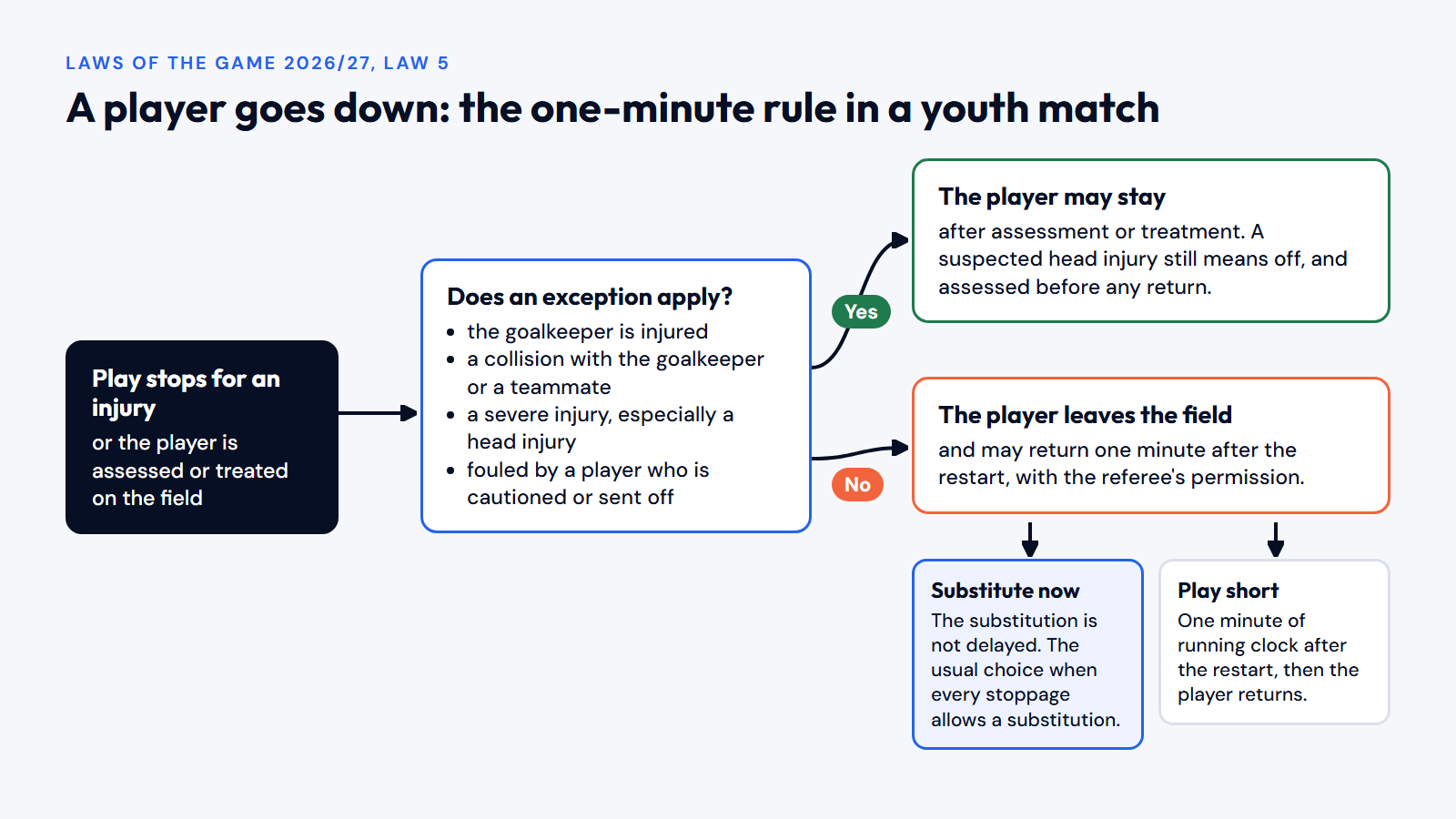
The protocol also says that if the injured player is substituted, the substitution is not delayed. That is the line that changes youth football. Where substitutions are unlimited at any stoppage, the coach does not have to play a player short: send a substitute on, let the injured player recover on the bench, and bring them back at a later stoppage. In leagues with limited substitutions, the choice is real: a minute short or a substitution used.
A suspected head injury is not a one-minute question. It is one of the listed exceptions because the player should be assessed properly, and a player with a suspected concussion should be removed from play and not return until they have been evaluated under your league's concussion policy.
Ten seconds to leave when substituted
Once the referee signals a substitution, the player coming off must be off the field within ten seconds, at the nearest point on the boundary line unless the referee says otherwise. If they take longer, they still have to leave, but the substitute cannot come on until the first stoppage after one minute has passed (time-limited substitution protocol). The referee can waive the limit when an injury prevents a player from leaving quickly.
Youth teams make many substitutions, and children walk slowly to a bench on the far side. Two habits avoid a team playing short: the substitute is ready at the halfway line before the stoppage, and the player coming off jogs to the nearest line. If your league requires substitutions at the halfway line, ask your referees how they apply the "nearest point" wording.
Accessories are allowed if they are safe and covered
The old wording banned all jewellery, and taping was not allowed. The 2026/27 Law 4 says accessories "are permitted as long as they are not dangerous and are safely and securely covered", and that dangerous items must be removed, not taped or covered. The IFAB's explanation is that the old ban had been applied inconsistently and overlooked cultural, religious, medical and personal reasons for wearing certain items.
For parents, this matters at check-in. A medical alert bracelet or a religious item may now be allowed if it is covered securely. Whether an item is dangerous is still the referee's call during the pre-match inspection, so a family should not assume that taping an earring will be accepted. Your league can say more in its own rules.
Advantage after a wrongly taken restart
The referee may now play advantage when a restart is taken incorrectly and the ball is in play, if the opponents benefit. The IFAB's own example list includes free kicks and throw-ins. In youth matches the obvious case is a foul throw that goes straight to an opponent: rather than stopping play to give the throw the other way, the referee can let the opponent run with it.
Fewer than seven players
Approved on April 28, 2026: a match may not start or continue if either team has fewer than seven players, and where a team is responsible, it will in principle forfeit, subject to competition regulations. Sin bins and the one-minute and ten-second protocols do not count as reducing a team for this purpose.
The rule is written for eleven-a-side. In 4v4, 7v7 and 9v9 the number of players is a modification your league has set, and the minimum to start or continue a match is in your league's rules. Check them before the season, especially the forfeit rule, because low turnout on a cold November morning is a youth problem, not a professional one.
Smaller changes
Dropped ball: if the ball would have gone out of play, the team that would have taken the restart counts as the team that "would have gained possession". When play stops because of interference by a match official or an outside agent, the ball is dropped where that interference happened.
DOGSO and advantage: if a player denies an obvious goal-scoring opportunity, the referee plays advantage and a goal is scored, there is no caution. The same applies to an unsuccessful handball attempt to stop a goal.
Delaying a restart: a caution only applies when the delay is excessive, because giving the restart to the opponents is now the main sanction.
Penalty kicks: the law-changes page clarifies what happens after an accidental double touch in a penalty or a shoot-out.
The goalkeeper eight-second rule is a 2025/26 change, not a 2026/27 one, and it is worth checking that coaches and young goalkeepers know it: a goalkeeper who controls the ball with the hands for more than eight seconds concedes a corner kick.
Changes that will not reach most youth games
VAR can now review a red card from a clearly wrong second yellow, a card shown to the wrong player and, as a competition option, a clearly wrong corner. Competitions may give referees body cameras. Senior "A" international friendlies may use up to eight substitutes, or up to eleven if both teams agree. Youth matches with no video review and unlimited substitutions are untouched by these.
The two April additions about protest are competition options: a red card for covering the mouth when speaking to an opponent in a provocative, derisory or inflammatory way, and a red card for leaving the field, or telling players to leave, in protest at a referee's decision. They apply only where a competition has adopted them, so ask your league.
"Only the captain" arrives in July 2027, with a youth version
From July 1, 2027, the IFAB's "Only the captain" guidelines become a compulsory protocol for all competitions starting on or after that date (guidelines). Only one player per team, usually the captain, may approach the referee after a key decision.
There is a version written for youth, veterans, disability and grassroots football. The referee whistles, crosses their arms above their head, then pushes their open palms forward. A captain-only zone of 4 m (4.5 yards) then surrounds the referee. Only the captains may enter, and another player who enters should be cautioned for dissent.
Clubs have a full season to prepare. Pick captains who can talk calmly to a referee, give them an armband, and practise the conversation in training: what to ask, how to bring the answer back to the team.
A checklist for this week
Confirm with your league or state association which Laws edition it plays and which modifications it has published.
Brief every coach on the one-minute rule and on substituting immediately instead of playing short.
Set the substitution routine: substitute ready at halfway, player leaving at the nearest line.
Name goal-kick and throw-in takers and practise quick restarts.
Tell families how the league handles accessories at check-in.
Find your league's minimum number of players and its forfeit rule.
Choose captains for 2027 and teach them the captain-only zone.
For how age-group formats change the rules your players meet each season, see our guides to 7v7 soccer formations and 9v9 soccer formations.