Small-sided games are matches with fewer players on a smaller field: 1v1 up to about 7v7, often with changed rules. Youth coaches use them because each player gets more of the ball, makes more decisions and works harder than in a line drill or a full-sided scrimmage. The research supports that, with limits worth knowing before you quote a number at a parent meeting.
This guide covers what the main studies found, the four levers a coach controls, the space each player gets in common setups, a ten-minute touch count you can run at your own practice, and which games suit which age.
What the studies actually found
More touches with fewer players. The number most often repeated comes from a study of eight elite players at an English Premier League academy. In 4v4, each player had 36 individual ball contacts per game on average, against 13 in 8v8. Average heart rate was similar in both formats (175 and 168 beats per minute, a difference the authors did not find significant), and so was total distance covered (Jones and Drust, Kinesiology, 2007). It is a clear result from a very small group of very good players. It supports small-sided games; it does not prove that every 4v4 triples every child's touches.
More technical actions, fewer long balls. A study of 34 players aged about 13 compared 3v3 and 6v6. In 3v3, players made significantly more short passes, kicks, tackles and dribbles and scored more goals. In 6v6 they played more long passes and headed the ball more often. Heart rates were higher in 3v3 (Katis and Kellis, Journal of Sports Science and Medicine, 2009).
What the reviews conclude. A systematic review of small-sided games for teaching team sports at young ages included 47 studies and found that reducing the number of players and the size of the area increases ball contacts per player, and with them the number of technical actions (Fernandez-Espinola and colleagues, 2020). A review of the physiology of small-sided games found that intensity generally rises when there are fewer players and more space per player, that consistent coach encouragement raises intensity too, and that most rule changes have a weaker effect (Hill-Haas and colleagues, Sports Medicine, 2011). The same review notes there was still little information on how to use small-sided games to build technical and tactical skill over the long term.
Put simply: fewer players means more ball and more effort for each child. How much more depends on the field, the rules and the players, and nobody has a precise conversion table.
The four levers you control
Every small-sided game is a combination of four choices. Change one at a time so you can see what it does.
Number of players. Fewer players, more touches and more decisions each. 1v1 and 2v2 are intense and short; 4v4 and 5v5 add passing options and team shape.
Space. A bigger area per player gives more time on the ball and more running. A smaller one forces quick decisions and close control.
Rules. Touch limits, extra points for a target behaviour, end zones instead of goals, neutral players who join the team in possession. Use rules to aim the game at the topic of the session.
Coach behaviour. Encouragement raises intensity. Long stoppages kill it. Let the game coach, and freeze play only when a picture will teach more than another minute of playing.
Unbalanced games (4v3, 5v3) are a fifth tool. U.S. Soccer's U7 to U8 guide already lists 1v2 and 4v3 (U7 to U8 guide). Overloads give the attacking team time to succeed early in a session, then you take the extra player away.
How much space each player gets
Area per player is the easiest number to control and the one coaches rarely calculate. Here it is for the match formats in U.S. Soccer's 2017 small-sided standards (Player Development Initiatives) and for common practice setups. Area is length times width divided by the number of players on the field, goalkeepers included.
Setup | Field (yards) | Players on the field | Square yards per player |
|---|---|---|---|
4v4 match, smallest standard field | 25 x 15 | 8 | 47 |
4v4 match, largest standard field | 35 x 25 | 8 | 109 |
7v7 match (6 + GK each) | 55 x 35 to 65 x 45 | 14 | 138 to 209 |
9v9 match (8 + GK each) | 70 x 45 to 80 x 55 | 18 | 175 to 244 |
11v11 on a 110 x 70 field | 110 x 70 | 22 | 350 |
Practice 3v3 | 25 x 20 | 6 | 83 |
Practice 4v4 | 30 x 20 | 8 | 75 |
Practice 5v5 | 40 x 30 | 10 | 120 |
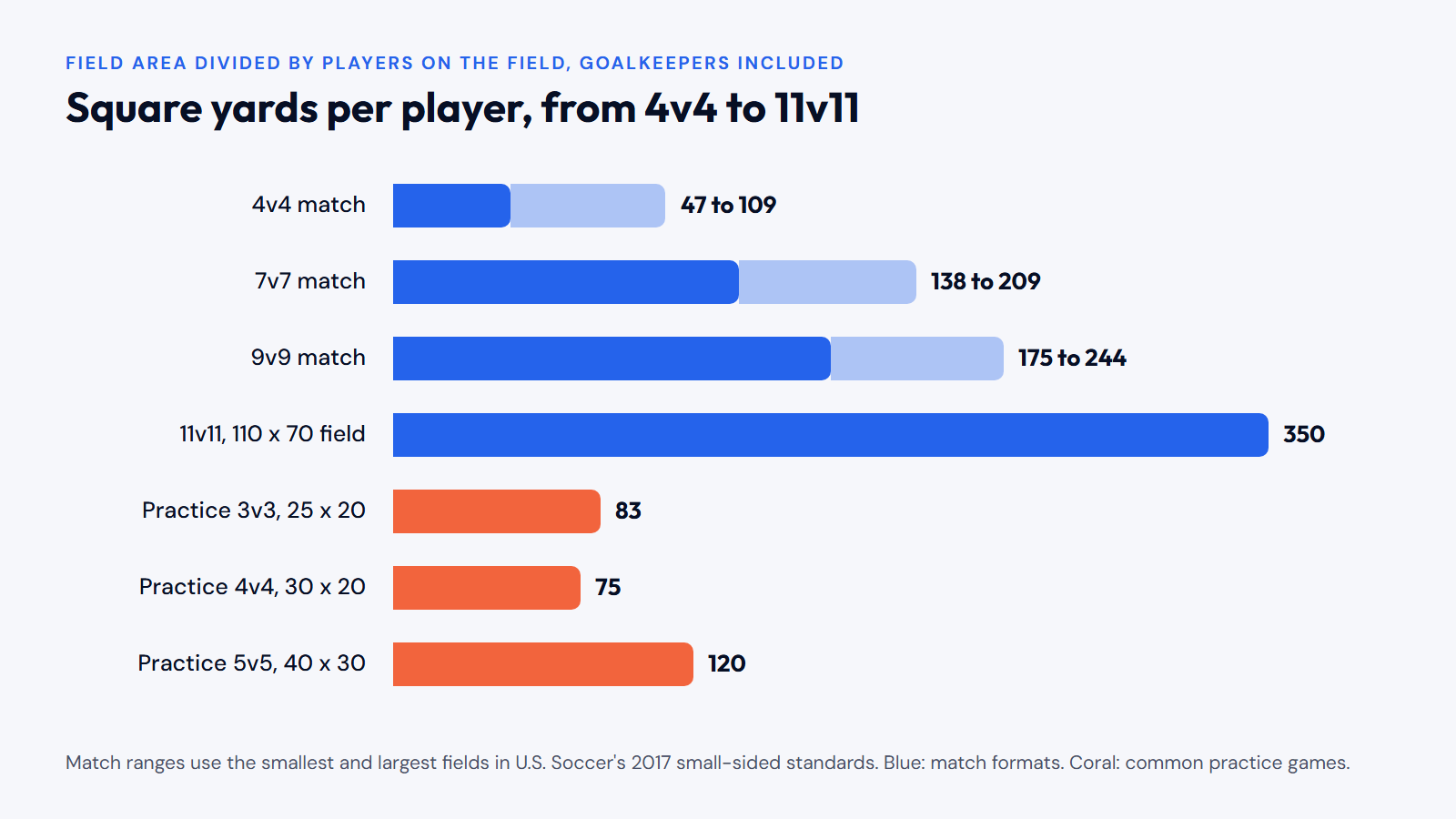
Two practical uses for the table:
Matching a practice game to match day. A 5v5 in a 40 x 30 area gives each player nearly as much room as the smallest standard 7v7 field. If your team struggles with time on the ball in 9v9, a practice game at 75 square yards each is much harder than a Saturday, which is the point.
Fixing a game that is not working. If players never get past the first defender, the space is too small or the numbers too big. If nobody presses and the ball goes long every time, the space is too big. Adjust the cones before you adjust the players.
Run a touch count at your own practice
The studies counted touches in academy players. You can count them in yours. It takes ten minutes and one helper.
Pick three players: one confident, one average, one quieter player who tends to drift.
During a line drill or a large scrimmage, have a parent or assistant count each player's touches for four minutes. Every contact with the ball counts.
Later in the same session, count the same three players for four minutes of a 3v3 or 4v4.
Write the six numbers on the session plan and compare.
The number that matters most is usually the quiet player's. In large games they can go four minutes with one or two touches; in a 3v3 they cannot hide. If the numbers do not move, the small game is too big, too static or too full of stoppages.
Small-sided games by age group
U.S. Soccer's age-group guides set the range for each band. The starting games are our suggestions within those ranges.
Age group | U.S. Soccer range | Good starting games |
|---|---|---|
U7 to U8 | 1v1, 1v2, 2v2, 3v3, 4v3, 4v4 | 1v1 to small goals; 3v3 with no goalkeepers; 4v3 to end zones |
U9 to U10 | 1v1 to 7v7, including unbalanced teams | 2v2 plus two neutral players; 4v4 to four small goals; 5v5 with goalkeepers |
U11 to U12 | 1v1 to 9v9, including unbalanced teams | 3v3 plus three neutrals for possession; 5v5 with a regain rule; 7v7 to goals |
U13 to U14 | 1v1 to 11v11, including unbalanced teams | 4v4 plus three neutrals; 6v6 with goalkeepers and wide zones; 8v8 to two goals |
Sources: U.S. Soccer guides for U9 to U10, U11 to U12 and U13 to U14.
Four games worth knowing
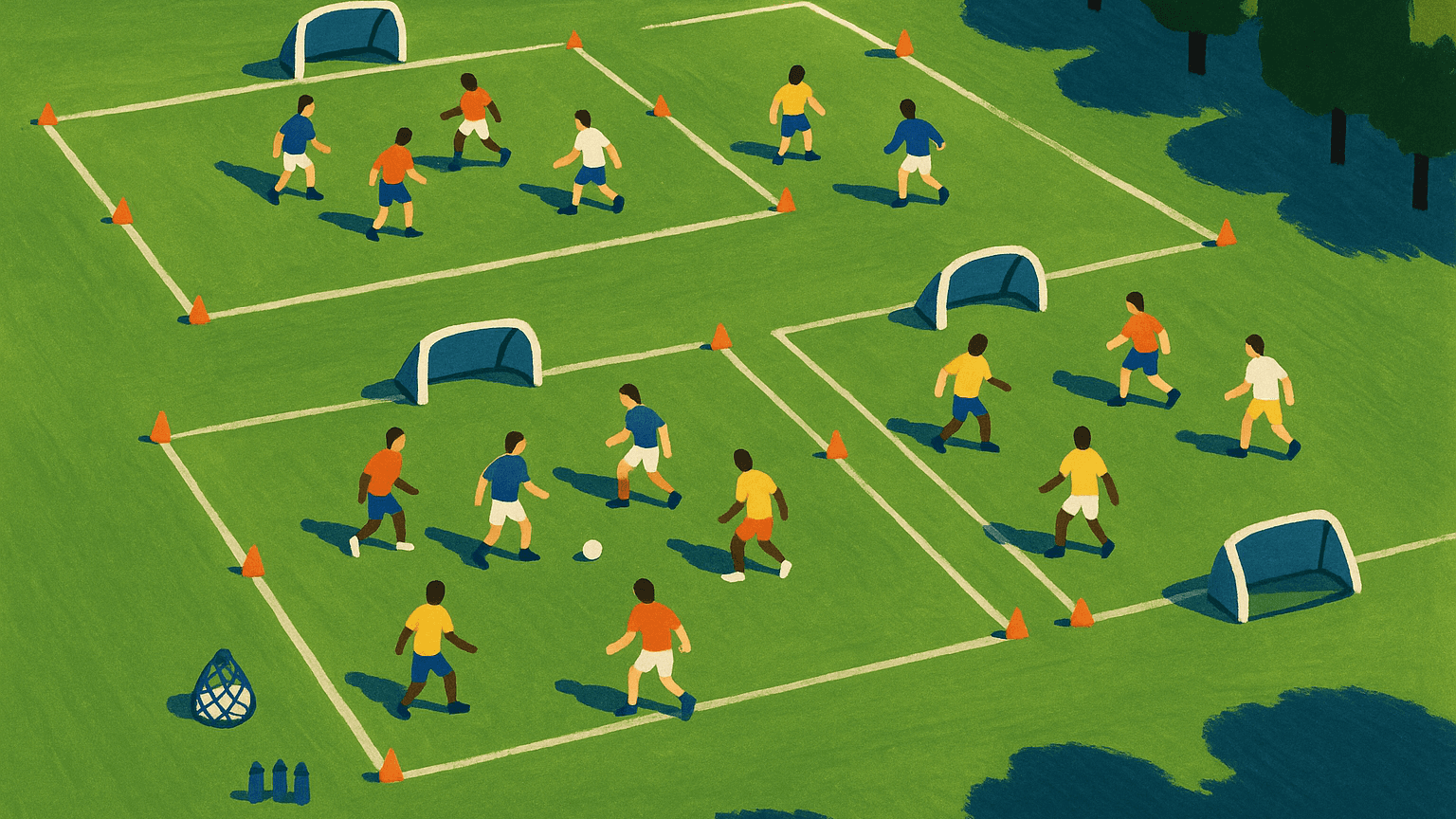
1v1 to small goals (U7 and up). 10 x 15 yards, one player attacks one goal, one defends. 45 seconds of work, then rest while the next pair goes. Short and intense, and nobody can hide.
4v4 to four goals (U8 to U12). Each team attacks two small goals and defends two. Players learn to switch the point of attack because one goal is always less defended.
3v3 plus three neutrals (U11 and up). The neutrals play for whoever has the ball, so the team in possession is 6v3. Score a point for a set number of passes. It is a possession game with constant transitions.
5v5 with a regain rule (U11 and up). Normal game with goalkeepers, but a goal scored within five seconds of winning the ball back counts double. It teaches the reaction after losing the ball without a lecture; our guide to coaching counter-pressing develops it into a full session.
Common mistakes
Too many players per game. Two games of 4v4 give each player far more of the ball than one game of 8v8. Bring enough cones and bibs for two fields.
Too long without rest. Small games are intense. Bouts of two to four minutes with a short rest keep quality high.
No goalkeeper plan. If you play 5v5 with goalkeepers, rotate the job so nobody spends the whole session in goal.
Forgetting the heading rules. Larger games produce more headers, as the 6v6 study found. For players aged 11 and 12, a below-head-height rule in practice games keeps you inside the weekly limit; see our guide to heading rules by age.
Where small-sided games fit in a session
A useful default for youth practice is to start with a game, teach inside a smaller game, and finish with a bigger game. Our guides to planning a youth soccer practice and 4v4 formations cover the structure and the match format. Free session plans for U6 to U14, in English and Spanish, are on our practice plans page.