Counter-pressing is what a team does in the first seconds after losing the ball: instead of running back, the nearest players attack the ball at once to win it back or stop the counterattack before it starts. It suits youth teams better than its reputation suggests, because it rewards effort, awareness and short sprints rather than size. It also goes wrong in predictable ways: the whole team chasing, nobody covering, and fouls.
This guide covers what the evidence says, when to introduce counter-pressing, the three jobs players need to learn, and a 75-minute session for U12 to U14 teams playing 9v9 or 11v11.
Why coaches are talking about it now
FIFA's Technical Study Group, in its post-tournament report on the 2026 World Cup, named counter-pressing "one of the competition's defining trends". It found that the top teams regularly turned a loss of possession into an immediate attacking opportunity, with champions Spain using their in-possession structure to regain the ball (FIFA, October 2, 2026).
The research on professional football points the same way:
An analysis of all 306 matches of the 2010/11 Bundesliga season found that the top teams won the ball back quickest after losing it, about one second faster than the rest of the league, whatever the score (Vogelbein, Nopp and Hokelmann, Journal of Sports Sciences, 2014).
A study combining interviews with seven professional coaches and tracking data from 153 Bundesliga matches concluded that regaining possession as fast as possible after a loss is the most important success factor in defensive transition (Forcher and colleagues, Journal of Sports Science and Medicine, 2023).
Across 13 LaLiga seasons and 4,940 matches, champions started their attacks from more advanced positions on the field than every other group of teams (Gonzalez-Rodenas and colleagues, PLOS ONE, 2023).
None of these studies looked at youth players, and none proves that counter-pressing alone wins matches. What they show is that winning the ball back quickly and high up the field is part of how good teams play. For a youth coach, that is a reason to teach the habit, not a reason to copy a professional system.
When to start teaching it
U.S. Soccer's age-group guides put transition into the curriculum early. At U9 to U10 players should learn their role "in attack, defense, and transition". At U11 to U12 the guide adds 2v1 overloads in attack and defense, and at U13 to U14 it talks about skills "under high pressure" (U.S. Soccer U9 to U10 guide, U11 to U12 guide, U13 to U14 guide).
A sensible progression:
U9 to U10 (7v7): the reaction, not the system. When you lose the ball, the nearest player tries to win it back straight away. Reward it in small games.
U11 to U12 (9v9): the three jobs below, in groups of three, with a regain window counted by the coach.
U13 and up (11v11): counter-pressing as a team decision: when to press, when to drop, and who stays back.
The three jobs after the ball is lost
Counter-pressing fails when everyone does the same thing. Teach three jobs and let players work out who does which.
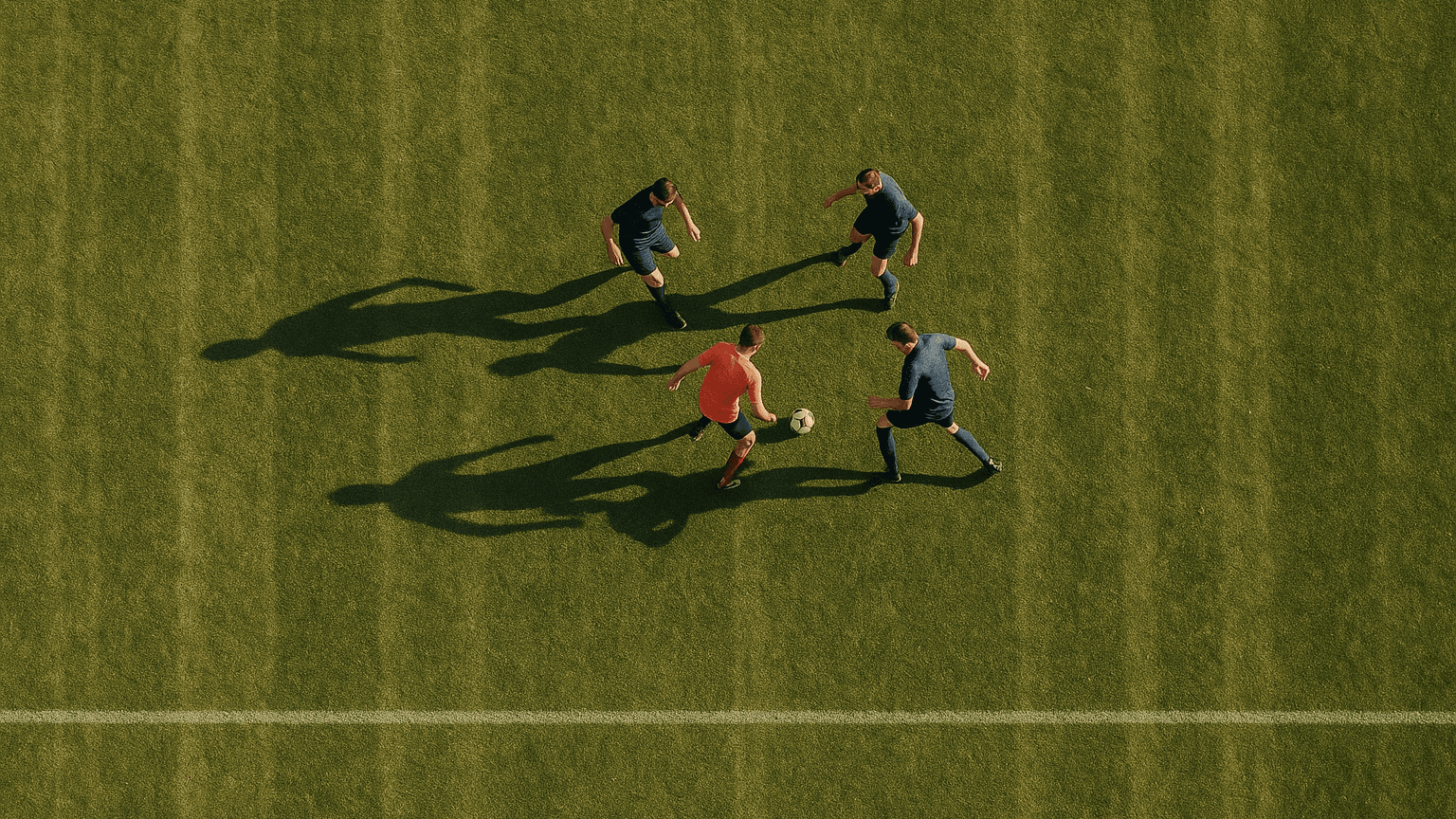
Press the ball. The nearest player sprints at the ball carrier on a curved run that cuts off the easiest forward pass, then slows down in the last two yards so they do not lunge into a tackle. The aim is to force a backward pass, a sideways touch or a mistake. A tackle is a bonus, not the target.
Shut the lanes. The next two players close the passes the ball carrier would most like to make: the one forward and the one into the middle. They are not chasing the ball. They are standing where the next pass would go.
Stay as the safety net. Everyone else holds their position or recovers a few steps, and the deepest players do not join in. This group is often called rest defence: the players who, while their team has the ball, are already positioned to stop a counterattack. Forcher's study describes it as the positioning of the deepest defenders during possession to prevent an opposing counterattack after a loss.
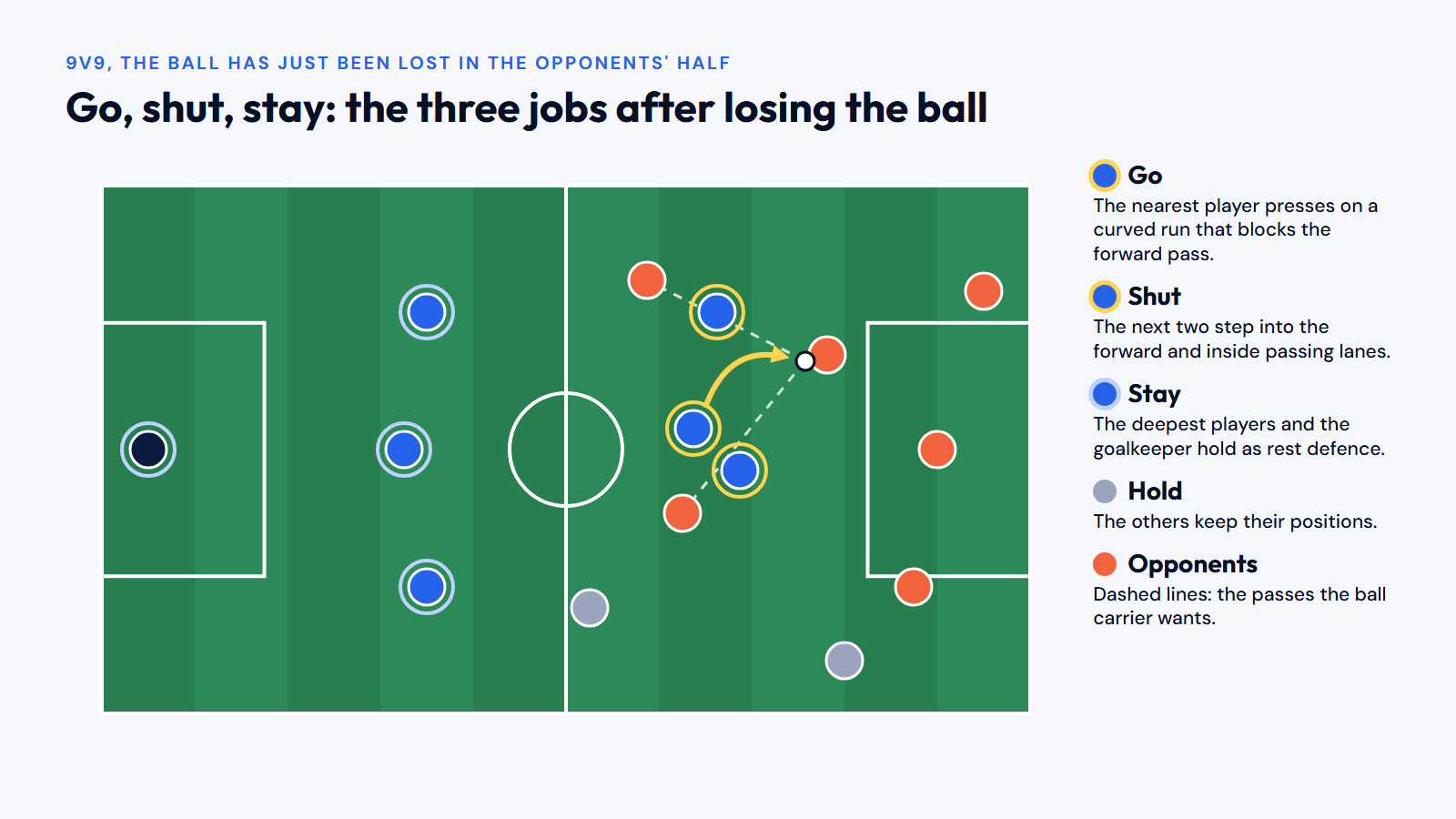
A cue players can shout: "Go, shut, stay." The first player to react says "go" and presses. The next two shut. Everyone else stays.
When to counter-press and when to drop
A counter-press is a short bet. If it is not working after a few seconds, the team has to recover into its defensive shape. Teach players to read the moment rather than to press every time:
Press now when | Drop and recover when |
|---|---|
The ball carrier has a poor first touch or has the ball under their feet | The ball carrier is facing forward with space in front of them |
The ball carrier has their back to your goal | The ball carrier has two or more passing options forward |
Your team has two or three players within a few yards | You are outnumbered around the ball |
The ball is near a touchline, which takes away one side of the field as an escape route | Your deepest players are already level with the ball |
Professional teams are often described as using a fixed window, and the "six-second rule" is one coaches quote a lot. Treat any number as a coaching tool, not a law. In the session below the coach counts five seconds out loud, because a count gives young players a clear signal to switch from pressing to recovering.
A 75-minute counter-pressing session for U12 to U14
Designed for 12 to 16 players with two goalkeepers. Field sizes are for 9v9 age groups; add a few yards for 11v11 teams. Fewer players with more space each raises exercise intensity, and consistent coach encouragement raises it further, according to a systematic review of small-sided games (Hill-Haas and colleagues, Sports Medicine, 2011), so keep the work in short bouts with real rest.
Rondo with a counter-press (12 minutes). 5v2 in a 12 x 12 yard square. When a defender wins the ball, the player who lost it and the passer next to them have five seconds to win it back before the new team in possession completes a pass to a coach outside the square. Rotate defenders every 90 seconds.
Possession game with a regain point (15 minutes). 4v4 plus three neutral players in a 30 x 25 yard area. The team with the ball keeps it with the neutrals. Six passes scores a point; winning the ball back within five seconds of losing it also scores a point. Four bouts of 3 minutes, 1 minute rest.
Directional game, goals count double (20 minutes). 6v6 plus goalkeepers on a 50 x 35 yard field with the goals your age group plays on, or 7v7 goals. A goal scored within five seconds of a regain counts double. Coach "go, shut, stay" during play and freeze it once or twice per bout to show the three jobs. Four bouts of 4 minutes, 1 minute rest.
Add rest defence (13 minutes). Same game, but each team must keep two outfield players in its own half while it attacks. If a team concedes on the counterattack while it has fewer than two players back, that goal counts double. Three bouts of 4 minutes.
Free game (15 minutes). 9v9 or the largest game your numbers allow, no special rules. Count regains within five seconds for each team on a clipboard and share the numbers at the end.
The scoring rules do the coaching. Players will press when pressing scores points, and they will leave defenders back when an empty back line costs a goal.
What to look for, and what to correct
The first reaction. Does anyone move toward the ball within a second of losing it? If not, use the rondo more often before adding the bigger games.
The run. Players should arrive in a line that blocks the forward pass, not straight from behind. Straight runs push the ball carrier forward.
The last two yards. Slow down, stay on your feet. A counter-press that ends in a foul gives the opponent a free kick and the time you were trying to take away.
The cover. If three players press the ball and nobody shuts a lane, the ball carrier only needs one pass to escape. Freeze play and show where the lanes were.
The switch. When the coach reaches "five", every player recovers at full speed. A failed counter-press followed by a slow walk back is the worst outcome.
Common mistakes with youth teams
Teaching it as "everyone chase". Young players already chase the ball. Counter-pressing is organized chasing, with jobs.
Starting the system too young. At U9 and U10, reward the individual reaction in small games and leave team rules for later.
Forgetting the safety net. A team that commits seven players to every press concedes on the counter. The rest-defence rule in step 4 exists for this reason.
Making it a fitness drill. Sprinting for five seconds then recovering is demanding. Keep bouts short, rest properly and stop the activity when quality drops.
Where it fits in a season
Counter-pressing works best as a theme for two or three weeks, then as a scoring rule you bring back into small-sided games every few sessions. Pair it with possession work, because a team that keeps the ball in tight spaces has players close together when it loses the ball, which makes the counter-press possible.
If you coach a U12 team, our U12 soccer drills include a counter-press game you can use as a progression, and the 9v9 formations guide shows the common 9v9 shapes. Free session plans from U6 to U14, in English and Spanish, are on our practice plans page.