Bilingual Soccer Coaching: How to Coach Youth Soccer in Two Languages
Mixed-language teams are the norm in much of the US. This guide makes bilingual soccer coaching practical: where language actually matters, the field techniques that work for two-language teams, and how serving bilingual parents differs from coaching bilingual players.

On this page
Walk onto almost any youth field in Miami, Los Angeles, Houston, or a hundred other places, and you will hear two languages on the sideline. Bilingual soccer coaching is no longer a niche skill, it is the everyday reality of coaching in much of the United States. The good news is that soccer is already a shared language, and a few practical habits go a long way. This guide covers where language matters, the techniques that work on the field, and how serving bilingual parents differs from coaching bilingual players. None of it requires you to be fluent in two languages, only to be intentional about a few simple habits.
Key Takeaways
- Mixed-language teams are the norm in much of the US, so bilingual soccer coaching is a core skill, not an extra.
- Soccer is a shared language, but instructions, feedback, and safety still depend on words.
- Teach a handful of key terms in both languages and lead with demonstration over explanation.
- Coaching the player and communicating with the parent are two different jobs with different needs.
- The right tools make Spanish content effortless instead of an afterthought.
The Mixed-Language Team Is the Normal Team Now
The numbers make the case better than any anecdote. According to the US Census Bureau's 2024 American Community Survey, about 44.9 million people aged five and over speak Spanish at home in the United States, roughly one in seven residents. In a market like Miami-Dade, where the Census Bureau puts the Hispanic share of the population near 69%, a Spanish-speaking family is not the exception, it is the team.
Interest is there too. The Aspen Institute's Project Play reported that 65% of Latino youth tried a sport in 2024, a higher rate than their white and Black peers. The families want their kids playing. The question for a coach is whether your sideline meets them halfway. Most do not, and usually not out of indifference but because no one ever showed them how. The techniques are simple and the payoff is large. Families who feel understood stay, volunteer, and bring their friends, while families who feel shut out quietly drift away to a program that speaks their language.
Bilingual soccer coaching is simply the skill of making sure every player and parent can understand you, regardless of which language they are most comfortable in. It is not about being fluent in both. It is about a handful of intentional habits. Our complete guide to coaching youth soccer covers the fundamentals, and our guide to running a bilingual youth soccer club zooms out to the club level.
Where Language Matters and Where It Doesn't
Here is the part that makes this manageable: a huge amount of coaching at the youngest ages does not depend on language at all.
A demonstration crosses every language. When you show a move, set up a game, or model a pass, the kids understand instantly. The ball itself, the cones, the goals, and the act of playing are universal. For a five or six year old, you could run a whole session with almost no words and they would learn plenty.
Language starts to matter in three specific places: detailed instructions, individual feedback, and anything involving safety. Telling a player exactly how to adjust their body shape, giving a kid encouragement that actually lands, or making sure every player understands a safety instruction in the heat and the noise: those need real words in the right language. So put your language effort where it counts, on instructions, feedback, and safety, and let demonstration carry the rest.
Safety deserves a special mention. In an emergency, on a brutally hot day, or when a player is hurt or frightened, there is no room for a misunderstanding. Make sure your most important safety instructions, and any conversation with a Spanish-speaking parent about an injury, happen in a language the family fully understands. This is the one area where almost-understood is not good enough, and it is worth finding a fluent speaker to be certain.
Practical Techniques on the Field
You do not need to be bilingual to coach a bilingual team well. These techniques work whether you speak one language or two.
Demonstrate first, explain second. Show the activity, then add a few words. This is good coaching for any group, and it is essential when not everyone shares your language.
Learn the key terms in both languages. You only need a dozen or so: pass, shoot, dribble, spread out, man on, good job, water break. Pasa, tira, regatea, abran, te marcan, buen trabajo, agua. A coach who uses even a few Spanish terms signals respect and gets understood.
Use visual cues. Colored cones, numbered bibs, and hand signals carry meaning without words. A consistent visual system lets every player follow along regardless of language.
Use buddy translation. Pair a bilingual player with a teammate who needs a quick translation. Kids do this naturally and it builds team bonds, just do not lean on one child as a full-time interpreter.
Watch your machine translation. A translation app can help you prep, but be careful relying on it for anything important. Research published in JAMA Internal Medicine found that while Google Translate was about 92% accurate for Spanish, a meaningful share of translations still carried potential for harmful errors on high-stakes messages. For a quick cone-drill instruction, fine. For a safety or medical message, get a real bilingual speaker to check it.
Free resourceParent communication templatesEight templates, English and SpanishCoaching the Player vs. Communicating With the Parent
One distinction trips up a lot of coaches: the player and the parent often have different language needs, and serving one does not serve the other.
Many bilingual kids, especially school-age players, are comfortable in English or pick it up fast. You can often coach them in English with a few Spanish terms sprinkled in. Their parents are a different story. A Spanish-dominant parent needs the important things, registration, schedules, costs, safety, and any serious conversation about their child, in Spanish. Getting the player to understand a drill is not the same as getting the family to understand the season.
This is why the field and the inbox are two separate jobs. On the field, demonstration and a few key terms go a long way with the players. Off the field, parent communication has to actually reach Spanish-speaking families in their language, or you lose them long before any coaching matters. Our guide on running a bilingual youth soccer club digs into the parent side in detail.
Building a Bilingual Team Culture
The goal is not just to be understood. It is to make every family feel the team is theirs. A few habits build that culture over a season.
Make the welcome bilingual from the first contact. If your first email, your first team meeting, and your roster sheet all arrive in both languages, Spanish-speaking families know immediately that they belong here. That first impression sets the tone for everything that follows.
Recruit a bilingual assistant or team parent. You do not have to carry both languages alone. One bilingual volunteer who can translate a message, settle a confused parent, or relay a coaching point during a game is worth more than any app. Lean on the community you already have, because it is almost always there.
Celebrate the two-language identity instead of treating it as a problem to manage. Teams that embrace both languages often build a tighter culture than monolingual ones, because every kid sees their home language valued on the field. The mix becomes a strength, not a hurdle. Families want their kids playing, and the club that meets them in their language is the one they stay with for years. That loyalty, earned by meeting families where they are, is worth more than any single season's results.
Common Mistakes in Bilingual Coaching
A few well-meaning habits actually get in the way. Knowing them helps.
Relying on one child as a full-time interpreter. Buddy translation is great in short bursts, but turning one bilingual kid into your permanent translator robs them of their own playing and learning time. Spread it around, and lean on adults for anything important.
Trusting a translation app with high-stakes messages. An app is fine for a quick drill instruction. For a safety notice, a medical question, or a serious conversation with a parent, get a fluent human to check it, because a small error in those moments is a big problem.
Treating Spanish as a translation of English rather than its own language. Families notice the difference between a club that speaks Spanish and a club that runs English through software. Real, natural Spanish signals respect. A clumsy machine translation signals the opposite.
Assuming the kids and the parents have the same needs. A player comfortable in English does not mean their parents are. Serve each on their own terms.
Going silent because you are not fluent. The worst response to a language gap is to coach less. A coach who demonstrates, points, uses a few words of Spanish, and keeps everyone involved reaches a mixed-language team far better than one who pulls back out of fear of getting it wrong. Effort counts for more than fluency here.
Drill Content That Already Speaks Both
The hardest part of bilingual coaching is usually not the field, it is the prep. Building or finding session content in two languages, by hand, is a real burden on a volunteer coach.
That is where Centro removes the friction. The AI Game Plan delivers every drill and session in English and Spanish natively, the same content, no separate translation step and no add-on. You can hand a Spanish-speaking assistant coach the exact same session in their language, and message the whole team in both. Because Centro is bilingual across the entire platform, the Spanish is built in, not bolted on. See how it works on the AI Game Plan and bilingual pages.
Centro gives every drill, session, and message in English and Spanish, the same product, no add-on, so coaching a two-language team stops being extra work. See how the bilingual side works.
Keep reading
More on running a better club.
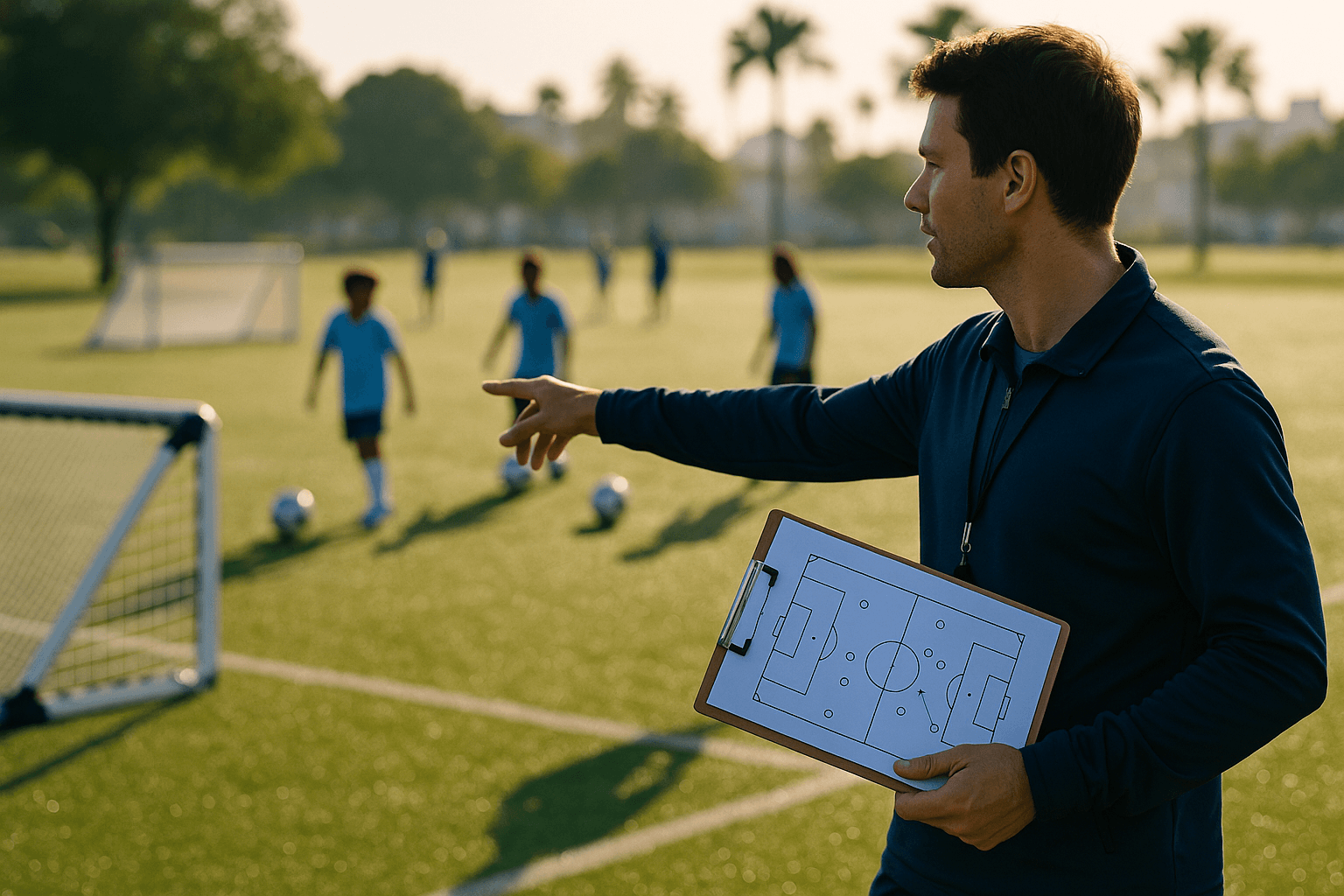
How to Coach Youth Soccer: The Complete Guide for 2026
Coaching youth soccer in 2026 means navigating new U.S. Soccer frameworks, state compliance changes, and player retention challenges that didn't exist a decade ago. This hub guide surveys the entire landscape and points you to deeper resources for each piece of the picture.
How to Build a Club Soccer Curriculum That Every Coach Follows
A club soccer curriculum is what makes a club bigger than any one coach. This guide shows directors how to map a curriculum to age and game format, roll it out to volunteer coaches without an academy budget, and measure whether it works.

Fun Soccer Drills for Kids Under 8: A Volunteer Coach's Playbook
At this age, games are the curriculum. This playbook gives a volunteer coach ten fun soccer drills for kids under 8 that teach without feeling like practice, the one rule that keeps every kid moving, and a 45-minute beginner session.