Soccer Tactics Board: How Youth Coaches Use One (Free Tools Included)
A soccer tactics board makes shape and movement visible to young players in seconds. This guide covers how youth coaches actually use one, the genuinely free tools (and which apps only look free), and how to teach formations and set pieces without over-coaching.
On this page
A good soccer tactics board turns an idea in your head into a picture your players understand in seconds. Instead of explaining where the left back should stand for the third time, you show them. Used well, a tactics board is one of the simplest coaching tools there is. Used badly, it becomes a lecture that kills the very play it is meant to improve. This guide covers how youth coaches actually use a board, the genuinely free tools available, and where to draw the line so you help instead of over-coach.
Key Takeaways
- A soccer tactics board makes the invisible visible, showing young players shape and movement they cannot picture from words.
- Keep it short and age-appropriate, because a board is a quick visual, not a classroom.
- Genuinely free tools exist, alongside freemium apps and paid options, so you do not have to spend money to start.
- A board shines for teaching formation shape and set pieces.
- The board helps when it gets players onto the field faster and hurts when it eats their playing time.
What a Tactics Board Is For (at Youth Level)
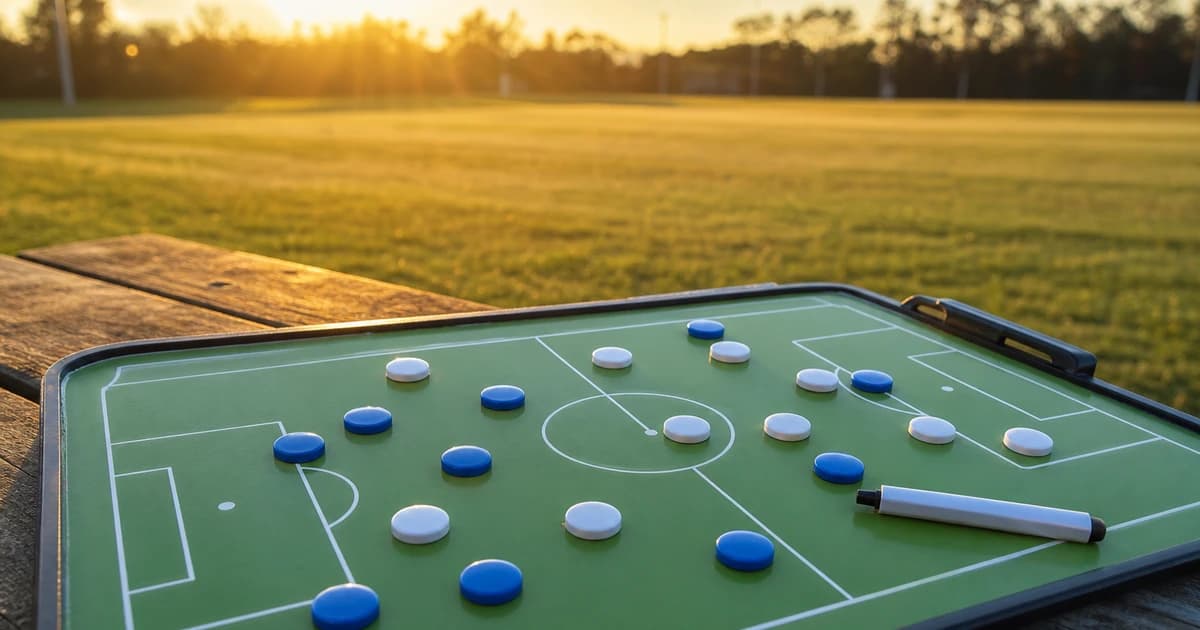
A tactics board is usually a magnetic dry-erase board printed with a field. You move discs or numbered markers to represent players and draw runs and passing lanes with a marker. The point is to make an abstract instruction concrete.
At the youth level, the realistic uses are simple. You walk through formation shape so each player can see where their position lives. You map out a set piece like a corner or a throw-in. You make a quick halftime adjustment, or set the picture before a game. That is mostly it, and that is enough.
The value is in translation. A young player often cannot picture an instruction like "stay wide" or "drop into the space" from words alone. On a board, you move their marker and they see it in an instant. Most kids are visual learners, so one quick diagram replaces a paragraph of explanation that would have lost them halfway through.
What a board is not, at this age, is a place to script every movement of a match. Young players learn the game by playing it, not by memorizing diagrams. US Soccer's grassroots approach is built around letting players solve problems and develop their own solutions, with the coach guiding using minimal talk. A tactics board should serve that, clarifying one idea quickly and then getting out of the way. For the shapes you will actually teach, our complete guide to coaching youth soccer and the formation guides below are the place to start.
Free and Low-Cost Options
You do not need an expensive tool to use a tactics board. Here is an honest breakdown, because "free" gets used loosely and the differences matter.
Genuinely free, no account. Several web-based boards run in your browser with nothing to install and no signup. RenderFoot advertises a tactical board that is free with no sign-up and no hidden fees. Tactico offers a free, browser-based board with no account needed. These are the simplest way to draw a quick shape on your phone or laptop.
Freemium apps. Some mobile apps are free to use with paid upgrades. Coach Tactic Board for soccer is free for most features on iOS and Android, with an optional paid Coach Pro tier for advanced tools. TACTICALista offers a free starter plan with paid tiers above it. Free to start, pay only if you want the extras.
Paid with a free demo. Be careful with one popular name: TacticalPad is a paid product, with only a limited free demo, not a free app. It is a fine tool, just do not expect the full version for nothing.
Old-fashioned and cheap. A physical magnetic dry-erase board with player markers usually runs in the low tens of dollars and never needs a battery. Free printable formation sheets are also widely available to sketch on. For most youth coaches, a free web board or a cheap physical one covers everything you need.
One honest caveat on the free apps: the line between free and paid moves over time, and an app that is free today may add a paywall tomorrow. Before you build a habit around any tool, check its current terms. The browser-based boards and a cheap physical board are the safest bets precisely because there is nothing to upsell you on later.
Free resourceFree soccer practice plan templatesBy age group, U6 through U14Teaching a Formation Without Losing the Room
A board is great for introducing shape, but young attention spans are short, so the rule is one idea, shown then played.
The most effective method barely uses the board at all. Draw the shape once, then take it to the field. Place a cone at each position and physically walk players from goalkeeper to forward so they feel where their spot is. Then run shadow play, where the team moves together with no opponents, passing position to position, for a short block before you add any complexity.
Keep your coaching points to one per session. A child retains far more by doing than by listening, and a long talk in front of a diagram loses them fast. Show the picture, answer one question, and get them moving. Our guides to 7v7 soccer formations and 9v9 soccer formations give you simple, development-first shapes that are easy to teach this way, and the 11v11 formations guide covers the full game for older teams.
Repetition on the field matters more than precision on the board. A formation a team has walked and shadow-played a dozen times is one they own. A formation you explained beautifully once on a board but never rehearsed is one they will abandon the moment a game gets chaotic. The board starts the lesson. The field finishes it.
Designing Set Pieces on a Board
Set pieces are where a board earns its keep, because the routine is genuinely easier to show than to describe. The key at youth level is to keep it tiny.
One setup with two or three options is plenty. For a throw-in, the simplest reliable play is a short throw to a marked teammate who immediately returns it to the now-unmarked thrower. For a corner, pick one target area and one backup option, draw it once, and rehearse it briefly. Do not build a ten-page set-piece binder for a U11 team.
Be realistic about time, too. With one or two sessions a week, you have maybe five to ten minutes for set pieces, and at the youngest ages they should not be a priority at all. Ball mastery and enjoyment come first, with set pieces growing in importance as players get older. The board lets you cover a routine in two minutes instead of ten, which is exactly the point.
A quick word on what to draw. For a corner, mark one or two target runs and a short option for when the box is crowded. For a throw-in near your own goal, the safe play is almost always a simple give-and-go back to the thrower. For kickoffs, the only thing young teams really need is to keep the ball, not to launch it. Keep every routine to one picture a child can hold in their head, then rehearse it until it is automatic rather than memorized.
The Line Between Useful and Over-Coaching
A tactics board is a tool, and like any tool it can be used well or badly. The line is simple: the board should get players onto the field faster and clearer, never keep them off it longer.
It helps when it shows one concept in seconds, clarifies a shape a player could not picture from words, or sets a restart everyone then rehearses by playing. It hurts when it eats minutes the kids should spend touching the ball, scripts every movement so players stop thinking for themselves, or turns a practice into a lecture.
The research is firmly on the side of playing. US Soccer's grassroots model is built to minimize over-coaching, with the coach guiding through questions and letting players find their own solutions. The Aspen Institute's Project Play stresses giving kids real playing time and finds that development-minded coaching keeps more of them in the game. A board that replaces play works against both.
Here is a useful test: if you have been talking at the board for more than a minute or two, you have probably crossed the line. Draw it, show it, then play it. The game is still the best teacher you have. A board is there to make that teacher's job faster, not to replace it. Use it for thirty seconds of clarity, then give the field back to the players, where the real learning happens.
Tactics Boards Inside a Session Builder
A standalone board is useful, but it is one more thing to keep track of. The bigger time-saver is having the board live inside the tool that also plans your session.
That is how Centro's AI Game Plan works. It includes a tactical board with over 160 formations across all 7 game formats, so you can show a shape and then build the drills and the full session to coach it, all in one place. You are not jumping between a free board app, a drill website, and a notes file. The formation, the session, and the coaching points come together, in English or Spanish. Explore the AI Game Plan to see how it fits together.
Centro's Game Plan gives you over 160 formations on a tactical board, plus the drills and session to coach them. See how AI Game Plan builds a session.
Keep reading
More on running a better club.
The Complete Guide to Coaching U8 Soccer (For First-Time Coaches)
Coaching U8 soccer for the first time is simpler than you think. This guide covers what 7 and 8 year olds are ready for, the 4v4 rules, a repeatable session structure, three go-to games (with a link to ten more), and the mistakes new coaches make.
4v4 Soccer Formations: A Complete Guide for U6 and U8 Coaches
The right 4v4 soccer formations make U6 and U8 games feel like soccer, not beehive chaos. We cover the 1-2-1 diamond, 2-2 box, and 2-1-1 shapes, when to pick each, and what coaches should not do at this age.
AI Youth Soccer Coaching in 2026: Tools, Limits, and What Comes Next
AI youth soccer coaching is changing how clubs plan practice, analyze games, and communicate with parents. We tour the tools coaches actually use in 2026, the limits of single-purpose apps, and how an integrated club platform changes the math.