Every youth soccer league has the same three referee jobs: work out how many officials each match day needs, set and budget the fees, and look after referees well enough that they come back next season. Most problems with referees, from empty fields at kickoff to a 15-year-old quitting after one bad Saturday, start with one of those jobs being left to chance.
This guide covers each job with real numbers: the certification rules for new referees in 2026, a published 2026 fee schedule, a worked season budget for an eight-team division and the decisions a league should make before the first whistle.
Step 1: count the officials you need
Referees are booked by kickoff, not by game. The number that matters is how many games kick off at the same time, multiplied by the officials each game uses.
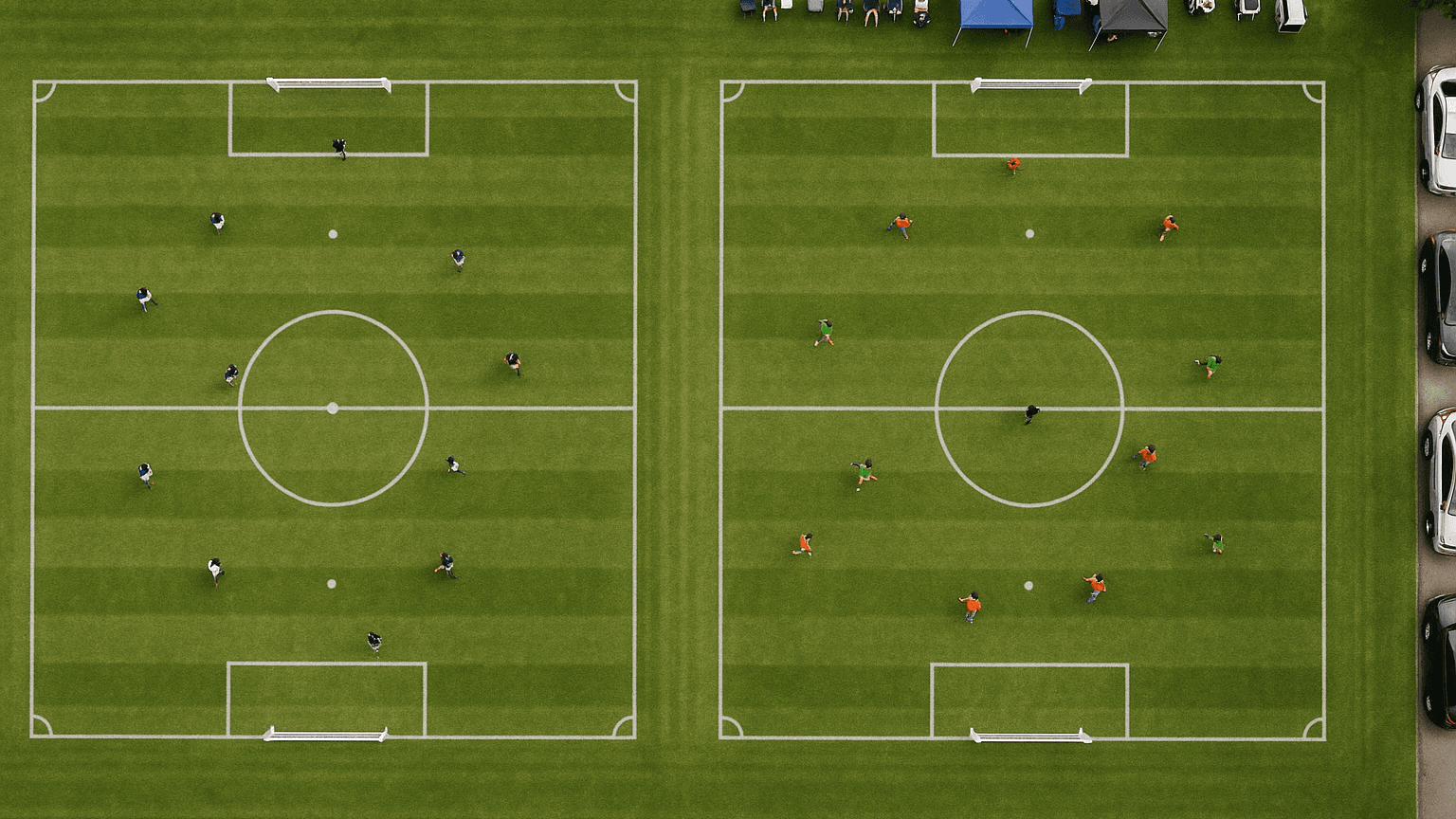
Take an eight-team U-12 division playing on two fields with kickoffs at 9:00 and 10:30, as in our worked round-robin schedule. That is two games at each kickoff. With a referee and two assistant referees per game:
Officials on site: 2 games × 3 officials = 6, if each official works both kickoffs.
Assignments per Saturday: 4 games × 3 officials = 12.
Assignments per season: 28 games × 3 officials = 84.
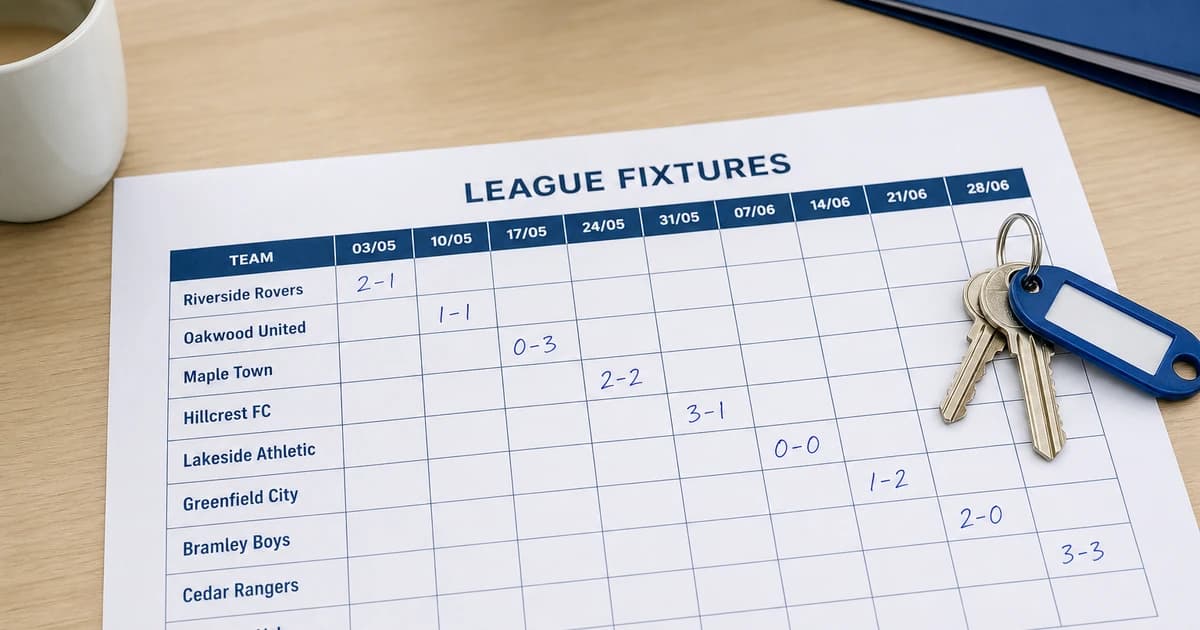
Then add the rest of the league. Every division that plays at the same complex at the same time competes for the same people. Give your assignor the full fixture list with fields, kickoff times and blackout dates as early as you can, and agree a deadline after which schedule changes need the assignor's sign-off.
Decide also what happens when there are not enough officials: which age groups play with one referee and club linesmen, and which games are moved. Writing that down in advance avoids arguments on the day.
Step 2: know what certification requires in 2026
U.S. Soccer-certified referees register each year through the U.S. Soccer Learning Center, with courses run by state referee associations. The 2026 requirements published by one state association, the California North Referee Association, follow the U.S. Soccer standard:
Minimum age: 13 for a first-time referee license.
Training: online modules in the Learning Center, an online Laws of the Game update and an in-person field session.
Safety and compliance: Safe and Healthy Playing Environments training for every new referee, plus a background check and SafeSport training for officials 18 and older.
Renewal: the license is renewed every registration year.
Course fees and dates are set by each state association, so check yours. Two things follow for a league. First, many of your referees will be teenagers, which changes how you pay them, how you protect them and who is responsible for them at the field. Second, recruiting new referees is a calendar job: a new referee needs a course with an in-person field session before their first game, so point interested players and parents to your state association's course listings months before you need them.
Step 3: set the fees and budget them
Fees vary by state, league and age group, so use your own association's schedule. For a sense of the numbers, here is a published one: the Cal South InterCity referee fees for fall 2026.
Age group | Game length | 3 referees | 2 referees | 1 referee |
|---|---|---|---|---|
U-12, 9v9 | 60 minutes | $136 | $100 | $78 |
U-14, 11v11 | 70 minutes | $158 | $116 | $88 |
U-16, 11v11 | 80 minutes | $180 | $140 | $110 |
The same sheet sets the three-official rate at $2.25 per minute of game time, says payment is prorated when fewer officials work a game, and says both teams split the fee, paid in cash before kickoff. It also says assistant referees not in proper uniform are treated as club linesmen and are not paid, and that coaches pay no assigning fees.
Now put a schedule like that into a season budget. For the eight-team U-12 division above, at the three-official rate:
Line | Calculation | Amount |
|---|---|---|
Division, whole season | 28 games × $136 | $3,808 |
Each team, whole season | 7 games × $68 (half of each game) | $476 |
Each player, 12-player roster | $476 ÷ 12 | $39.67 |
Two lessons come out of this table. Referee fees are a real share of what a family pays, so they belong in the registration fee calculation, not in a surprise collection at the field. And the cost scales with games, not teams: a double round robin doubles it, and every make-up game adds to it. Our budget calculator has a line for it.
Step 4: decide how referees get paid
There are two common models, and each has trade-offs.
Cash at the field. Each team brings its share and pays the officials before kickoff, as in the InterCity schedule. Referees are paid the same day and the league handles no money. The costs: a team manager has to carry cash every week, there is no central record, and disagreements about who paid happen at the field, in front of a young referee.
Paid centrally by the league. The league collects referee fees inside the registration fee and pays officials or the assignor on a schedule. Teams never handle cash and the league has a record of every payment. The costs: the league needs a treasurer process, it carries the money between registration and payment, and it takes on the paperwork.
If you pay centrally, talk to your accountant about how your league classifies referees and what you need to report. For example, the IRS instructions for Forms 1099-MISC and 1099-NEC set a $2,000 reporting threshold for nonemployee compensation for tax years beginning after 2025, so a referee who works many games for one league in 2026 could cross it. Collect the information you need at the start of the season, not in January.
Whichever model you choose, publish it in your league rules, along with:
what a referee is paid if a game is cancelled after they arrive, for example for weather;
what happens if an assigned referee does not show up, and who finds a replacement;
whether a club linesman or volunteer referee is paid, and how much;
who pays when a game goes to extra time in a tournament.
Step 5: keep the referees you have
Officiating numbers have recovered since the pandemic, and how officials are treated was one of the reasons given for the earlier losses. The National Federation of State High School Associations estimated in 2022 that about 50,000 high school officials across all sports had stopped officiating since 2018-19, and named unsportsmanlike behavior by players, coaches, parents and fans as a contributing factor. Its 2025 survey of 36 state associations counted 237,811 officials' registrations in 2024-25, above the 220,340 of 2018-19, with soccer 13% above its pre-pandemic level. Those are high school figures, not youth club figures, but the pattern matters for youth leagues too.
What a league can do:
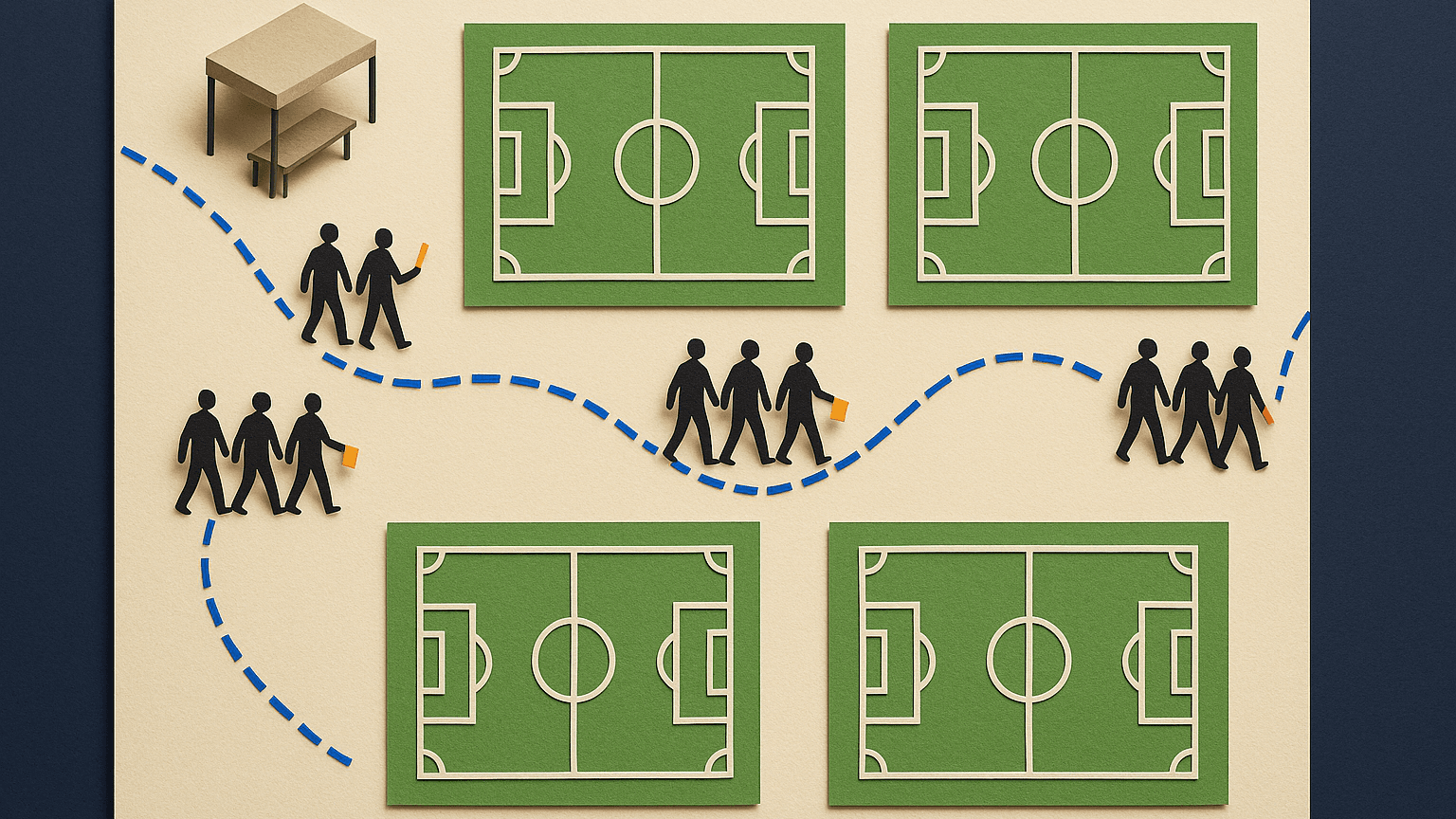
Make one person responsible for referees on match day, at every site, who checks in on young officials at halftime and walks with them to their car after a difficult game.
Separate feedback from the field. Coaches send concerns about a referee in writing to the league or assignor within a set time, never at the field. Referees get the same route for reporting abuse.
Adopt a captain-only rule now. The IFAB's Circular 32 makes the protocol in which only the captain may approach the referee compulsory for all competitions from July 1, 2027. Youth leagues can introduce the habit before then.
Put parents on the opposite touchline from the benches, where your fields allow it, and publish a sideline code that families accept at registration.
Pair new referees with experienced ones for their first games, and give new referees easier games first.
Pay on time, every time. It is the simplest way to show referees the league takes them seriously.
Where Centro fits
Centro does not assign or pay referees; that stays with your assignor and your treasurer. What it can do is make the assignor's job easier upstream. Leagues that run their season in Centro build the fixture list in the league tools, from divisions, match nights and fields, so the assignor works from one schedule. When a league match is cancelled, postponed or rescheduled, Centro emails the teams and families automatically. Telling the referees remains the assignor's job.
If you are still building the season's fixtures, our free generator produces a round robin with every game on a field and a time, ready to send to your assignor.