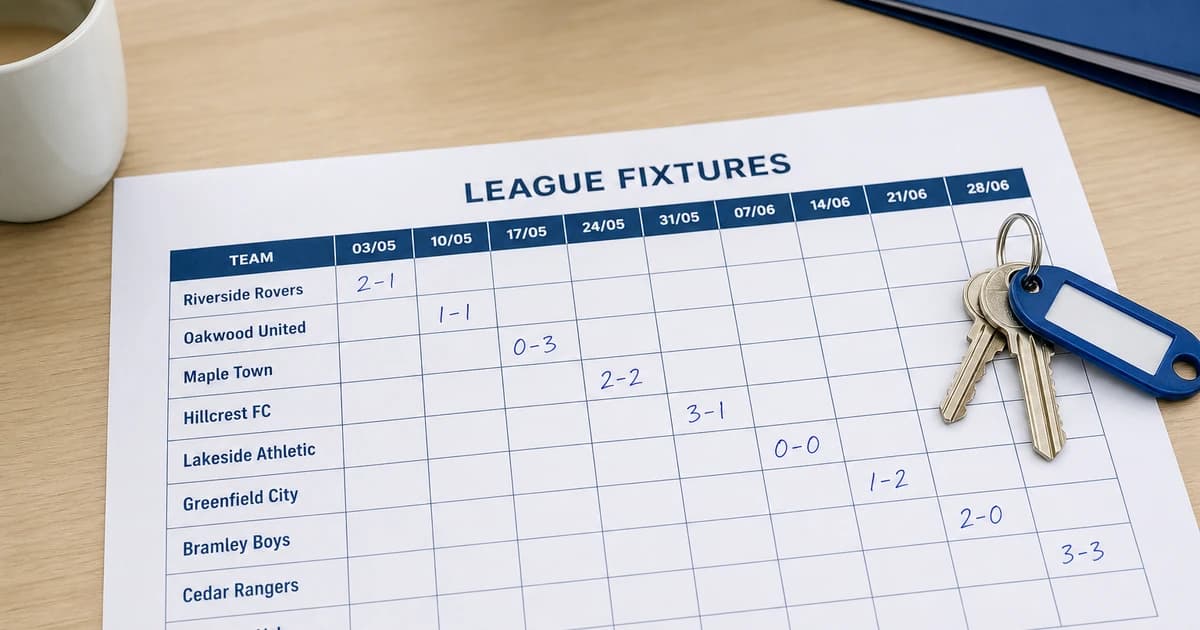
A soccer team manager is the volunteer who runs everything on a team that is not coaching: paperwork, the schedule, team money, tournament entries and the messages that keep families informed. Most clubs hand the job to a parent with a one-line description and a link to a portal. This guide turns the role into a checklist you can follow from the week you say yes until the last trophy is handed out.
We built it from manager handbooks that real clubs publish, so the duties match what leagues and clubs actually ask for. Your club's handbook wins wherever it differs.
Key Takeaways
- The manager handles non-coaching work, and questions about selection, positions and playing time always go to the coach.
- Compliance comes first: background check, SafeSport and concussion training usually have to be done before the manager can stand on the bench.
- A team binder with medical releases and player cards travels to every game and tournament.
- Team money needs a written budget, a record of every payment and a second person who can see the account.
- Good managers delegate: treasurer, tournament travel, equipment and first aid are all separate jobs.
What a soccer team manager does (and does not do)
City SC, a California club, describes the manager's primary role in its Team Manager Handbook as "team administrator and communicator", a liaison between the coach, parents, players and the club "on NON-COACHING related issues." That last phrase is the boundary that keeps the job workable.
The manager does not pick the roster, set the lineup or decide playing time. When a parent asks why their child played 20 minutes, the answer is "that is a coaching question, and here is how to ask the coach." Write that boundary into your first email to families, so nobody expects you to settle it.
The manager also speaks for the team, not the club. If a league rule or a club policy is unclear, ask your club's designated contact before you contact the league or state association yourself.
Before the season: compliance and the team binder
Start with your own requirements. City SC's handbook says league compliance "may include background checks, online courses like SafeSport, concussion, sudden cardiac arrest, mandated reporter training." Great River SC in Minnesota lists the same three core items for managers in its team manager duties sheet: background check, CDC concussion training and SafeSport training, all due before the season starts.
If your club is in Florida, our guide to Level 2 background screening for youth coaches explains what state law now requires of volunteers who work with players.
Then build the team binder. Both handbooks above name the same core contents. Great River SC says the medical release and insurance card "must be at every game/tournament."
Team binder checklist (example, adjust to your league):
- Signed medical release for every player, current season
- Copy of each family's insurance card, if your club requires it
- Player cards or passes, with photos, plus the coach and manager cards
- Official league roster, printed if your league asks for paper on game day
- Signed code of conduct forms for players and parents
- Emergency contact sheet with two numbers per player
- Copy of your club's concussion removal and return-to-play form
- Incident report forms and a pen that works
If your club collects waivers and medical details at registration, ask the registrar for an export rather than chasing paper. Our guide to digital waivers covers what those forms should hold.
The first two weeks: rosters, contacts and the welcome message
Your club or competitive director usually sends you the roster with contact details. Verify it before anything else. Great River SC asks managers to send families an email confirming their information, and to check that each player's record in the league system is complete, including head shots and jersey numbers. It calls the jersey number "an easily missed task."
Then send one welcome message that covers:
- Who you are, how to reach you and the hours you answer messages.
- How the team will communicate (one channel, not three), and where the schedule lives.
- The coach-manager boundary: coaching questions go to the coach, at a time the coach sets.
- What documents are still missing, by family, with a deadline.
- The team budget, if there is one, and when payments are due.
- Volunteer jobs you need filled, with a short description of each.
Our parent communication guide has templates for the tone and structure of that first message, including a bilingual version.
Ask families early for dates their player cannot attend. Great River SC asks managers to collect unavailable dates for the spring and summer so the coach can plan games and tournaments around them.
Team money: budget, collection and records
Many competitive teams carry costs the club fee does not cover: extra tournaments, coach travel, team socials. City SC's handbook tells managers to "build and manage team budget" and to "collect funds from team members and document payments and expenses for all players."
Keep team money out of anyone's personal account. If your club offers a team account or collects team fees itself, use that. A simple budget looks like this:
| Line (example numbers) | Cost | Per player (14 players) |
|---|---|---|
| Two extra tournaments at $650 entry each | $1,300 | $92.86 |
| Coach travel for one overnight tournament | $400 | $28.57 |
| End-of-season party | $210 | $15.00 |
| Total | $1,910 | $136.43 |
These numbers are made up to show the math. Round the per-player figure up to a number families can remember, state the due dates, and share a running record of who has paid and what was spent at least monthly. Have a second adult, usually a parent who volunteers as team treasurer, check the record.
Game days and the league
The routine is the same every week. City SC's list for game day: print game day rosters as the league directs, bring referee fees when the league requires them, and report scores afterward.
Game day checklist:
- Team binder and player cards packed the night before
- Field address, arrival time and uniform color sent to families at least 48 hours ahead
- Referee fees in a labelled envelope, if your league pays referees at the field (our referee scheduling guide explains how leagues handle this)
- Score reported, or checked, within the league's deadline
- Any injury written on an incident form the same day
Weather is where managers earn their keep. Great River SC reminds its managers that only referees or the field coordinator can cancel a game for weather, and that a no-show forfeit costs the team at least $200 in its league. Know who makes the call in your league, and never cancel on your own.
Tournaments
The manager usually handles tournament entry once the coach chooses the event. City SC's sequence: register and pay after funds are collected from families, monitor emails from the tournament director, and send the schedule and rules to families.
Tournament check-in deserves its own preparation. Most events ask for an official roster, player cards and medical releases, and many require any guest player to be approved in advance. Read the event's check-in instructions as soon as you are accepted, not the night before.
For out-of-town events, hand hotel blocks and travel to a separate volunteer. It is the most time-consuming job on the list and the easiest to delegate.
Delegate before you burn out
City SC strongly encourages its managers to hand administrative work to other parents and leaves the choice to them: "it's up to you which responsibilities you wish to delegate." Its handbook lists the roles managers commonly hand off.
| Role | What the volunteer does |
|---|---|
| Team treasurer | Keeps the team budget and payment record |
| Schedule coordinator | Keeps the team calendar current |
| Travel and hotel coordinator | Books room blocks for away tournaments |
| Equipment | Brings the canopy, bench and first-aid kit |
| Social coordinator | Plans team events |
| Photographer | Sends photos to the club's social media volunteer |
Post the list in your welcome message and ask for names in the first week. Two short jobs per family is easier to fill than one big one.
A worked example: one week for a U-12 manager
Here is a fictional week for the manager of a U-12 girls team with a Saturday 9:00 game and a tournament entry deadline on Friday.
- Sunday: check the league site for schedule changes, send the week's plan to families.
- Tuesday: two medical releases still missing; message both families directly.
- Wednesday: coach confirms the tournament; collect the $650 entry from the team fund and register.
- Thursday: send arrival time, field address and uniform color for Saturday.
- Saturday: binder and referee envelope at the field by 8:15, score reported by noon, one minor injury recorded on the incident form.
Roughly two to three hours, spread across the week. That is what to tell the next parent you recruit.
How Centro helps a club support its managers
Centro does not have a separate team manager role, so the club decides who on each team works in Centro. Coaches are invited with access scoped to their own teams. From there the team calendar holds practices and games, staff can send a team broadcast to families in English or Spanish, and cancelling an event emails families automatically in each family's language.
If you are the director setting this up for every team, see how Centro works for clubs, then start a 14-day trial with no credit card required.
Cover photo: Florian Christoph, CC BY 2.0, cropped, via Flickr. License terms.