The answer to how to schedule a soccer league with more than one age group is to schedule fields before you schedule teams. Each age group plays a different format, on a different size of field, for a different length of time, so a "slot" for a U10 match is not the same thing as a slot for a U14 match. This guide shows how to turn your fields into format-specific slots, how to fit several divisions into one match day, and what to check before you publish a single fixture.
Key Takeaways
- Count slots per format (7v7, 9v9, 11v11), not just per field, because field markings decide what can be played where.
- Slot length is match length plus halftime plus turnover time, and turnover is the part most schedules forget.
- Build the fixture list per division first, then assign it to slots week by week.
- Rotate time slots and fields so no team always gets the 8:00 a.m. kickoff.
- Check coach, sibling and referee conflicts before you publish, not after families complain.
Why a multi-division schedule is harder than it looks
A single division is a round-robin problem. Eight teams, two fields, a fixed number of weekends: our guide to building a round-robin league schedule walks through that case by hand.
Once a league has several age groups, three new constraints appear at once:
- Format. US Soccer's recommended game formats cap U9 and U10 at 7v7, U11 and U12 at 9v9, and move to 11v11 from U13. Each format needs its own field size and goals.
- Match length. Younger age groups play shorter matches, so their slots are shorter.
- Shared people. Coaches who coach two teams, families with children in two age groups, and referees who can do three matches but not five.
Learning how to schedule a soccer league with all three in play mostly means solving them in the right order.
Step 1: Turn your fields into format slots
Start with what each field is lined for. US Soccer's Player Development Initiatives standards, published by US Youth Soccer, give these ranges:
| Format | Ages (US Soccer) | Field size range (yards) | Match length in the standards |
|---|---|---|---|
| 4v4 | U6 to U8 | 25-35 long, 15-25 wide | 4 quarters of up to 10 minutes |
| 7v7 | U9, U10 | 55-65 long, 35-45 wide | 2 halves of 25 minutes, 10-minute halftime |
| 9v9 | U11, U12 | 70-80 long, 45-55 wide | 2 halves of 30 minutes, 10-minute halftime |
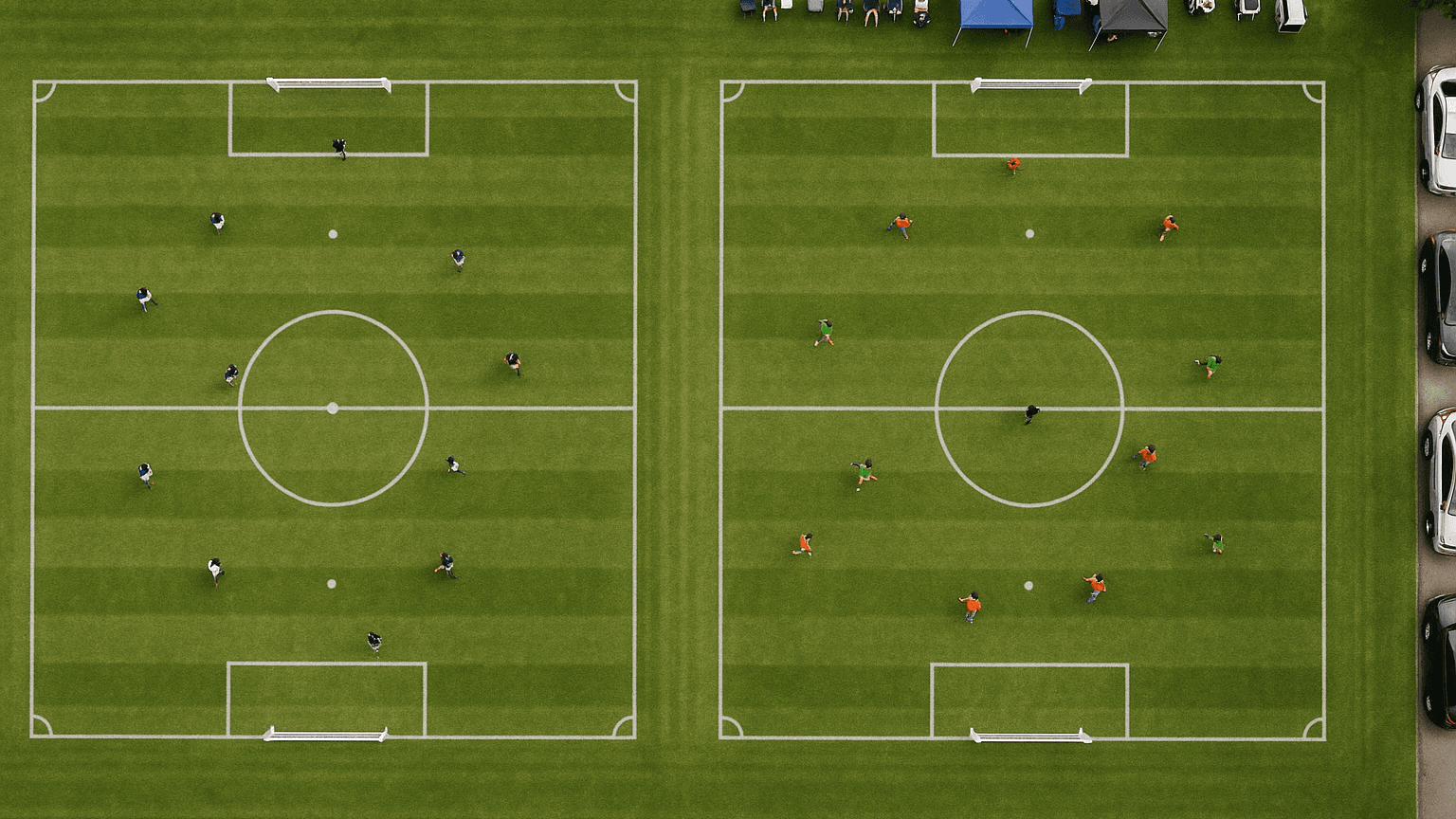
Your state association or league rules may set different match lengths, so use your own rules where they differ. The point is that one full-size field can often be lined as two smaller fields running across it, which doubles your small-sided capacity but removes that field from 11v11 use for the day. Check your actual field dimensions and your permit before you plan on it.
Step 2: Work out slot length
A slot is not the match length. It is:
match length + halftime + turnover
Turnover covers the end of one match, teams clearing the bench area, the next teams warming up near the field, and the referee's check-in. Ten to fifteen minutes is a realistic allowance at a busy complex. Leave it out and every match after the first starts late, and by mid-afternoon you are 40 minutes behind.
Using the standards above and a 15-minute turnover as an example:
- 7v7: 50 minutes of play + 10 halftime + 15 turnover = a 75-minute slot.
- 9v9: 60 + 10 + 15 = an 85-minute slot, which most schedulers round to 90.
- 11v11: depends on your age group's match length, so calculate it from your league rules.
Step 3: Fit the divisions into one match day
Here is a constructed example to show the arithmetic. The numbers are illustrative, not a recommendation.
A league plays Saturdays from 8:00 a.m. to 5:00 p.m. at a complex with three fields. It has a U10 division of 8 teams (7v7), a U12 division of 6 teams (9v9) and a U14 division of 6 teams (11v11, with a 105-minute slot in this league's rules).
Each weekend, every team plays once:
- U10: 8 teams, 4 matches.
- U12: 6 teams, 3 matches.
- U14: 6 teams, 3 matches.
Now the fields:
| Field | Lined as | Slot length | Matches | Time used |
|---|---|---|---|---|
| Field 1 (full size) | One 11v11 field | 105 min | 3 U14 | 8:00 to 1:15 |
| Field 2 (full size) | Two 9v9 fields across it | 90 min | 3 U12 (2 + 1) | 8:00 to 11:00 |
| Field 3 (smaller) | Two 7v7 fields | 75 min | 4 U10 (2 + 2) | 8:00 to 10:30 |
Everything fits before 1:15 p.m., with a full afternoon spare. That spare capacity is your make-up space for rainouts, or room for a fourth division. If the league had instead tried to schedule the U12 matches on Field 1 as well, that field would need 585 minutes and run to 5:45 p.m., past the 5:00 p.m. close.
The lesson is general: when you schedule a soccer league, first match each format to the field lined for it, then see where the spare capacity sits.
Step 4: Build fixtures per division, then assign slots
Generate each division's full fixture list first: who plays whom in each round, with home and away balanced. A round robin of 8 teams needs 7 rounds, and a division of 6 needs 5. Our free league schedule generator produces the pairings for any number of teams without an account.
Then assign each round to a weekend and each match to a slot. This is where fairness lives:
- Rotate kickoff times. Track how many 8:00 a.m. starts each team gets, and spread them.
- Rotate fields if one field is noticeably worse, or farther from parking.
- Byes. An odd number of teams means one bye per round. Spread them so no team gets two in a row.
- Rest. For tournaments or doubleheaders, US Youth Soccer's 2025 Southern Regional rules treat four and a half hours between the scheduled starts of two games as sufficient rest. One match per team per day is better where you can manage it.
Step 5: Check the people conflicts
A schedule can be perfect on paper and still fail on Saturday because one person is needed in two places.
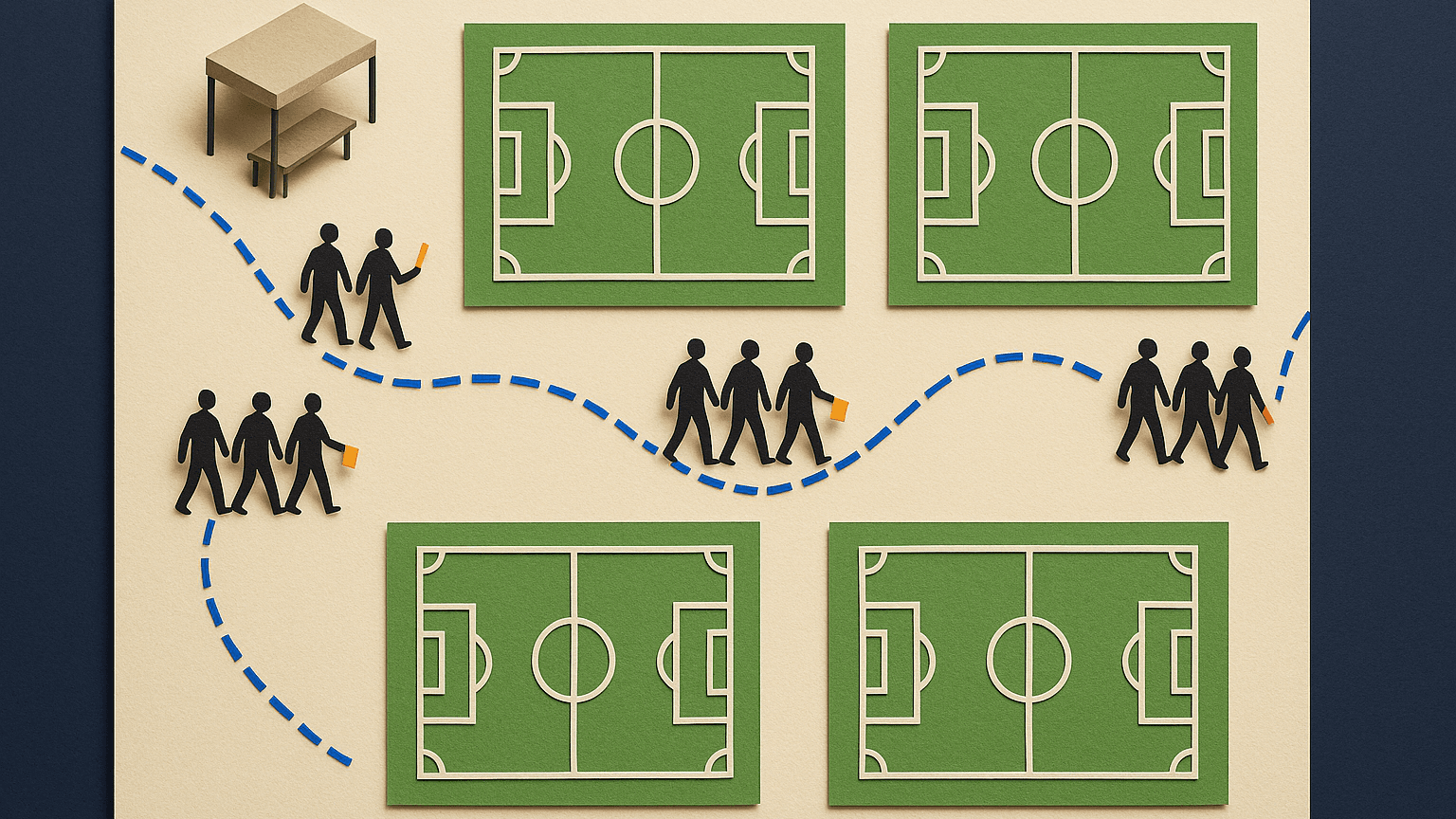
- Coaches with two teams. Put their teams in non-overlapping slots, ideally back to back on nearby fields.
- Families with children in two age groups. You cannot solve every case, but a league that places clubs' U10 and U12 teams near each other in the day solves many of them.
- Referees. Your assignor needs the final schedule early, and slot times affect how many matches each referee can cover. Our guide to referee scheduling and pay for a youth league covers that side.
Publish only after these checks. Changing a published schedule costs far more goodwill than delaying it by two days.
When the schedule changes mid-season
It will. Rainouts, field closures and withdrawals all move matches after publication. Keep spare slots in reserve, as the example above does, and decide in your rules who approves a moved match. Our season operations playbook for running a soccer league covers the policies that should sit behind those changes.
How Centro helps with league scheduling
In Centro, you set up each division with its teams, match nights and fields, and Centro builds a round-robin schedule as a draft. Staff review the draft, adjust it, and publish it when it is right, so nothing reaches families until you are satisfied with it. Centro does not replace the field-lining and conflict checks above; you still decide which field suits which format.
After publication, results entered by staff update each division's standings using that season's points and tiebreakers. When a league match is postponed or rescheduled, the teams and families involved get an email automatically in each person's language.
We built Centro so a multi-division schedule lives in one place instead of one spreadsheet per age group. See how Centro builds league schedules.
Cover photo: Steve Dawson., CC BY-SA 2.0, cropped, via Flickr. License terms.