Florida Youth Soccer Heat Protocol: A Coach's Guide
A working youth soccer heat protocol in Florida combines WBGT monitoring, hydration breaks, the 14-day acclimatization window, and a bilingual handout parents understand. We pull together what FYSA, FHSAA, U.S. Soccer, and NATA actually require.
On this page
Florida Youth Soccer Heat Protocol: A Coach's Guide for May Through September
A working youth soccer heat protocol is the difference between a Saturday match that runs on schedule and a 911 call from the sideline. Florida summer practice and game weather is among the most dangerous in the country for exertional heat illness, and most volunteer coaches have never been formally trained on it. This guide pulls together what FYSA, the FHSAA, U.S. Soccer, and the National Athletic Trainers' Association actually require, what the WBGT and heat-index thresholds mean in plain English, and how to run a 60-minute practice safely from May through September. We close with a bilingual hydration handout structure your club can hand to parents in English and Spanish.
Key Takeaways
- A youth soccer heat protocol must cover acclimatization, monitoring, hydration, breaks, recognition of heat illness, and a written cold-water immersion plan.
- FYSA mandates hydration breaks at any sanctioned match when air temperature is or is expected to reach 85°F, with breaks running 1 to 2 minutes.
- U.S. Soccer's heat-stress guidelines require 4-minute hydration breaks per 30 minutes of continuous play once WBGT reaches 89.6°F.
- The first 7 to 14 days of preseason carry the highest risk of exertional heat illness, per NATA acclimatization guidelines.
- Spanish-speaking parents need the protocol in their language, and most clubs do not provide that today.
Why a Florida Youth Soccer Heat Protocol Is Not Optional
Florida summer field conditions routinely cross every published threshold for heat-stress risk. By June, midday Wet Bulb Globe Temperature in Miami-Dade and Broward regularly exceeds the 89.6°F mark that triggers mandatory hydration breaks under U.S. Soccer's published heat-stress guidelines. The Florida High School Athletic Association requires WBGT measurement 30 minutes before any outdoor practice and every hour during, with cooling zones and a cold-water immersion plan in place, per the Zachary Martin Act and FHSAA's published policies. Youth club programs are not all bound by the FHSAA rule, but every credible safety body uses the same baseline.
Coaching capacity is the second half of the picture. Per the Aspen Institute's Project Play State of Play 2024 report, more than four in 10 youth sports coaches have never received training in concussion management, safety, injury prevention, or motivational technique. A youth soccer heat protocol you can hand to a volunteer assistant on Tuesday night, in their language, is the only realistic way to cover the gap.
WBGT, Heat Index, and the Florida Rules That Matter
There are two numbers a coach has to know.
Heat index is what the temperature feels like when humidity is folded in. It is the number weather apps show. For practical sideline use, U.S. Soccer's Recognize to Recover environmental guidance applies these heat-index thresholds:
- Up to 89°F: normal play.
- 90 to 95°F: mandatory water breaks every 25 minutes.
- 96 to 102°F: mandatory water breaks every 15 minutes.
- Above 103°F at the start of training: outside activity is cancelled.
Wet Bulb Globe Temperature (WBGT) is the medical-grade measurement that accounts for humidity, wind, sun angle, and surface heat radiating off the field. The FHSAA-approved threshold is 89.6°F, at which clubs must build in 4-minute hydration breaks per 30 minutes of continuous play, per U.S. Soccer's Recognize to Recover environmental guidance. Above that, training plans need active modification.
For FYSA-affiliated clubs, the binding rule is simpler. Per the FYSA Water Break Policy, mandatory hydration breaks are required at any FYSA-sanctioned match when air temperature reaches or is expected to reach 85°F, with breaks running 1 to 2 minutes maximum.
The decision tree on a Florida Saturday in July is: check the heat index in the weather app, check WBGT if your club has a meter, follow the lower threshold of whichever is more restrictive.
The 14-Day Heat Acclimatization Window
The National Athletic Trainers' Association defines a heat-acclimatization period as the initial 14 consecutive days of preseason practice. The first 7 to 14 days of that window present the greatest risk of exertional heat illness.
Practical translation for a Florida youth club starting summer training in May or June:
- Days 1 to 5: shorter sessions (60 to 90 minutes), reduced intensity, water available continuously, no full-day camps yet.
- Days 6 to 10: gradually extend session length, add 1 v 1 and small-sided activity, schedule sessions in the morning or after 6 PM when WBGT drops.
- Days 11 to 14: typical practice intensity is acceptable for acclimated players; new players or players returning from travel should be treated as Day 1.
A volunteer coach who skips this window and runs a full-intensity 90-minute July practice on Day 1 is operating against the published medical consensus, regardless of how fit the players were last season.
Free resourceClub bylaws templateEditable, with guidance notesHydration: How Much, How Often, and What
Per the U.S. Soccer Federation Youth Soccer Heat Stress Guidelines, players should drink 5 to 9 ounces of fluid every 20 minutes during activity. The lower number applies to players under 90 pounds; the higher number to players over 90 pounds. Fluids are most absorbable when chilled to 50 to 59°F, and sports drinks containing sodium chloride help maintain voluntary intake and replace electrolytes lost through sweat.
U.S. Soccer summarizes the parent-facing version of this protocol as G.O.A.L.: Get acclimated, On-schedule drinking before thirst, Always bring a sports drink, and Learn the signs of heat illness. That acronym fits on a flyer in two languages and is the foundation of the bilingual handout we recommend below.
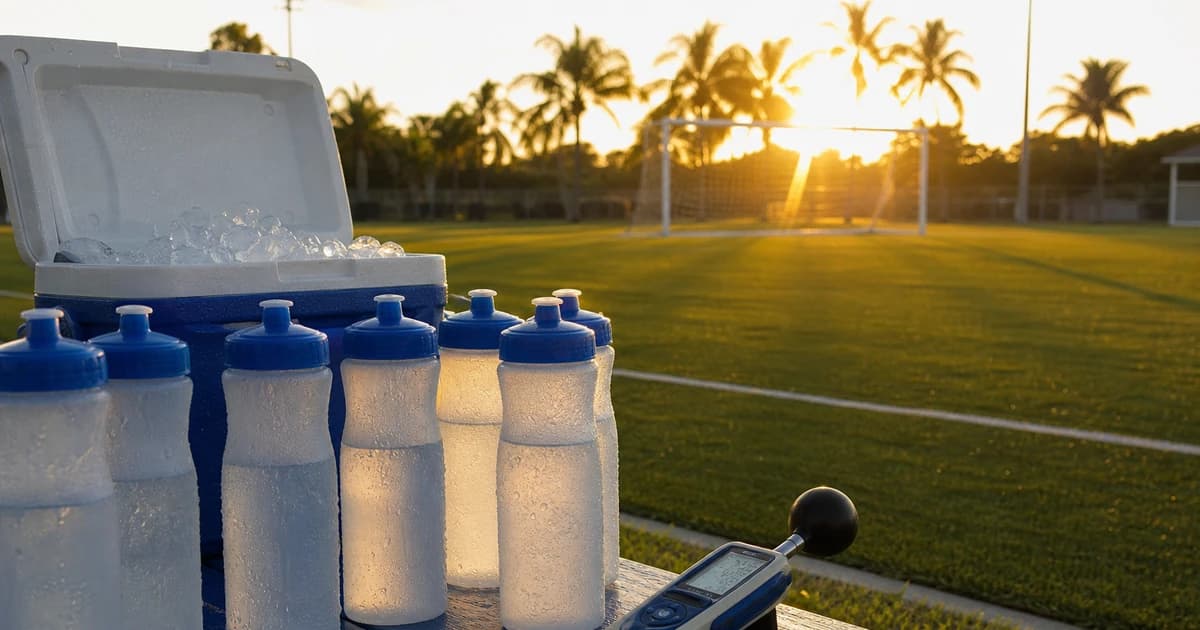
A practical hydration kit on the bench: one chilled 32 oz bottle per player, a team cooler with ice and electrolyte mix, two water jugs for refills, and a laminated G.O.A.L. card in English and Spanish.
Recognizing Heat Illness on the Field
Three patterns matter. Heat exhaustion usually shows up as heavy sweating, weakness, dizziness, headache, nausea, and pale or clammy skin. The player should stop, sit in shade, drink, and not return that session.
Heat stroke is the medical emergency: hot dry skin, very high body temperature, confusion, slurred speech, possible loss of consciousness. Per the Korey Stringer Institute at the University of Connecticut, cold-water immersion is the gold standard treatment for suspected exertional heat stroke. A pre-positioned ice tub on the sideline, with a written plan to fill it, is what the FHSAA's Zachary Martin Act framework requires for high schools and what every youth club should mirror.
The third pattern is exercise-associated muscle cramps. They are not heat stroke, but they signal under-hydration and electrolyte loss. Stop play, fluids with sodium, gentle stretching.
If a coach sees any of the heat-stroke signs, call 911, start cooling immediately, and do not wait. Our volunteer coach onboarding guide covers the documentation and the chain of communication for every club coach we recommend; the heat-illness EAP belongs in that file from day one.
Bilingual Hydration Handout for Spanish-Speaking Families
A protocol that exists only in English does not protect a club where a third or more of families speak Spanish at home. Most parents we talk to in South Florida appreciate the safety effort, and they appreciate a handout that respects their language.
A working bilingual handout structure:
- English column: G.O.A.L. acronym, hydration math (5-9 oz / 20 min), heat-index thresholds, signs of heat illness, sideline EAP contact.
- Spanish column: same content, informal "tu" register, idiomatic Latin American Spanish (not peninsular).
- One page, laminated, fridge-magnet-friendly, also a PDF for WhatsApp.
Our bilingual youth soccer club guide covers the broader translation discipline, and our parent communication templates include a starter pack for weather alerts in both languages.
How Centro Helps Clubs Run a Heat Protocol
Centro is built for clubs that need to communicate, in two languages, with families who all carry a phone. The platform's communications module pushes weather alerts, modified practice times, and cancellation notices in each parent's preferred language with a single send. The bilingual website builder hosts the club's heat-illness EAP and the G.O.A.L. handout as a downloadable PDF parents can pull on a phone. Coaches can schedule recurring "WBGT check at 5:30 PM" reminders so the protocol does not depend on memory.
For South Florida clubs in particular, the South Florida youth soccer guide lays out the seasonal calendar that makes a heat protocol a year-round consideration, not a summer afterthought.
A Real August Tuesday in Hialeah
A volunteer coach at a Hialeah U10 club arrives at 6:00 PM. The phone weather widget shows heat index 96°F. The club's WBGT meter reads 90.4°F. The protocol calls for water breaks every 15 minutes per heat-index guidance and a 4-minute hydration break every 30 minutes per WBGT, so the coach uses the more restrictive 15-minute cadence. The session is shortened to 60 minutes, drills are spaced with two stations in shade, and the bilingual G.O.A.L. card is pinned to the bench. The team's WhatsApp parent alert goes out at 4:30 PM in Spanish and English: practice is on, bring two water bottles, expect breaks every 15 minutes. Every player finishes healthy. That is what a working protocol does.
Frequently Asked Questions
Does FYSA require a written heat protocol? FYSA's Water Break Policy mandates hydration breaks at sanctioned matches when air temperature reaches or is expected to reach 85°F. Clubs are responsible for their own preseason practice protocols and EAPs. Match officials enforce the water-break rule on the day.
What WBGT meter should a club buy? A handheld Kestrel Heat Stress Tracker is the standard meter referenced by FHSAA-aligned programs. Any WBGT-capable meter that reports outside the lab is acceptable for sideline use.
Can a club rely on the heat index alone? The heat index is good enough for short rec sessions in lower-risk weather. Once temperatures or humidity climb into Florida summer ranges, WBGT is the more accurate measurement, and FHSAA programs are required to use it.
We built Centro so a club director or volunteer coach can run a complete bilingual heat protocol with a single login: parent alerts, the EAP document hosted on the club website, and the WBGT-check reminder on the calendar. See the coaching side of Centro.
Keep reading
More on running a better club.
Florida Level 2 Background Screening for Youth Coaches: What's Required Now
Florida’s Level 2 fingerprint screening requirement has applied since July 1, 2026, per F.S. 943.0438. We cover what the statute requires, how SB 1546 set that date, and the compliance steps a club needs to have in place now.
Hurricane Preparedness for Youth Soccer Clubs: A South Florida Playbook
Hurricane preparedness for youth soccer clubs in South Florida starts in May, not in September. We cover the five-part club EAP, cancellation and refund policy, and the bilingual storm comms that reach Spanish-speaking families.

The Complete Guide to Volunteer Coach Onboarding for Soccer Clubs
A complete onboarding system for volunteer youth soccer coaches, covering US Soccer licensing, SafeSport certification, background checks, and a week-by-week checklist. Includes mentorship strategies, practice plan resources, and the most common mistakes clubs make with first-time coaches.