Youth Soccer Parent Communication Templates (English and Spanish)
Eight free bilingual parent communication templates for youth soccer clubs, covering welcome messages, schedule changes, payment reminders, weather cancellations, tournament info, and more. Each template comes in English and Spanish, ready to customize and send.

On this page
Most mid-season conflicts at youth soccer clubs trace back to one thing: a message that was never sent, sent too late, or sent in a language a family could not fully understand. A payment reminder that went out the day after the deadline. A schedule change buried in a group chat. A tryout announcement that only reached half the roster.
Having a set of ready-made youth soccer parent communication templates for the situations you know are coming saves hours of writing, prevents misunderstandings, and keeps every family informed all season long. According to Coach & Athletic Director magazine, four topics cause 90% of mid-season parent complaints: squad selection, playing time, team rules, and scheduling. Most of those complaints start with a communication gap.
Key Takeaways
Most mid-season parent conflicts come from poor communication, and having ready-made templates for common situations prevents them
The 8 messages every club needs: welcome, season kickoff, schedule changes, payment reminders, weather cancellations, tournament info, end of season, and tryout announcements
Bilingual templates are not optional in diverse communities. They are a signal of respect and belonging.
Keep messages short and link to details rather than attaching long documents
The templates linked below come in both English and Spanish, ready to customize
The 8 Parent Communication Templates Every Club Needs
You do not need a 20-page parent handbook. You need eight well-written messages, sent at the right time, in the language each family understands. Here are the eight templates we built, and when to use each one.
1. Welcome to the Club
Send this immediately after a family completes registration. It sets the tone for the entire season. A strong welcome message includes the club director's name, a short note about what the club values, a link to the season calendar, and instructions for how to access club updates.
Keep it warm and brief. This is not the place to list every policy. It is the place to make a new family feel like they made the right choice.
2. Season Kickoff
Send this one to two weeks before the first practice. This is your "here is everything you need to know" message. Include the first practice date, time, and location. List what players should bring. Link to the full season schedule so parents can add dates to their calendar.
This message replaces the 10-page welcome packet that nobody reads. One clear message with the right links does more than a binder full of printouts.
3. Schedule Change
This one gets used more than any other template during the season. Fields get double-booked. Referees cancel. Rain moves a Saturday game to Sunday. A schedule change message needs three things: what changed, what the new plan is, and a link to the updated calendar.
Send it as early as possible. A schedule change sent 24 hours in advance is helpful. One sent 45 minutes before kickoff creates chaos. If your club uses a platform for parents that pushes notifications directly to phones, even better.
4. Payment Reminder
This template alone will save your treasurer hours of awkward follow-ups. Send it three to five days before a payment deadline. Include the amount due, the deadline, the accepted payment methods, and a direct link to pay.
Do not make parents hunt for payment instructions. The fewer steps between reading the message and completing the payment, the better your collection rate.
5. Weather Cancellation
Bad weather decisions need to go out fast. Your weather cancellation template should be pre-written and ready to send with one edit: the specific date and time being canceled, and whether a makeup is already scheduled.
Include your club's weather policy (for example: "Games are called 90 minutes before kickoff if lightning is detected within 10 miles"). Parents want to know they can trust the process, not just the individual decision.
6. Tournament Info
Tournament weekends are when communication breaks down the most. Parents need the tournament name, dates, location address, game times, parking details, and any uniform requirements that differ from regular games.
Send this at least one week before the tournament. For travel tournaments, send it two weeks out. A single, well-organized tournament info message prevents the 47 questions that flood the group chat when families are trying to plan logistics.
7. End of Season
Close the season with a message that thanks families, summarizes accomplishments, and gives clear next steps. Will there be a year-end celebration? When does registration open for the next season? How can parents provide feedback?
This message matters more than most clubs realize. It is the last impression families have before deciding whether to come back. Make it personal and make it count.
8. Tryout Announcement
Whether your club holds formal tryouts or open evaluations, the announcement needs to include dates, times, locations, age groups, what to bring, and how to register. If there is a cost, say it upfront. If returning players still need to attend, say that too.
Tryout announcements also reach beyond your current roster. Parents forward them, post them in community groups, and share them with friends. Make sure the message represents your club well, because it may be the first thing a new family ever reads about you.
Writing Messages That Parents Actually Read
Here is the hard truth: parents are busy, their inboxes are full, and your message is competing with work emails, school updates, and every other notification on their phone. If you want parents to read what you send, you need to make it easy.
Keep It Short
Data from Boomerang's analysis of 40 million emails found that messages between 50 and 125 words achieve the highest response rates (50 to 51%). Research from Litmus (2022) shows that the average person spends just 9 seconds on any given email. That is not a lot of time.
Write your subject line like a headline. Get to the point in the first sentence. Use bold text for dates, times, and action items so parents can scan without reading every word.
Link, Do Not Attach
Emails with large PDF attachments often get clipped by Gmail (which hides content past 102 KB) or flagged by spam filters. According to F-Secure, 85% of malicious emails contain attachments, which is why filters treat them with suspicion. Mailjet and Mailforge both recommend linking to web-hosted content instead of attaching files.
Over 55% of all email opens happen on mobile devices (Return Path / Adobe), and PDFs render poorly on phone screens. Research from the same sources shows that 42% of users delete emails that are not optimized for mobile.
The better approach: host detailed information on a web page and send a short message with a link. Parents can access it from the field, the car, or the dinner table.
Real-World Scenario: Short Messages Win
A club in Central Florida used to send long, detailed emails with PDF attachments for every major announcement. Their average open rate: roughly 12%.
The following season, they switched to short messages (under 125 words) with a single link to a mobile-friendly web page. Open rate: 61%. Same information, different format. The data backed up what parents had been telling them all along: keep it short, make it clickable.
Free resourceParent communication templatesEight templates, English and SpanishWhy Your Templates Need to Be Bilingual
Nearly 45 million people in the United States speak Spanish at home, according to the 2024 American Community Survey. In South Florida, where Miami-Dade County is roughly 70% Hispanic or Latino, that number is not abstract. It is your registration line.
Bilingual parent communication templates are not about translation for the sake of appearances. They are about making sure every family in your club actually understands the message you are sending.
The Data Is Clear
Research from Kantar's U.S. MONITOR (2021) found that 88% of U.S. Hispanics appreciate businesses that communicate with them in Spanish. Nielsen's 2023 Diverse Intelligence Series reported that 84% of Latinos favor brands that play a positive role in their community. And a 2025 McKinsey report found that Latino and Black children are three times more likely than White children to stop playing soccer because they feel unwelcome.
Language is part of that welcome.
Real-World Scenario: The Missed Payment Deadline
A youth soccer club in South Florida has about 40% Spanish-speaking families. The club sends an English-only payment reminder explaining a three-installment plan with deadlines on September 1, October 15, and December 1.
Three families miss the first deadline. When the club director follows up, two of the three parents explain they did not fully understand the installment terms. They thought the full amount was due at registration and did not realize they could pay over time.
The result: late fees, frustrated parents, and extra admin work. A bilingual platform that delivers every message in both English and Spanish would have prevented the confusion entirely.
Hispanic youth sports participation is growing faster than any other demographic group. The Aspen Institute's State of Play 2025 report found that 65% of Latino youth ages 6 to 17 tried sports in 2024, the highest rate on record. Yet 66% of Latino families who have participated in youth sports said they struggled to afford the costs (Aspen Institute Project Play). When families already face financial barriers, adding a language barrier on top of it is something clubs can and should prevent.
Get All 8 Templates Free (English + Spanish)
We built eight bilingual parent communication templates covering the most common messages clubs send all season, from welcome emails to payment reminders to tryout announcements. Each template comes in both English and Spanish, ready to copy, customize, and send.
Download all eight at withcentro.com/resources/parent-templates.
How to Customize Them
Each template is written in plain language and designed to work as a starting point. Replace the placeholder club name and contact information with your own. Adjust dates, fees, and locations to match your season. Review the tone and tweak any phrasing that does not match your club's voice.
The structure and formatting are intentional. Short paragraphs, clear headers, and bold action items make every message scannable on a phone screen, which is where most parents will read it.
Going Digital with Your Parent Communication
Printing handouts and stuffing them into folders at registration feels thorough. But printed materials get lost in backpacks, left in car seats, and forgotten by October. Sending every update as a long email is not much better.
Why Digital Communication Platforms Beat Email Chains
The best clubs keep all parent communication in one place: a platform that stores messages, schedules, and payment information where parents can access it year-round. No digging through old emails. No scrolling through a group chat with 200 unread messages. Parents open the app, find what they need, and move on.
Platforms with built-in communication features let clubs send updates, reminders, and announcements from a central dashboard. When a schedule changes or a payment deadline approaches, the notification goes out automatically.
Bilingual Messaging Without the Extra Work
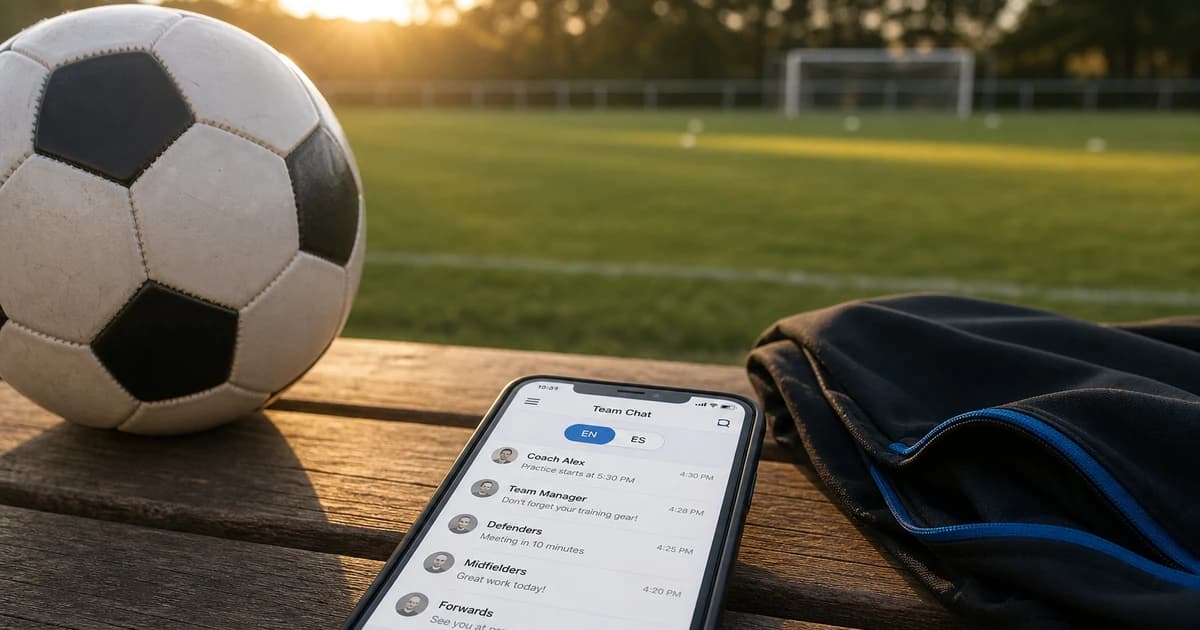
Centro's bilingual communication tools take this further. Every announcement, invoice, and notification is sent in both English and Spanish simultaneously. Parents see the version in their preferred language without anyone on your staff translating a single word. For clubs serving diverse communities, this means payment reminders, schedule updates, and tryout announcements all reach every family in the language they understand best.
Centro sends every message, invoice, and notification in both English and Spanish, automatically. See what families see in Centro.
Keep reading
More on running a better club.
How to Communicate With Sports Parents: The Complete Guide for Soccer Clubs
Most clubs lose families because of communication, not coaching. This guide covers how to communicate with sports parents through pre-season meetings, in-season cadence, bilingual delivery, and a real playbook for difficult parents. Built for youth soccer clubs that want families to renew.

Managing Difficult Sports Parents: A Coach's Survival Guide
Managing difficult sports parents is the coaching challenge no clinic prepares you for. This guide gives you a practical system for prevention, in-the-moment de-escalation, documentation, and protecting your coaches from burnout.

Marketing a Florida Hispanic Youth Soccer Summer Camp: A Bilingual Playbook
Filling a Hispanic youth soccer summer camp in South Florida is not the same job as filling a generic soccer camp. We cover the Spanish-first channels that work, the May-to-June close timing that captures the decision window, and the bilingual landing page that converts.