AI Youth Soccer Coaching in 2026: Tools, Limits, and What Comes Next
AI Youth Soccer Coaching in 2026: Tools, Limits, and What Comes Next
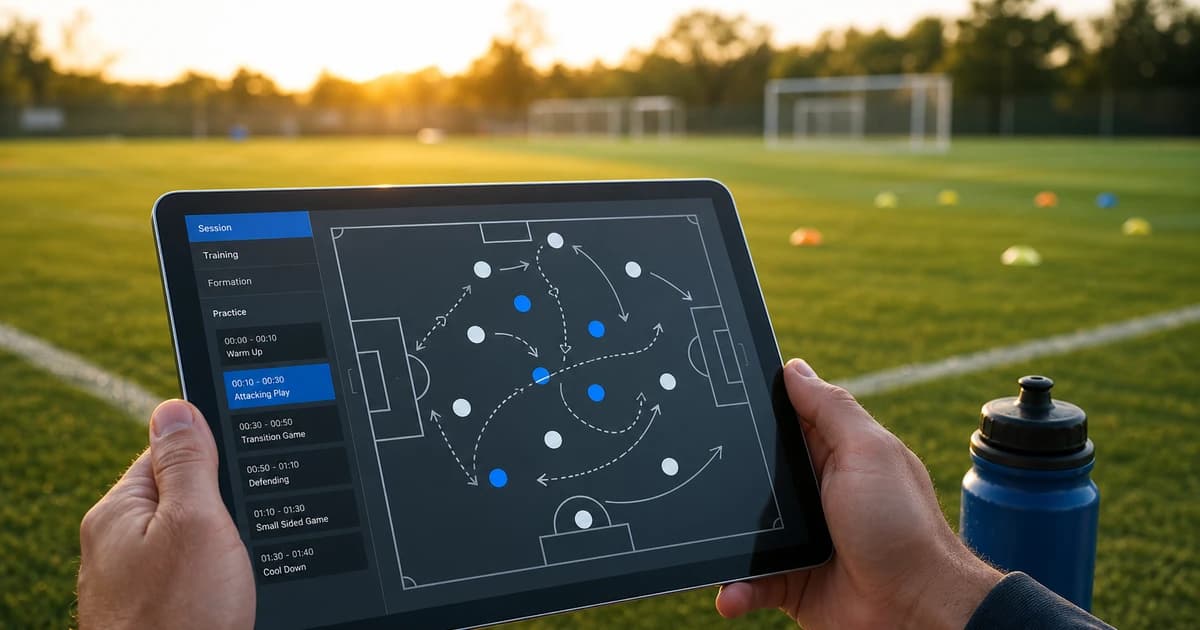
AI youth soccer coaching has gone from a curiosity to a working tool inside one season. Coaches who used to spend Monday nights staring at a blank session sheet are pulling up a phone, typing in the age group and the focus, and getting a printable plan in under a minute. The tools are real, the limits are real, and the gap between a good AI assistant and a club-ready system is wider than the marketing suggests. This guide walks through what the category actually means in 2026, the tools we see coaches using, and how to choose the right one for your situation.
Key Takeaways
- AI youth soccer coaching covers two distinct workflows: pre-practice session planning and post-game video analysis. Most clubs need both, and they are different tools.
- Free AI tools like Coach Frank and FootballGPT can generate solid 60-minute session plans in seconds, including formation diagrams from 5v5 through 11v11.
- ChatGPT and Claude work for practice planning if you write good prompts, but you supply the coaching context every session.
- Cameras like Veo, Trace, and SportsVisio handle game-day capture and post-match highlights without extra staff, but they sit outside your roster and parent communication.
- The biggest jump comes from connecting AI to the rest of your club: rosters, attendance, parent messaging, and payments. That is where Centro fits.
What AI Youth Soccer Coaching Actually Means in 2026
The phrase covers two very different jobs. The first job is everything that happens before a coach steps on the field: writing a session plan, picking drills for the age group, drawing formations, sending the plan to assistant coaches in the right language. The second job is everything that happens after the game ends: reviewing video, tagging key moments, sending each player something they can learn from.
These two jobs use very different AI. Practice planning uses large language models. Video analysis uses computer vision. A tool that does one well rarely does the other, and most clubs that want both end up running two tools side by side.
There is a reason this matters now. Adults 55 and older now make up 40 percent of youth sports coaches for ages 6 to 14, up from a typical 14 to 20 percent over the past decade, according to the Aspen Institute's Project Play State of Play 2024 report. More than four in 10 youth sports coaches reported never receiving training in concussion management, safety, injury prevention, or motivational technique. The volunteer coach base is large, the training gap is real, and AI tools are moving fastest in the slot where preparation used to take hours.
The AI Tools Coaches Are Actually Using
Coach Frank: Free Session Plans on a Phone
Coach Frank is a free mobile app from the Player Development Project. It generates instant session plans from a short brief: age group, focus area, available time, number of players. The output is structured into warmup, technical, small-sided game, scrimmage, and cooldown blocks. The app is on iOS and Google Play. Coach Frank is the simplest entry point for a volunteer coach who has never used AI for soccer before.
The limit is what every standalone session-plan AI runs into. Coach Frank does not know your roster. It does not know who was hurt last week, who needs to rotate into goalkeeper this Saturday under US Youth Soccer rotation guidance, or who only speaks Spanish at home. The session plan is good. The context is yours to keep.
FootballGPT: Tactical Board and Specialist Modes
FootballGPT is a free-to-start web app with a Pro tier at $10.99 per month or $99 per year, per the published FootballGPT pricing as of May 2026. The free tier gives you one message per day plus the tactical board. Pro gives 40 messages per day, 11 specialist advisors across Coach, Player, Goalkeeper, Scout, and Football Manager modes, and a session plan generator that exports diagrams for 5v5, 7v7, 9v9, and 11v11.
FootballGPT publishes its coaching frameworks: FA, UEFA, US Soccer, FIFA, La Liga, and the Dutch youth development system. The output respects age-appropriate principles, which matters in a market where some AI tools will hand a U6 coach a high-press tactical brief if you ask for one.
ChatGPT and Claude: Flexible If You Write Good Prompts
Plenty of coaches use ChatGPT and Claude directly. The prompt that gets a useful U10 plan is specific: age, focus, available space, equipment, time, language. Coaching American Soccer's published prompt examples are a fair starting point if you want to try this without subscribing to a sport-specific app.
The trade is the same one every coach who has tried it knows. Generic chat models give a competent generic plan. They do not remember your team, your venue, your weather, or your league rules. Every session, you write the context again, because the model does not.
Cameras: Veo, Trace, SportsVisio
The other half of the picture is video. Veo is built for team-level analysis with AI-tracked ball footage and shot maps. Trace's PlayerFocus is built around individual-player highlights, so a single family can subscribe and pull their player's clips from any game. SportsVisio takes phone-recorded game video, processes it post-game, and returns highlights and stats. Per SportsVisio's published positioning, the goal is "low friction, no special camera required."
Each of these tools is genuinely useful for the workflow it solves. None of them sit inside the rest of your club operations. The video lives in one app, the roster lives in another, and the parent who wants to know what their U12 daughter did on Saturday is still chasing two logins.
What AI Cannot Replace
A 60-second AI session plan is faster than any coach. It is not a coach.
A volunteer coach reads a 9-year-old who is having a bad day and shifts the warmup from technical to fun. They notice a parent on the sideline who needs to hear that their player is doing well, and they stop after practice to say it. They handle a Spanish-speaking grandmother who shows up to the wrong field, and they sort it out without making her feel small. AI does not do any of that yet, and the parts of coaching that retain players are mostly that.
This matters for one practical reason. Per Aspen's State of Play 2024, 40 percent of youth coaches are 55 or older, and many of them are volunteers giving a season to a club they want to stay loyal to. The right AI tool removes the work that pushes those coaches away, which is mostly admin: lesson plans they did not have time to write, parent emails in a language they do not speak, schedules they have to rebuild every time it rains.
How Centro Approaches AI Youth Soccer Coaching
Centro is built for clubs, not for solo coaches. Our AI Game Plan generates a full session in about 60 seconds: warmup, technical block, small-sided game, scrimmage, cooldown, plus the diagrams. The drill library has 1,500+ activities and 160+ formation setups across 4v4, 7v7, 9v9, and 11v11. The output is bilingual by design, English and Spanish, with the same drill IDs across both languages so a coach can hand a Spanish version to one assistant and an English version to another and they are coaching the same session.
What makes Centro different is what happens around the session plan. The plan already knows the roster because Centro is the roster. It knows who is rotating into goalkeeper because Centro tracks rotations. It knows which parents prefer Spanish because Centro stored that on registration. When you publish the plan, parents get a reminder in their preferred language. When practice ends, attendance is logged automatically. When registration opens for the next season, the same coaches and the same families are already there.
Coach Frank, FootballGPT, ChatGPT, Veo, Trace, and SportsVisio each solve one slice of the problem well. Centro is what we built when we wanted the slices to talk to each other. It is the same idea covered in our complete guide to coaching youth soccer: a coach's job at a youth club is not just the 75 minutes on the field, and the tools should reflect that.
A Real Tuesday Night for a U10 Coach in Miami
Take a volunteer coach in Hialeah running a U10 girls team. Tuesday practice starts at 6 PM. At 5:15, they open the Centro app on the bus. They tap "AI Game Plan", type "60 minutes, focus on first touch and small-sided games, 12 players, two of them just back from injury," and choose Spanish. By 5:18, the plan is on screen with a warmup, three technical stations, a 4v4 to goal, a cooldown, and printable diagrams. They tap "send to assistants" and the plan goes to two assistant coaches in their preferred language. They tap "notify parents" and the parents who set their language to Spanish get the heads-up in Spanish, the parents who set English get English. By 5:50 the cones are out.
The same prep on a tool that does not know the team takes 25 to 40 minutes the night before, and it is missing the rotation, the attendance, the language, and the parents.
How to Pick an AI Coaching Tool for Your Club
The right answer depends on how big you are and what else you need to run.
If you are a single volunteer coach with one team and no budget, Coach Frank is genuinely good and free. FootballGPT's free tier covers most of what a U6 to U10 coach needs to see. ChatGPT works if you already use it for other things and do not mind writing the same prompts every week. Trace, Veo, and SportsVisio are worth their price if your club or your families care about post-game video.
If you are running a club, the calculation changes. The savings from a session-plan AI are real, but they are dwarfed by the cost of running a club on six different apps that do not talk to each other. The tool to look at is the one that connects AI session planning to your roster, your communications, and your payments in one place. That is the case we make with Centro, and it is the reason coaches who have used solo AI tools tell us the integrated version saves them more time.
A few practical questions to ask before subscribing to anything:
- Does it produce age-appropriate plans for the age groups our club actually coaches?
- Does it support the language our parents and assistant coaches actually speak?
- Does it know our roster, or do we type the players in every time?
- Does the cost stay flat as we add coaches, or does it scale per coach?
- Does it integrate with how we already register players and collect payments?
If you are working through these questions for the first time, our soccer practice plan templates by age group are a good baseline to compare any AI output against. And if you are running a bilingual club, the bilingual youth soccer club guide covers what changes when both languages have to work.
Where AI Goes Next for Youth Soccer
The tools available today are the early version of what coaches will have by the next World Cup cycle. We expect three things to land in the next 12 to 24 months. Real-time bilingual translation for parent communications is already partly here and will be a default. AI-built individual development plans tied to actual game video will move from premium camera systems into platform features. And the gap between the coach who is alone with an AI app and the coach who is plugged into a full club platform will keep widening, because the platform will keep accumulating context the solo tool does not have.
That last point is the real shift. AI is not replacing coaches. It is removing the work that pushes good people out of coaching, and the tools that win will be the ones that show up everywhere a coach already works.
We built Centro's AI Game Plan so a Saturday-only volunteer coach gets the same prep a paid director of coaching would build, in 60 seconds, in their language, already wired to the roster. Everything else our club tools do, registration, payments, parent comms, and club shop, sits behind the same login. Start free for 14 days at withcentro.com.
Consejos semanales para directores de clubes de fútbol juvenil.