The World Cup Effect: How 2026 Is Changing Youth Soccer Registration
The 2026 FIFA World Cup triggered the largest youth soccer registration surge in US history. With 7 matches played at Miami's Hard Rock Stadium, a nationwide age group transition on August 1, and participation projected to reach 29 million, clubs need to be ready for fall.
On this page
The 2026 FIFA World Cup is over, and it left behind the largest youth soccer registration surge this country has ever seen. For club directors, the question now is simple: can you keep the families who arrived this summer?
This is not speculation. We have 30 years of data showing exactly what happens to youth soccer participation when the World Cup comes to American soil. The last time it happened, in 1994, the sport changed forever. The 2026 tournament was bigger and the audience was larger. What clubs do over the next few months decides who keeps the players it produced.
Looking for the action plan instead? Work through our 15-item World Cup registration surge preparation checklist. This article focuses on the data behind the surge and what it means for clubs.
Key Takeaways
US Youth Soccer counted more than 1 million registered players in the early 1990s and more than 3 million by 2006 (US Youth Soccer)
Current US soccer participation stands at 20.5 million, with outdoor soccer up 8.1% year over year (SFIA 2025 Topline Report)
The U.S. Soccer Federation projects participation will reach 29 million in 2026 (Soccer Forward Foundation, October 2025)
Miami hosted 7 World Cup matches at Hard Rock Stadium from June 15 to July 18, including Brazil, Portugal, and Colombia group stage games
US Youth Soccer's switch from birth-year to school-year age grouping (August 1, 2026) will force mass re-registration nationwide
Clubs that prepare now will capture the wave. Clubs that wait will drown in it.
What Happened After the 1994 World Cup
The 1994 World Cup changed American soccer permanently. In the early 1990s, before the tournament, US Youth Soccer counted more than 1 million registered players nationwide. By 2006 it counted more than 3 million (US Youth Soccer). Registration totals cannot separate the tournament’s effect from everything else that happened in those years, so treat 1994 as part of that growth rather than the sole cause of it. US Youth Soccer’s Soccer as a Lifetime Sport presentation puts the number of youth soccer players in the United States at 4.04 million, roughly double the 1990 figure, citing the US Soccer Federation. That counts players nationally across every organisation, not US Youth Soccer registrations, which the organisation itself puts at 2.68 million a year.
The growth was not limited to players on the field. FIFA required the United States to establish a Division 1 professional league as a condition of hosting the 1994 tournament. Major League Soccer was formally incorporated in 1995 and kicked off its inaugural season on April 6, 1996 with 10 teams. Women's college soccer programs grew from 318 in 1991 to 959 by 2009, a 201% increase that tracked directly with youth club expansion across the country (NCAA).
Why 2026 Was Bigger Than 1994
Three factors made the 2026 World Cup effect significantly larger than 1994.
First, the tournament itself was bigger. The 2026 format expanded from 32 teams to 48. More teams means more countries represented, more fans emotionally invested, and more kids watching players from their family's home country compete on American soil.
Second, the Hispanic and Latino population in the United States has grown dramatically since 1994. There are now more than 65 million Hispanic Americans, compared to roughly 27 million in 1994 (U.S. Census Bureau). Soccer is deeply embedded in Latino culture: 43% of Hispanic soccer fans discovered the sport before age 10, and 64% still actively play (FOR Soccer). A McKinsey Institute study found that 44% of US Latinos planned to follow the 2026 World Cup, the highest engagement rate of any demographic group.
Third, media access is incomparable. In 1994, fans relied on broadcast TV and newspaper coverage. Every match streamed live on phones, tablets, and social media. Every goal became a viral clip. Every young fan had a direct line to the excitement.
The Numbers Right Now: 2025-2026 Baseline
The growth is already underway. According to the SFIA 2025 Topline Participation Report (covering 2024 data), 20.5 million Americans played soccer last year. That is up 14% from 2021. Outdoor soccer alone reached 14.1 million participants in 2023, an 8.1% year-over-year increase (SFIA 2024 Team Sports Report). The most recent SFIA research (covering 2025 data) shows outdoor soccer has since surged to 16.7 million, a clear sign that pre-World Cup momentum is building.
Youth soccer specifically accounts for a massive share of this activity. US Youth Soccer registers approximately 2.68 million players annually across 10,000+ clubs and leagues in 54 state associations. Add AYSO's 630,000+ participants, US Club Soccer members, and high school players, and the total youth footprint exceeds 3 million registered players.
Rising Costs Add Pressure on Club Operations
These numbers come with a cost challenge. The Aspen Institute's Project Play survey (March 2025) found that average family spending on a child's primary sport reached $1,016 in 2024, a 46% increase since 2019. That is twice the rate of overall US inflation. Soccer families have historically spent even more: Project Play's State of Play 2025 put average soccer spending at $1,188 a year on 2024 data, higher than basketball, baseball, or football.
For club directors, this means parents are spending more and expecting more. They want professional registration management, clear invoicing, and modern payment options. Clubs still running on WhatsApp group chats and Venmo screenshots will struggle to justify rising fees without the systems to match.
Why Miami Is Ground Zero for World Cup 2026 Youth Soccer Growth
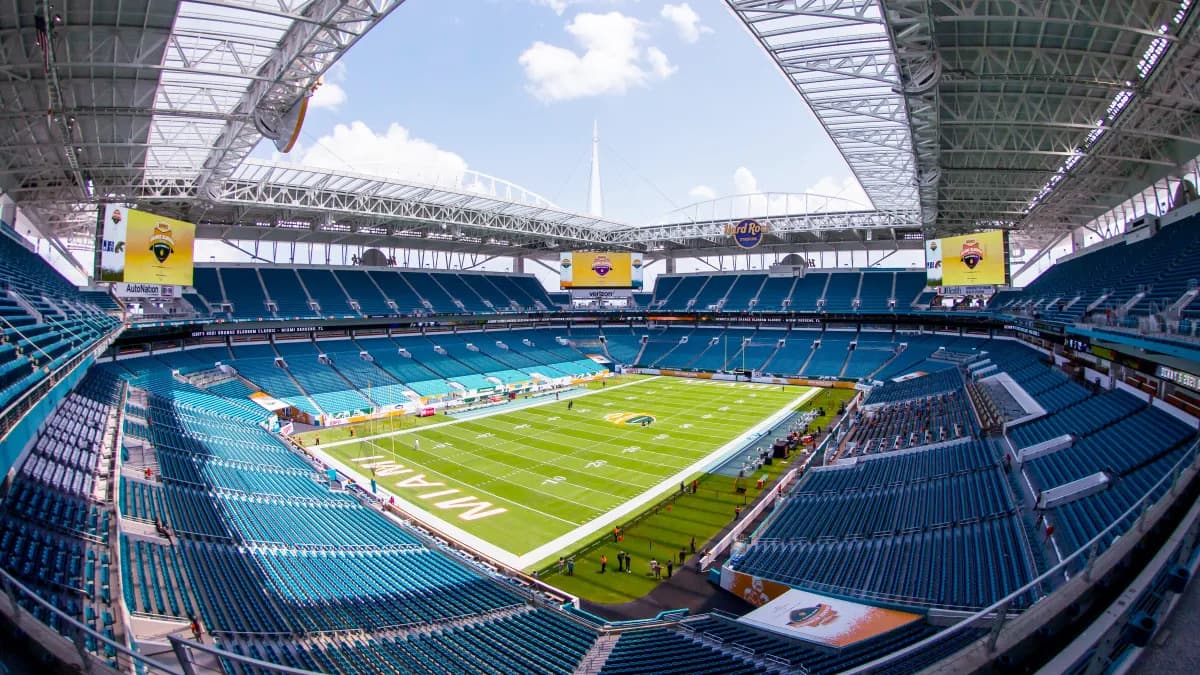
Hard Rock Stadium in Miami Gardens hosted seven FIFA World Cup matches between June 15 and July 18, 2026. That is more than a month of world-class soccer in a single metro area.
The match schedule includes some of the most anticipated group stage games in the entire tournament:
June 15: Saudi Arabia vs. Uruguay (Group H)
June 21: Uruguay vs. Cape Verde (Group H)
June 24: Scotland vs. Brazil (Group C)
June 27: Colombia vs. Portugal (Group K)
July 3: Round of 32 match
July 11: Quarterfinal
July 18: Bronze Final (Third-Place Match)
Scotland vs. Brazil and Colombia vs. Portugal are the headliners. For South Florida's massive Brazilian, Colombian, and Portuguese communities, these are not just soccer matches. They were cultural events that filled living rooms, restaurants, parks, and stadiums across the region.
The Fan Festival and Community Impact
Downtown Miami's Bayfront Park hosted the official FIFA Fan Festival from June 13 through July 5. The 32-acre waterfront venue accommodated up to 30,000 fans daily with free admission, live broadcasts on giant LED screens, concerts, cultural programming, and interactive fan experiences (Axios Miami, March 2026). Miami Beach added satellite watch parties at Lummus Park and the Bandshell.
The economic impact is projected at $1.3 to $1.5 billion for Miami-Dade County alone. Local organizers have described it as the equivalent of seven Super Bowls back to back.
Demographics Make Miami Unique
Miami-Dade County's population of 2.84 million is approximately 69% Hispanic or Latino (U.S. Census Bureau, 2024 American Community Survey). That is 1.9 million people in a county where soccer is the dominant sport across most households. Nearly 20% of residents are under 18, translating to roughly 550,000 young people.
The South Florida United Youth Soccer Association (SFUYSA) already serves 4,000+ players across 500+ teams and 60+ clubs. Now that the tournament has finished, every one of those clubs is feeling the surge. And new clubs will form to meet demand that existing organizations cannot absorb.
McKinsey projects that Latino youth sports participation is growing at a compound annual rate of 3.9%, nearly double the rate of non-Latino youth (McKinsey Institute for Economic Mobility, October 2025). By 2024, 53.7% of Latino youth were active in sports, and the participation gap with non-Latino peers had narrowed from 6.3 percentage points to just 2.8. The 2026 World Cup accelerated this trend in a market where the audience was already primed for soccer.
Free resourceRegistration in CentroForms, waivers and payments in one flowThe Age Group Transition Compounds Everything
Here is the detail most club directors are not talking about enough: effective August 1, 2026, US youth soccer will switch from birth-year registration (January 1 to December 31) to school-year registration (August 1 to July 31).
US Youth Soccer, US Club Soccer, and AYSO jointly announced the change on March 5, 2025, then revised the cutoff date from September 1 to August 1 on June 10, 2025. This is actually a return to the system used before US Soccer mandated birth-year registration in 2017. A 2024 survey of more than 15,000 stakeholders found 47% preferred the school-year model versus 41% for birth-year (US Club Soccer).
What This Means for Your Club
Every player born between August 1 and December 31 will shift down to play with their school-grade classmates. Players born January 1 through July 31 experience minimal change. But for clubs, the operational impact is significant: every roster must be reorganized, every team reassigned, and every player effectively re-registered under the new framework.
US Club Soccer CEO Mike Cullina estimated that the birth-year system created 2 to 5 "trapped" players per team, describing it as hundreds of thousands of kids affected nationwide. The transition will correct this, but it requires every club to process a complete registration cycle for its entire player base.
Now layer the World Cup effect on top. You have existing players who must re-register under new age groupings. You have a wave of brand-new players inspired by watching Brazil, Colombia, and Portugal play in their backyard. And you have parents who expect a modern, professional registration experience.
If your club handled this August on paper forms, spreadsheets, or email chains, you already know how much of the month it took.
Five Things Your Club Should Do Before Fall Registration
The clubs that keep the players this surge produced are the ones that get the next 60 days right, while the new families are still deciding whether to stay. Here is what to prioritize.
Get your club website ready. A professional, bilingual site with clear program information and registration links is the first thing parents will find when they search after a match.
Set up online registration before the rush. Digital forms, online waivers, and immediate confirmations, in place before fall registration opens rather than after.
Prepare your coaching staff. Recruit and vet additional coaches now, map field availability, and decide how many new teams you can add at each age level.
Plan tryout and evaluation capacity. Expect 20-40% more players than previous years and document evaluations digitally.
Get your financial systems ready. More players means more invoices and payment plans, so you need invoicing, reminders, and real-time tracking that scale.
Each of these deserves more than a paragraph, and this analysis is not the place for it. We turned all five, plus ten more items covering waitlists, welcome packets, scholarships, and staff permissions, into a step-by-step companion piece: the World Cup registration surge preparation checklist. If your club has not started preparing, start there.
Centro handles all five of these areas in a single platform: registration management, payment processing, a bilingual website, communication tools, and financial tracking. Everything is included for $25 per month with no per-player fees. A 2% platform fee applies to digital payments; cash and Zelle are always free. Setup takes under 10 minutes.
What Happens Next
The 1994 World Cup proved that hosting this tournament on American soil permanently changes youth soccer participation. The 2026 edition was larger in every dimension: more teams, more matches, more media coverage, more cultural connection, and a larger, more soccer-passionate population.
For clubs in South Florida and across the country, the opportunity is enormous. But so is the risk of being unprepared. The World Cup registration surge will not wait for clubs to get organized. The age group transition will not pause while you figure out a new system. The families who watched their country play at Hard Rock Stadium are searching now, and they will sign up with whoever makes it easiest.
The clubs that act now will grow. The ones that wait will watch those families go somewhere else.
The World Cup registration surge is here. Centro gets your club ready in under 10 minutes: online registration, payments, and a professional bilingual website. See how registration works in Centro
Keep reading
More on running a better club.
Is Your Club Ready for the World Cup Registration Surge? A Preparation Checklist
The 2026 World Cup will drive a massive soccer registration increase, and the mandatory age group transition compounds the demand. This 15-item checklist covers everything club directors need to prepare across registration, payments, communication, and staffing before June 2026.
World Cup 2026 in Miami: The Youth Soccer Parent's Complete Guide
The 2026 FIFA World Cup came to Miami, and for families with young soccer fans it was a summer unlike anything we have seen in our lifetimes. Here is what it means for getting a child into local soccer now.

US Youth Soccer Participation Statistics 2026: What Club Leaders Need to Know
Total US soccer participation hit 20.5 million in 2024, outdoor soccer grew 8.1% year over year, and the World Cup on American soil could push that number to 29 million. Here is every stat club directors need, from demographic trends to cost data to geographic hotspots.